Contractor Invoice Template Word for Accounting

Effortlessly manage your billing with our intuitive tool. Boost efficiency and streamline your invoicing process today.

Award-winning eSignature solution

What the contractor invoice template word for accounting is and why it matters

A contractor invoice template in Word for accounting is a prestructured document that standardizes billing, expense tracking, and payment terms for independent contractors and subcontractors. It typically includes fields for client details, invoice number, service descriptions, hours or unit rates, taxes, payment due dates, and remittance instructions. Using a consistent Word template helps accounting teams reduce entry errors, maintain audit-ready records, and integrate invoice content with bookkeeping systems. Templates can be adapted for fixed-price, hourly, or milestone billing and save time when combined with digital signature and workflow tools.

Why using a template improves accounting accuracy

Standardized Word invoice templates reduce manual errors, speed reconciliation, and ensure consistent financial records across projects and contractors.

Why using a template improves accounting accuracy

Common challenges without a standardized contractor invoice template

  • Inconsistent line-item descriptions hinder matching invoices to purchase orders and project codes, delaying payment processing.
  • Missing or incorrect tax calculations create reconciliation discrepancies and may require manual journal adjustments.
  • Lack of uniform payment terms causes disputes and variable cash flow timing across contractors.
  • Poor version control leads to duplicate invoices and difficulty maintaining an auditable record trail.

Typical users and their objectives

Independent Contractor

Self-employed professionals use the template to issue clear invoices showing services rendered, rates, and due dates. Templates reduce administrative time and present consistent records for quarterly tax filings and client accounting teams.

Accounting Manager

Finance leaders deploy standardized Word invoice templates across contractors to maintain consistent GL mapping, accelerate invoice approval cycles, and ensure invoices meet internal controls and external audit requirements.

Who benefits from a contractor invoice template and how they use it

Accounting teams, independent contractors, and project managers use Word invoice templates to standardize billing and simplify record keeping.

  • Accounting departments streamline AP matching and reduce manual entry when templates follow chart-of-accounts conventions.
  • Independent contractors present clear, professional invoices that include payment terms and tax details for faster processing.
  • Project managers receive consistent progress billing formats that simplify cost tracking against budgets.

Consistent templates support faster approvals, easier audits, and smoother handoffs between contractors and accounting systems.

Six tools that improve invoice processing efficiency

Combine template features, automation, and integrations to reduce manual work and accelerate approvals.

Template locking

Lock sections of the Word template to prevent accidental edits while allowing fillable fields for variable invoice data, preserving consistent formatting across submissions and simplifying validation.


Auto-calculation

Configure formulas to compute line totals, subtotals, taxes, and discounts automatically so invoices always present accurate sums without manual calculation errors before sending.

Bulk Send

Send identical or customized invoices in batches to multiple recipients with individual fields auto-populated to speed mass billing cycles and keep records centralized for reconciliation.

Template versioning

Maintain version history for templates so teams can track changes, revert to prior formats, and ensure all contractors use the most current billing layout.

API export

Use APIs to push invoice metadata to accounting systems directly, eliminating CSV exports and reducing manual import steps for bookkeeping.

Mobile approvals

Enable managers to review and approve invoices from mobile devices to shorten approval timeframes and maintain payment cadence while remote.

be ready to get more

Choose a better solution

Four features to make contractor invoicing reliable

Focus on templating, validation, signature, and integration features to reduce errors and improve payment speed.

Prebuilt fields

Form fields and content controls in Word let you lock invoice structure and add mandatory fields, ensuring every submitted invoice includes required accounting data and consistent formatting for downstream processing.

Validation rules

Set rules to validate totals, tax calculations, and required client fields before sending; this prevents common errors and reduces back-and-forth between contractors and accounting staff.

Digital signature

Integrate a compliant eSignature provider to capture signed approvals electronically, producing an auditable signature record tied to the invoice for contract acceptance and payment authorization.

Accounting integration

Connect invoice data to bookkeeping platforms or export standardized CSV files so line items, taxes, and payment status map directly to ledger accounts and reduce manual journal entries.
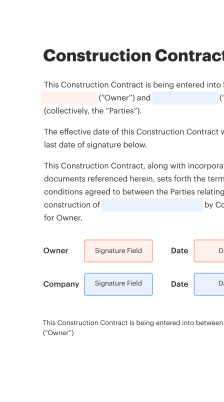
How to use the Word template with digital signing and accounting

This sequence describes linking a finished Word invoice to signing and accounting systems for a complete billing cycle.

  • Populate template: Enter project, rate, and totals
  • Export PDF: Convert Word to secure PDF
  • Request signature: Send via chosen eSignature workflow
  • Record payment: Update AR and reconcile in accounting
Collect signatures
24x
faster
Reduce costs by
$30
per document
Save up to
40h
per employee / month

Step-by-step: preparing a contractor invoice template in Word

Follow these essential steps to create a reusable Word invoice template suited for accounting workflows.

  • 01
    Create header: Add company and contractor contact details
  • 02
    Add fields: Insert invoice number, date, PO and terms
  • 03
    Line items: Include description, quantity, rate, and tax
  • 04
    Payment info: Specify due date and remittance instructions

Quick grid: finishing and sending an invoice

Use this checklist to finalize a contractor invoice before distribution.

01

Confirm client info:

Verify billing contact and address
02

Validate totals:

Check math and tax calculations
03

Attach backup:

Include receipts or timesheets
04

Select workflow:

Choose approval and signing path
05

Record invoice:

Log in AP register or system
06

Follow up:

Set reminder for unpaid invoices
be ready to get more

Why choose airSlate SignNow

  • Free 7-day trial. Choose the plan you need and try it risk-free.
  • Honest pricing for full-featured plans. airSlate SignNow offers subscription plans with no overages or hidden fees at renewal.
  • Enterprise-grade security. airSlate SignNow helps you comply with global security standards.
illustrations signature

Recommended workflow settings for automated contractor invoicing

Set these workflow configurations to support consistent approvals and timely reminders for contractor invoices.

Setting Name Configuration
Approval threshold amount 1000 USD
Reminder Frequency 7 days
Late fee policy Enabled
Attachment requirement Receipts mandatory
Signature authentication Email + MFA

Device and platform considerations for invoice creation and signing

Ensure your template and signing process work on desktop and mobile to support contractors and approvers who work remotely.

  • Desktop: Full Word feature set
  • Tablet: Responsive viewing and signing
  • Mobile: Quick approvals and eSign capability

Test templates and signing workflows across Windows, macOS, iOS, and Android clients to confirm form fields render correctly and signatures are captured reliably before deploying to contractors.

Key security and protection controls for invoice documents

Encryption at rest: AES-256 encryption
Encryption in transit: TLS 1.2+ transport
Access controls: Role-based permissions
Multi-factor auth: Optional MFA login
Document watermarking: Visual audit marks
Audit logging: Immutable activity logs

How different teams apply the contractor invoice template in practice

Two practical examples show how templates speed accounting work and reduce disputes across industries.

Construction subcontractor billing

A site-based subcontractor fills the Word template with daily labor and materials, ensuring consistent task codes and supplier references

  • Includes progress percentage and retention line items
  • Eases month-end matching to job cost reports

Resulting in faster approvals and fewer reconciliation adjustments for the general contractor accounting team.

IT freelance milestone invoicing

An IT contractor issues milestone invoices using a standardized Word file to list deliverables, hours, and acceptance criteria

  • Attaches change-order references
  • Clarifies payment triggers for the client finance team

Leading to predictable cash flow and reduced dispute cycles during software deployment projects.

Best practices for secure and accurate contractor invoice templates

Adopt these operational and document-level practices to reduce disputes and support auditability.

Standardize field names and codes across templates
Use consistent chart-of-accounts codes, service descriptions, and tax designation fields in every template so accounting systems can automatically categorize charges, reduce mapping errors during import, and maintain uniform reporting across projects.
Require supporting attachments when appropriate
When invoices include reimbursable expenses, mandate scanned receipts or time logs as attachments to preserve proof of cost, support audit trails, and limit post-payment disputes over allowable expenses.
Enforce signature and approval workflows
Implement an approval chain that requires manager sign-off for invoices above set thresholds and capture electronic signatures or written approvals to demonstrate authorization for payments during reviews and external audits.
Retain versions and maintain clear naming conventions
Save each invoice iteration with a unique identifier and timestamp, and keep a retention schedule aligned with accounting policy to support tax reporting and potential audits without relying on ad hoc file searches.

FAQs About contractor invoice template word for accounting

Answers to common questions about using, securing, and integrating Word-based contractor invoice templates with accounting and signing systems.

Feature availability: signNow compared with leading eSignature vendors

A concise comparison of common capabilities that matter when pairing Word invoices with an eSignature provider.

Feature signNow DocuSign Adobe Sign
U.S. ESIGN compliance
Bulk Send capability
API access for invoices REST API REST API REST API
HIPAA-ready options Available Available Available
be ready to get more

Get legally-binding signatures now!

Typical processing stages from invoice to payment

Understanding the stages helps set SLAs and monitoring points for contractor invoices.

01

Invoice submission

Contractor sends completed invoice

02

Initial review

Accounting verifies fields and attachments

03

Approval

Manager authorizes payment

04

Payment scheduling

AP schedules payment date

05

Payment execution

Funds are disbursed

06

Reconciliation

Record and match payment to invoice

07

Archival

Store final signed invoice

08

Audit review

Periodic compliance checks

Key dates and deadlines to include in your invoice template

Including clear dates helps accounting teams manage cash flow and avoids confusion over payment schedules.

Invoice issue date:

The date the invoice is created or sent

Payment due date:

Deadline for remittance, e.g., Net 30

Service period:

Start and end dates of billed work

Late fee start date:

Date when penalties begin to accrue

Retention release date:

When withheld retainage becomes payable

Common risks and penalties from improper invoicing

Late payments: Cash flow harm
Tax misfiling: Compliance exposure
Overbilling disputes: Client friction
Duplicate payments: Financial loss
Audit findings: Restatement risk
Data breaches: Regulatory fines

Cost and support snapshot across popular eSignature platforms

Practical pricing and feature indicators for small and mid-market teams integrating Word-based contractor invoices with eSignature solutions.

Plan or Feature signNow DocuSign Adobe Sign HelloSign PandaDoc
Starting price per user (monthly) $8/user/month $25/user/month $24.99/user/month $15/user/month $19/user/month
API availability and limits Full API, reasonable limits Full API, tiered limits Full API, enterprise focus API available API available
Bulk Send support Yes, included Yes, paid tiers Yes, included Yes, paid tiers Limited
HIPAA compliance option Available Available Available Available on request Available on request
Phone and enterprise support Business support available Enterprise support available Enterprise support available Email and chat Enterprise plans available
walmart logo
exonMobil logo
apple logo
comcast logo
facebook logo
FedEx logo
be ready to get more

Get legally-binding signatures now!