Courier Bill Format for Small Businesses

See your invoicing process become fast and effortless. With just a few clicks, you can perform all the necessary steps on your courier bill format for small businesses and other important files from any gadget with internet access.

Award-winning eSignature solution

Legal and practical considerations for digital courier bills

Digital courier bills, when created and stored correctly, provide legally admissible records under US ESIGN and UETA, improve operational accuracy, reduce physical paperwork, and offer auditable trails for shipments and claims.

Legal and practical considerations for digital courier bills

Typical users and roles for courier bill workflows

Small Business Owner

A Small Business Owner needs a simple, auditable courier bill format to track deliveries, reconcile charges, and resolve disputes. They typically require easy templates, cost visibility, and access to signed records for accounting and customer service.

Logistics Manager

A Logistics Manager oversees dispatch and delivery operations, enforcing template consistency, configuring automation for reminders and bulk sends, and using audit trails to investigate delivery exceptions and claims efficiently.

Key features that improve courier bill formats for small businesses

Essential features make courier bills accurate, auditable, and efficient for small operations handling frequent shipments and returns.

Templates

Reusable templates let teams standardize courier bill layouts with mandatory fields, conditional sections for special items, and version control to reduce errors and speed up processing across repetitive shipments.


Auto-fill

Auto-fill integrates saved customer and product records to populate addresses, contact details, and common charge items, reducing manual entry and accelerating pickup-to-delivery workflows for repeat shipments.

Conditional fields

Conditional fields show or hide sections such as hazardous material declarations or customs details only when applicable, keeping bills concise while maintaining compliance where required.

Audit trail

A detailed audit trail records timestamps, signer identity, IP address, and change history for every courier bill to support dispute resolution and regulatory inspection requirements.

Multi-signature

Multi-signature workflows capture approvals from dispatch, driver, and recipient with ordered signing rules and role-based placement of signature fields to ensure accountability.

Cloud storage

Encrypted cloud storage centralizes signed bills with search, tagging, and retention controls to meet business recordkeeping needs and enable quick retrieval during claims or audits.

be ready to get more

Choose a better solution

Integrations and templates for courier bill formats

Integrations reduce manual work by connecting courier bills with CRM, cloud storage, and document editors for streamlined creation and archival.

Google Docs integration

Link templates to Google Docs to generate courier bills from prefilled documents, enabling staff to draft bills in a familiar editor, then convert and send for signature while preserving document formatting and metadata in the workflow.

CRM synchronization

Integrate with CRMs to auto-populate customer addresses, contact names, and order history into courier bill templates, reducing data entry and ensuring delivery records match invoicing and customer accounts.

Dropbox and cloud storage

Automatic saving of signed courier bills to Dropbox or cloud folders maintains centralized archives, enforces naming conventions, and enables team access without manual uploads or email attachments.

API and Zapier connectors

Use APIs or Zapier to trigger courier bill creation from order systems, push signed documents to accounting, and automate status updates between dispatch and customer-facing systems.
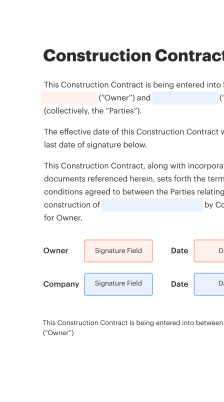
How to create and use a courier bill format for small businesses online

Online creation simplifies distribution, completion, and storage of courier bills so small teams can send, sign, and archive documents from any web-enabled device.

  • Choose format: Select or upload a PDF or template with necessary fields.
  • Map fields: Assign data fields for addresses, weights, charges, and signatures.
  • Request signature: Send to recipient or driver for digital signature and timestamp.
  • Store copy: Save signed bill in the cloud for audit and retrieval.
Collect signatures
24x
faster
Reduce costs by
$30
per document
Save up to
40h
per employee / month

Quick setup to create a courier bill format for small businesses

This concise setup walks small businesses through creating a standardized courier bill format that records shipper, consignee, parcel details, charges, and signatures for compliant recordkeeping.

  • 01
    Create template: Define fixed fields like addresses, tracking, and invoice numbers.
  • 02
    Enter shipment data: Add sender, recipient, content description, weight, and dimensions.
  • 03
    Calculate charges: Apply rates, taxes, discounts, and display total payable clearly.
  • 04
    Finalize record: Include signature block, timestamp, and archive the completed bill.

Managing audit trails for courier bill transactions

An effective audit trail captures who, what, when, and where for every courier bill to support dispute resolution and regulatory requirements.

01

Enable logging:

Turn on detailed action logging for documents.
02

Record signatures:

Capture signer identity, method, and timestamp.
03

Store metadata:

Keep IP, device, and revision history.
04

Retention policy:

Apply legal retention periods automatically.
05

Export evidence:

Generate tamper-evident audit reports.
06

Access reporting:

Review user access and activity logs.
be ready to get more

Why choose airSlate SignNow

  • Free 7-day trial. Choose the plan you need and try it risk-free.
  • Honest pricing for full-featured plans. airSlate SignNow offers subscription plans with no overages or hidden fees at renewal.
  • Enterprise-grade security. airSlate SignNow helps you comply with global security standards.
illustrations signature

Workflow automation settings for courier bill processing

Automated workflows reduce manual follow-up and ensure courier bills move through creation, approval, signing, and archival consistently across teams.

Workflow Automation Setting Name Header Default Configuration
Signature request timeout (days) 7 days
Email reminder frequency (hours) 48 hours
Auto-archive after signing (days) 1 day
File naming convention OrderID_Date
Retention review trigger (months) 24 months

Using courier bill format for small businesses on mobile, tablet, and desktop

Mobile and desktop compatibility ensures drivers, dispatchers, and office staff can view, complete, and sign courier bills regardless of device or operating system.

  • iOS and Android support: Mobile browsers and apps supported.
  • Desktop browsers: Chrome, Edge, Safari compatibility.
  • Offline readiness: Save temporary copies for later sync.

For mobile-first operations, choose tools that offer responsive templates, local field validation, and offline signing to maintain continuity during deliveries and areas with limited connectivity.

Security controls for courier bill documents

Encryption at rest: AES-256 encrypted storage.
Encryption in transit: TLS-secured connections.
Access controls: Role-based permissions.
Two-factor authentication: Optional MFA for accounts.
Document watermarking: Visible audit markings.
Compliance attestations: SOC 2 and ISO controls.

Real-world use cases for courier bill formats

Two concise examples show how small businesses can implement courier bills for daily delivery and returns management.

Local retail deliveries

A neighborhood retailer standardizes a courier bill to capture customer address, order number, and item weights

  • Uses templates and auto-fill to reduce manual entry
  • Cuts driver handoff time and errors during peak hours

Resulting in faster deliveries, fewer disputes, and clearer charge reconciliation for same-day orders.

Perishable goods shipping

A catering service creates a courier bill capturing temperature requirements, delivery window, and recipient confirmation

  • Conditional fields show refrigeration need only for applicable orders
  • Drivers sign on delivery and note deviations immediately

Leading to improved compliance, reduced spoilage claims, and documented evidence for customer inquiries.

Best practices for secure and accurate courier bill formats

Adopt practices that reduce errors, maintain compliance, and make courier bills reliable evidence for deliveries and charge disputes.

Standardize templates and mandatory fields
Use consistent templates requiring key fields like order ID, weight, recipient name, and signature to reduce omissions. Validate fields on entry to prevent incorrect addresses or missing shipment details before a bill can be finalized.
Lock final documents and capture an audit trail
After signatures, lock the PDF to prevent edits and store a detailed audit trail including signer identity, IP, and timestamps. This preserves evidentiary integrity for claims and legal needs.
Implement role-based access and approvals
Restrict who can create, modify, or delete courier bill templates and records. Require approvals for rate overrides or manual charge changes to maintain financial controls and accountability across staff.
Define clear retention and backup policies
Establish retention periods based on legal and business requirements, ensure encrypted backups, and schedule periodic reviews to purge or archive records in line with policies and data minimization principles.

FAQs and common issues with courier bill formats for small businesses

Answers to frequent questions and solutions for common problems encountered when implementing and using courier bill formats.

Digital signing capabilities compared for courier bill formats

This comparison highlights core compliance and capability differences among leading eSignature providers relevant to courier bill workflows.

Feature and Compliance Criteria List signNow (Recommended) DocuSign Adobe Sign
Legal validity under US ESIGN and UETA
Detailed audit trail and evidence Comprehensive Comprehensive Comprehensive
API-driven automation support Available Available Available
Offline signing capability Limited offline caching Requires online Limited offline
be ready to get more

Get legally-binding signatures now!

Storage, backup, and retention milestones for courier bills

Set timeline checkpoints for backups, retention reviews, and archival to keep courier bill records secure and compliant.

Initial backup schedule:

Daily encrypted backups.

Retention review interval:

24 months review.

Archival start point:

After 6 months active period.

Periodic integrity checks:

Quarterly verification.

Legal hold process:

Immediate suspension of deletion.

Pricing and plan comparison for courier bill eSignature providers

Compare entry-level costs, free options, API availability, and notable usage limits to assess cost-effectiveness for small businesses managing courier bills.

Pricing Comparison: Providers signNow (Recommended) DocuSign Adobe Sign HelloSign PandaDoc
Free tier availability Limited free trial No free tier Trial only Limited free trial Trial only
Typical starting price per user $8 / user / month $25 / user / month $14 / user / month $15 / user / month $19 / user / month
API access included Yes (available) Available (paid) Available (paid) Available (paid) Available (paid)
Bulk send and templates Included in business plans Included in higher tiers Included in business tiers Included in plans Included in business tiers
Notable usage limits Standard limits; enterprise options Per-user envelope limits Per-user sending limits Monthly send limits Document limits per plan
walmart logo
exonMobil logo
apple logo
comcast logo
facebook logo
FedEx logo
be ready to get more

Get legally-binding signatures now!