



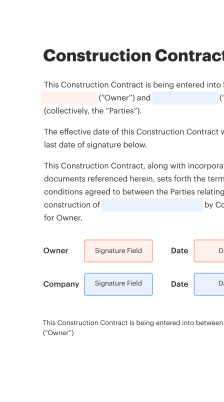
Courier Invoice Format for Small Businesses

Watch your billing procedure become quick and effortless. With just a few clicks, you can perform all the required actions on your courier invoice format for small businesses and other important documents from any device with internet access.

Award-winning eSignature solution

What a courier invoice format for small businesses includes

A courier invoice format for small businesses is a standardized billing document used to record shipment details, itemized charges, and payment terms between a courier and a small enterprise. It normally captures sender and recipient contacts, tracking or waybill numbers, service line items, surcharges, insurance, taxes, and payment terms. Electronic formats often include automatic numbering, attachments for proof of delivery, and signature fields to support reconciliation, claims handling, and accounting integrations that reduce manual entry and paper handling.

Why a consistent invoice format matters for small operations

Standardizing a courier invoice format for small businesses reduces billing errors, accelerates payment reconciliation, and simplifies tax reporting. Clear line items and consistent identifiers help resolve disputes quickly and make it easier to integrate shipping charges into bookkeeping and ERP workflows.

Why a consistent invoice format matters for small operations

Common challenges small businesses face with courier invoices

  • Inconsistent invoice fields among carriers force manual reconciliation, increase billing errors, and delay accounts receivable work.
  • Missing shipment identifiers such as waybill or tracking numbers make shipment tracking and claims management difficult for small accounting teams.
  • Unclear tax or surcharge line descriptions complicate accurate tax reporting and increase disputes with customers and auditors.
  • Paper-based courier invoices increase storage costs, slow document retrieval during audits, and hinder remote access for client inquiries.

Representative user profiles for courier invoice formats

Small Retailer

A single-location or online seller that ships goods regularly and needs clear freight billing for customer invoices and refunds. They use courier invoices to reconcile shipping line items with sales records, manage return shipments, and support customer inquiries about shipping charges and delivery timelines.

Local Courier

A regional courier or third-party logistics provider generating invoices for small business clients. They require a repeatable invoice layout to itemize services, apply surcharges, and provide tracking references. Clear invoices reduce disputes and speed up payment cycles for both the courier and its customers.

Who typically uses a courier invoice format for small businesses

Typical users of a courier invoice format for small businesses include operators who manage shipping costs, small accounting teams, and logistics coordinators in SMEs.

  • Small online retailers reconciling shipping charges across multiple carriers and marketplaces.
  • Local courier services producing standardized invoices for recurring business clients and subcontracted deliveries.
  • Accounting staff automating ledger entries and expense tracking for tax filing and vendor reconciliation.

These roles use standardized invoices to reduce manual work, improve dispute resolution, and maintain consistent financial records across small business operations.

be ready to get more

Choose a better solution

Essential features to include in your courier invoice format

Design invoice templates with features that support transparency, automation, and downstream accounting compatibility for small business needs.

Itemization

Detailed service line itemization separating base freight, fuel surcharges, accessorial fees, insurance, and taxes so both sender and recipient can reconcile charges and apply correct accounting codes.

Tracking IDs

Dedicated fields for waybill and tracking numbers, carrier references, and delivery timestamps allow rapid claims processing and automated status updates between courier and small business systems.

Payment Terms

Clear payment terms, invoice numbering, accepted payment methods, and late fee rules reduce disputes and provide finance teams with predictable timelines for accounts payable or receivable processing.

Digital Signature

Space for an authorized digital signature and signer details, enabling legal validation of the invoice and authorizations when combined with verified audit logs and identity controls.

How an electronic courier invoice format flows

This sequence explains the typical digital lifecycle of a courier invoice format for small businesses from creation through reconciliation.

  • Create Invoice: Populate template with shipment and rate details.
  • Attach Proof: Include tracking and proof-of-delivery documents.
  • Sign & Send: Obtain authorization and deliver to payer electronically.
  • Reconcile: Import into accounting and match payments.
Collect signatures
24x
faster
Reduce costs by
$30
per document
Save up to
40h
per employee / month

Quick setup: implement a courier invoice format for small businesses

Follow these concise steps to create and deploy a usable courier invoice format for your small business in a few practical stages.

  • 01
    Draft Template: Define required fields: sender, recipient, items, tracking, charges.
  • 02
    Standardize Codes: Use consistent service codes and tax classifications.
  • 03
    Integrate Accounting: Map invoice fields into your accounting software.
  • 04
    Review and Test: Pilot with a subset of shipments and adjust.
be ready to get more

Why choose airSlate SignNow

  • Free 7-day trial. Choose the plan you need and try it risk-free.
  • Honest pricing for full-featured plans. airSlate SignNow offers subscription plans with no overages or hidden fees at renewal.
  • Enterprise-grade security. airSlate SignNow helps you comply with global security standards.
illustrations signature

Recommended workflow settings for courier invoice processing

Configure workflow defaults to automate reminders, numbering, retention, and export rules tailored to small business needs.

Primary Workflow Configuration Setting Name Configuration Value and Default Setting
Outgoing Email Reminder Frequency Setting Every 48 hours up to three attempts
Standard Invoice Auto-Numbering Sequence Format Prefix with YYYYMM and sequential ID
Default Payment Terms and Late Fees Net 30 days; 1.5% monthly late fee
Attachment Retention and File Size Limits Keep attachments 7 years; max 10MB
Allowed Document Export and Integration Formats PDF for invoices; CSV and XML export

Platform and device requirements for implementing invoice formats

Ensure your systems support the courier invoice format for small businesses across devices and integrate with accounting or shipping platforms.

  • Supported Browsers: Modern Chrome, Edge, Safari browsers
  • Mobile OS: iOS and Android supported
  • File Formats: PDF, CSV, XML exports

Verify integration endpoints, API availability, and data export capabilities to match your accounting and shipping workflows, and confirm mobile access for staff who manage shipments on the road.

Security measures for digital courier invoices

Encryption in Transit: TLS 1.2+ encrypted connections
Encryption at Rest: AES-256 encrypted storage with key management
Access Controls: Role-based access and MFA
Document Watermarking: Visible timestamps and embedded watermarks
Audit Logs: Immutable event trails for every action
Secure Signatures: Cryptographic signature records with tamper-evidence

Practical examples: courier invoice formats in action

The following case summaries illustrate how a proper courier invoice format for small businesses improves reconciliation, dispute handling, and cash flow.

E-commerce Seller

A medium-volume e-commerce seller encountered frequent mismatches between carrier bills and sales orders that required manual reconciliation.

  • Standardized invoice fields with tracking ID mapping.
  • Reduces reconciliation time and errors.

Resulting in faster settlements, fewer customer refunds, lower dispute rates, improved cash flow, and comprehensive audit-ready records that simplify monthly reconciliation and annual tax reporting for the business.

Local Courier Partner

A regional courier contracted to service multiple small retailers struggled to provide consistent invoices across clients, causing payment delays.

  • Implemented a single invoice template and automated numbering.
  • Simplifies client invoicing and supports claims.

Resulting in reduced billing queries, faster payment cycles, clearer service-level tracking, and simpler accounting for both the courier and its small business customers.

Best practices for accurate courier invoices

Follow these recommended practices to keep courier invoices reliable, auditable, and easy to reconcile for small business accounting.

Always include unique invoice IDs and dates
Assign sequential invoice numbers and include issue and due dates. This supports automated reconciliation, prevents duplicate payments, and provides auditors with clear timelines for transactions and aging reports.
Use standardized surcharge and tax descriptors on each line item
Define a glossary of surcharge and tax line descriptions to ensure consistent treatment across carriers. Consistency reduces manual adjustments, improves tax reporting accuracy, and makes it straightforward to apply appropriate accounting codes.
Attach shipment proof and contract terms with invoices
Include tracking history, proof of delivery, and contract or service agreement references with each invoice. These attachments speed dispute resolution, validate charges, and assist auditors during compliance reviews or insurance claims.
Automate invoice data entry and validation checks
Implement validations for mandatory fields, numeric checks for totals, and automatic imports to accounting systems. Automation prevents common human errors, reduces processing time, and supports consistent financial reporting for small business operations.

FAQs about courier invoice format for small businesses

Answers to common questions and troubleshooting tips for using a courier invoice format for small businesses effectively.

Feature comparison: signNow (Recommended) and other eSignature providers

A concise capability comparison for common courier invoice requirements across leading eSignature platforms, highlighting availability of key features.

Feature and Capability Criteria Comparison signNow (Recommended) DocuSign Adobe Sign
Bulk Send and Mass Signing Capability
Native Google Docs Integration Available
API Access and Developer Support REST API, SDKs REST API, SDKs REST API, SDKs
HIPAA and FERPA Compliance Support Optional (BAA) Optional (BAA) Limited
Mobile App Signing Experience iOS/Android apps iOS/Android apps iOS/Android apps
be ready to get more

Get legally-binding signatures now!

Risks and penalties from poor invoice practices

Billing Disputes: Payment delays and customer churn
Tax Issues: Incorrect tax filings
Loss of Evidence: Missing signatures
Regulatory Fines: Noncompliance penalties
Operational Delays: Slower reconciliations
Data Breach Risk: Exposed invoices

Pricing overview for eSignature options relevant to courier invoices

High-level pricing and feature availability across eSignature providers; actual costs vary by plan, contract terms, and add-ons.

Pricing Feature or Tier signNow (Recommended) DocuSign Adobe Sign HelloSign PandaDoc
Starting price per user per month From $8 per user per month From $10 per user per month From $14 per user per month From $15 per user per month From $19 per user per month
Free tier or trial length Free trial available for 14 days Free trial available for 30 days Free trial available for 7 days Free tier with limited features Free trial and free limited plan
API access and pricing details API included; metered calls with clear tiers API included; usage-based pricing and plans API available; enterprise licensing may apply Developer API with tiered limits API included on mid and enterprise plans
SSO and enterprise features availability SSO and advanced admin controls on enterprise SSO available on business and enterprise plans SSO available with enterprise licensing SSO on higher tier enterprise plans SSO and dedicated onboarding for enterprise
Compliance and legal standards supported Supports ESIGN, UETA, SOC2 and optional HIPAA Supports ESIGN, UETA, SOC2 and optional HIPAA Supports ESIGN, UETA, SOC2 and optional HIPAA Supports ESIGN, UETA; SOC2 available Supports ESIGN and SOC2 compliance
Included customer support and SLA options Email support with paid priority options and SLAs Email and phone support; premium SLAs available Email and chat support; enterprise SLAs Email support with paid priority options Email and live chat with priority support
walmart logo
exonMobil logo
apple logo
comcast logo
facebook logo
FedEx logo
be ready to get more

Get legally-binding signatures now!