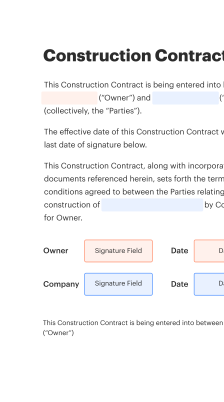
Customer Relationship Management for Legal

airSlate SignNow CRM helps you centralize, optimize and streamline your contact and document management. Upgrade your customer relationship workflows.

Award-winning eSignature solution

What customer relationship management for legal means in practice

Customer relationship management for legal refers to the processes and tools used by law firms and legal departments to manage client intake, matters, communication, and document lifecycles while maintaining legal and regulatory compliance. It combines contact and matter tracking, document versioning, secure signature capture, and audit-ready recordkeeping. Effective systems reduce administrative overhead, centralize client data, and help ensure that engagement letters, filings, and agreements are executed, stored, and retrievable in formats that satisfy ESIGN and UETA requirements in the United States.


Why adopt a formal CRM approach for legal workflows

A legal-focused CRM reduces duplicated effort, centralizes client and matter records, and enforces consistent document handling and signature processes to support compliance and predictable service delivery.

Why adopt a formal CRM approach for legal workflows

Common implementation and operational challenges

  • Ensuring accurate client identity verification while keeping onboarding friction low and meeting evidence standards for enforceability and confidentiality.
  • Integrating matter-level document control with existing case management and billing systems without breaking established workflows or creating duplicate records.
  • Balancing secure storage and access controls with the need for outside counsel, opposing parties, and clients to review or sign documents promptly.
  • Maintaining jurisdictional compliance across state law variances, preserving admissibility, and recording proof of consent under ESIGN and UETA.

Representative user profiles

Managing Partner

A managing partner oversees firm operations and needs at-a-glance matter dashboards, delegated workflows, and firm-wide standards for client onboarding and eSignature practices to reduce risk and improve turnaround times across multiple practice areas.

Client Relations Manager

A client relations manager coordinates intake and communications, requiring robust contact records, automated reminders, and templates to standardize engagement letters and disclosures while preserving audit trails and HIPAA protections where necessary.

Typical legal teams and roles that use CRM features

Legal teams use CRM features to coordinate client intake, communications, matter tracking, and document execution across attorneys, paralegals, and operations staff efficiently.

  • Managing partners and practice group leads needing consolidated matter status and client histories.
  • Paralegals and legal assistants responsible for document preparation, template management, and deadline tracking.
  • Law department operations and compliance staff who enforce retention policies and audit trails.

Firms and in-house legal departments apply these tools to reduce manual errors, accelerate signature cycles, and maintain defensible records for audits or disputes.

Expanded feature set relevant to legal CRM workflows

A fuller feature view shows how contact, document, signing, governance, integration, and automation elements combine to support legal needs.

Contact Management

Centralized contact and organization records tie client history, matter associations, and communication logs together so legal teams can quickly access relationship context and reduce redundant data entry during matter intake and correspondence.

Document Versioning

Built-in version control tracks edits, preserves prior drafts, and prevents accidental overwrites, enabling attorneys to trace clause changes and maintain a defensible document history for negotiations and litigation.

Role-Based Access

Granular permissions allow administrators to restrict document views and actions by role, supporting ethical walls, client confidentiality, and least-privilege access within multi-practice environments.

Integration Ecosystem

Connectors to CRMs, document repositories, and practice management systems reduce duplicate records, allow one-click pulling of client data into templates, and maintain synchronization between matter records and executed agreements.

Workflow Automation

Conditional routing, scheduled reminders, and triggers for archival or billing actions automate routine steps and reduce manual follow-up for signature completion and post-execution processing.

Compliance and Reporting

Prebuilt reports and exportable audit logs support internal compliance reviews and external audit requests while documenting chain-of-custody, signatory authentication, and document lifecycle events.

be ready to get more

Choose a better solution

Core features that support legal client relationships

Focus on contact management, templated documents, signing controls, and auditability to meet legal workflows and compliance requirements.

Contact and matter records

Structured contact and matter entries link communication history, documents, and billing references to a single client or case record for consistent client servicing and accurate reporting.

Document templates

Prebuilt and customizable templates preserve clause language and required metadata, reducing drafting time while ensuring consistent disclosure and signature placement across matters.

Signing controls

Configurable signer order, authentication options, and conditional fields allow legal teams to enforce process rules and capture valid consents under ESIGN and UETA.

Audit trail

Detailed, tamper-evident logs record user actions, timestamps, IP addresses, and document events to support admissibility and internal review.

How document execution fits into legal case flow

Document execution can be embedded at defined points in matter workflows to ensure approvals, signatures, and archive actions occur predictably and with clear audit evidence.

  • Prepare: Select template and populate matter fields
  • Route: Define reviewer and signer order
  • Authenticate: Apply chosen identity verification method
  • Archive: Store executed files with audit metadata
Collect signatures
24x
faster
Reduce costs by
$30
per document
Save up to
40h
per employee / month

Quick setup steps for a legal-focused CRM workflow

Core setup focuses on client intake fields, matter templates, signature roles, and retention rules tailored to legal processes.

  • 01
    Define intake fields: Map required client and matter metadata
  • 02
    Create templates: Prepare engagement and fee agreement templates
  • 03
    Set signing roles: Assign signer order and authentication methods
  • 04
    Configure retention: Specify retention durations and storage policies
be ready to get more

Why choose airSlate SignNow

  • Free 7-day trial. Choose the plan you need and try it risk-free.
  • Honest pricing for full-featured plans. airSlate SignNow offers subscription plans with no overages or hidden fees at renewal.
  • Enterprise-grade security. airSlate SignNow helps you comply with global security standards.
illustrations signature

Recommended workflow configuration settings for legal matters

Suggested workflow defaults help standardize execution and recordkeeping while remaining adaptable to matter-specific requirements.

Workflow Setting Name and Description Default Configuration
Reminder Frequency for Pending Signatures Every 48 hours up to three reminders
Signer Identity Verification Level Required Email OTP by default, ID scan optional
Template Version Control and Approval Require legal review before publishing
Retention and Archival Policy Auto-archive after matter closure
Audit Log Preservation Duration Retain logs for seven years

Supported platforms and technical requirements

Client access and signer experience work across modern browsers and major mobile platforms, but specific features may depend on browser capabilities and account settings.

  • Desktop browsers: Chrome, Edge, Safari supported
  • Mobile platforms: iOS and Android apps available
  • API requirements: Standard REST API endpoints

Ensure browser TLS support, enable cookies for session continuity, and verify mobile app versions for features such as camera-based ID verification and in-app signing to maintain a consistent legal-grade experience.

Security controls and protections to look for

Encryption at rest: AES-256 level encryption
TLS in transit: TLS 1.2 or higher
Access controls: Role-based permissions
Multi-factor authentication: MFA for user logins
Audit logs: Immutable activity records
Data residency options: Configurable regional storage

Practical examples from legal workflows

Two concise scenarios illustrate how CRM-like document and signature management supports common legal matters and client interactions.

Small firm client intake

A two-attorney firm automated engagement letters and conflict checks for new clients using templated forms and eSignature capture

  • Template-based intake reduced preparation time
  • Clients signed remotely the same day

Resulting in faster matter openings and reduced clerical backlog.

In-house contract approvals

A corporate legal team integrated matter records with centralized contract templates and approval routing

  • Automated reviewer assignment sped approvals
  • Execution records and audit trails preserved for compliance

Leading to clearer handoffs and defensible signing histories for audits.

Practical best practices for secure and accurate workflows

Adopt consistent templates, verify identities, and maintain clear retention policies to reduce risk and ensure reliable records for legal use.

Maintain standardized engagement templates across matters
Use centrally controlled templates for engagement letters and disclosures to reduce drafting variation, ensure required clauses are present, and accelerate approval cycles while enabling centralized updates when laws or firm policies change.
Use appropriate signer authentication methods by matter risk
Match identity verification strength to transaction sensitivity—email OTPs for low-risk agreements and ID verification or notarization workflows for high-value or regulated matters to strengthen enforceability.
Apply role-based access and least-privilege controls
Limit document and matter access based on roles to protect confidential client information, reduce internal exposure risks, and support ethical wall requirements when necessary.
Document retention and disposition governance
Establish and enforce retention schedules that reflect legal hold obligations, then automate disposition while preserving audit records to meet discovery and compliance needs.

Common issues and frequently asked questions

Answers address typical setup and usage problems encountered by legal teams adopting CRM and eSignature workflows.

Feature availability comparison among major eSignature providers

A concise capability matrix compares common legal requirements across popular eSignature platforms to inform integration and compliance considerations.

Comparison Criteria for eSignature Providers signNow (Recommended) DocuSign Adobe Sign
U.S. legal validity and standards ESIGN UETA ESIGN UETA ESIGN UETA
PHI handling and HIPAA support BAA available BAA available BAA available
Bulk send or batch signing capacity High-volume capable Enterprise-tier caps Enterprise-tier caps
Native CRM integrations available Salesforce, HubSpot Salesforce, MS Dynamics Salesforce, MS Dynamics
be ready to get more

Get legally-binding signatures now!

Legal risks and compliance consequences

Invalid signature risk: Contract unenforceable
Data breach exposure: Regulatory fines likely
HIPAA violations: Civil penalties possible
Retention failures: Spoliation or sanctions
Unauthorized access: Client confidentiality loss
Audit deficiencies: Evidence gaps created

Pricing and capability snapshot across providers

High-level pricing and feature notes illustrate relative cost and capability models; plan details vary and should be confirmed with each provider for accuracy.

Pricing and Feature Comparison signNow (Recommended) DocuSign Adobe Sign HelloSign PandaDoc
Entry-level plan overview Basic user plans include core eSigning and templates Standard personal and small business plans Individual and business subscriptions Freelance and small-team plans Sales-focused document workflows and templates
Typical monthly starting price range Tiered plans often start under $10 per user monthly Consumer and small business tiers around $10-$15 monthly Business plans commonly near $9-$15 monthly Individual plans often near $15 monthly Entry plans near $19 monthly
Bulk send and mass signing availability Bulk Send included on higher tiers Available on business and enterprise plans Available on enterprise tiers Available with advanced plans Available on enterprise plans
API access and developer support REST API and SDKs with developer docs Robust API and developer portal Comprehensive API and developer tools API access on paid tiers API with paid subscriptions
Enterprise features and compliance support Enterprise controls, SSO, and compliance options available Enterprise-grade governance and SSO Enterprise governance and SSO support Business and enterprise controls available Enterprise workflows and SSO available
walmart logo
exonMobil logo
apple logo
comcast logo
facebook logo
FedEx logo
be ready to get more

Get legally-binding signatures now!