Electricity Bill Format in Excel for Communications Media

Watch your billing procedure become quick and smooth. With just a few clicks, you can complete all the necessary steps on your electricity bill format in excel for Communications & Media and other crucial files from any gadget with internet access.

Award-winning eSignature solution

What an electricity bill format in Excel for communications media is

An electricity bill format in Excel for communications media is a standardized spreadsheet template that tracks usage, rates, taxes, and billing details tailored for organizations in the communications and media sector. It organizes meter readings, consumption by site or department, peak/off-peak calculations, and line-item charges so finance and operations teams can reconcile invoices and allocate costs accurately. The template typically includes formulas for prorating, lookup tables for tariff schedules, and fields for service identifiers and notes to support auditing and vendor queries across multiple sites.

Why a dedicated Excel bill format benefits communications media

A dedicated electricity bill format in Excel for communications media reduces billing errors and speeds reconciliation by aligning billing fields with industry-specific line items and site groupings.

Why a dedicated Excel bill format benefits communications media

Common challenges when managing electricity billing in media organizations

  • Multiple service addresses create complex allocation rules across production studios and transmitter sites, increasing reconciliation effort.
  • Varied tariff structures and demand charges require bespoke formulas and frequent tariff table updates in spreadsheets.
  • Manual data entry from PDF invoices introduces transcription errors and inconsistent formatting across months and vendors.
  • Lack of a standard template hampers comparisons, slows approvals, and complicates cost allocation for projects and departments.

Typical user profiles for the Excel bill template

Finance Analyst

A finance analyst uses the spreadsheet to validate monthly invoices against contracts, reconcile consumption versus billed amounts, and prepare GL entries. They rely on consistent naming conventions, embedded formulas, and an audit-ready record of adjustments to support month-end close.

Facilities Manager

A facilities manager tracks meter readings, schedules site-level checks, and isolates anomalous spikes. They use the template to compare real consumption against expected baselines and to prioritize investigations or energy-efficiency initiatives across studio and broadcast locations.

Teams and roles that use an electricity bill Excel format

Finance, facilities, and operations teams in communications media organizations rely on standardized Excel bill formats to reconcile vendor invoices and allocate costs.

  • Finance managers who prepare monthly ledger entries and need validated, line-level charges.
  • Facilities teams that track site-level consumption, meter readings, and maintenance-related energy use.
  • Project and production leads who require accurate utility allocations for budgeting and client billing.

A clear template speeds cross-team reviews, reduces questions to vendors, and supports internal chargebacks and regulatory reporting requirements.

Six practical features to include in your billing template

Build these features into the Excel format to improve accuracy, traceability, and integration across communications media billing processes.

Master meter table

A centralized table of meters, site codes, and rate zones enables consistent lookups, prevents duplication, and supports quick identification of meters for reconciliation across multiple vendor invoices and internal cost centers.


Tariff lookup

A tariff schedule with effective dates and tiered rates lets formulas select correct rates by billing period and consumption band, reducing manual rate-entry errors during monthly reconciliations.

Automatic totals

Prebuilt formulas and named ranges calculate energy charges, demand fees, taxes, and adjustments automatically so reviewers can focus on exceptions rather than routine arithmetic.

Audit notes

A dedicated column for reviewer notes and adjustment reasons creates a permanent record of disputes, credits, or assumptions to support internal audits and vendor queries.

Import assistant

A mapping worksheet or macro that normalizes vendor CSV/PDF extracts simplifies imports and reduces manual reformatting when invoices arrive in different layouts.

Reporting pivot

Preconfigured pivot tables and summary sheets generate site, department, and period reports for finance and operations without rebuilding views each month.

be ready to get more

Choose a better solution

Integrations and features to streamline billing

Linking the Excel bill format to common systems reduces manual work and improves accuracy for communications media teams.

Google Sheets

Syncing the Excel template with Google Sheets enables shared, real-time collaboration and simpler multi-user access for remote production and finance teams while preserving core formulas and named ranges for consistent calculations.

CRM integration

Connecting billing outputs to a CRM or project-management tool lets production cost centers receive automated chargebacks and ensures client invoices reflect accurate utility allocations tied to projects or campaigns.

Cloud storage

Storing templates in secure cloud folders centralizes version control, enables automated backups, and ensures teams access the approved template while maintaining change logs for auditing purposes.

Accounting export

Export structured summaries and journal entries to accounting systems in CSV or XLSX formats to speed month-end close and reduce rekeying errors between billing and ledger systems.
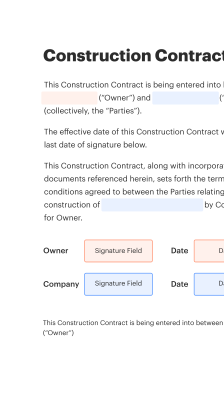
How the Excel format functions within a billing workflow

A clear flow converts raw invoices and meter data into validated entries ready for accounting and reporting.

  • Ingest data: Import CSVs or extract PDF line items.
  • Normalize fields: Standardize site names and meter IDs.
  • Validate totals: Compare invoice totals to calculated amounts.
  • Export results: Produce GL-ready summaries and journal lines.
Collect signatures
24x
faster
Reduce costs by
$30
per document
Save up to
40h
per employee / month

Step-by-step: prepare an electricity bill Excel template

Follow these core steps to build or adapt an electricity bill format in Excel for communications media reconciliation.

  • 01
    Collect invoice data: Gather PDFs, CSVs, and meter reads.
  • 02
    Define fields: Include meter ID, site, rate, period.
  • 03
    Add formulas: Implement tariff lookups and totals.
  • 04
    Protect workbook: Lock critical formulas and sheets.
be ready to get more

Why choose airSlate SignNow

  • Free 7-day trial. Choose the plan you need and try it risk-free.
  • Honest pricing for full-featured plans. airSlate SignNow offers subscription plans with no overages or hidden fees at renewal.
  • Enterprise-grade security. airSlate SignNow helps you comply with global security standards.
illustrations signature

Typical workflow settings for automated billing processes

Configure these workflow settings to automate import, review, and notification tasks while using the Excel format across teams.

Setting Name Configuration
Reminder Frequency 48 hours
Import Schedule Daily
Approval Chain Two-step
Export Format CSV
Retention Period 7 years

Supported platforms and device considerations

The electricity bill format in Excel is compatible with Windows and macOS Excel desktop applications and cloud-hosted spreadsheet editors for collaborative use.

  • Desktop Excel: Windows and macOS
  • Cloud editors: Google Sheets compatibility
  • Mobile access: Read and minor edits

For full formula compatibility and protected sheet enforcement use the desktop Excel application; cloud editors are useful for collaboration but may require periodic template validation to ensure formulas and protections function as intended.

Key security and protection features to include

Password protection: Restricts file opening
Protected sheets: Prevents formula edits
Role-based access: Limits editing to authors
Encrypted storage: Secures data at rest
TLS transfers: Encrypts data in transit
Audit logging: Records file changes

Industry examples showing the template in use

Two concise examples show how an Excel bill format supports media operations and vendor reconciliation.

Regional Broadcast Group

A regional broadcaster standardized monthly electricity invoices into a single Excel format to compare bills across 12 transmitter and studio sites

  • The template included columns for meter IDs and demand charges
  • This simplified variance analysis and monthly chargebacks to departments

Leading to faster dispute resolution and clearer internal cost allocation for budgeting.

Streaming Production House

A production house consolidated campus and on-location energy invoices into a shared Excel template to track shoot-related consumption

  • The sheet captured site-level tariffs and prorated usage for shoots
  • Reports enabled producers to estimate energy costs per production

Resulting in accurate client billing and transparent project cost reporting for finance.

Best practices for accurate electricity billing spreadsheets

Adopt consistent standards and controls to keep templates reliable and audit-ready across teams and months.

Standardize site and meter naming
Use a centralized naming convention and a master meter table so lookups and pivot summaries remain accurate when importing vendor data or performing cross-site comparisons.
Version control and approvals
Store only approved templates in a controlled folder, track changes with a revision log, and require sign-off for structural updates to prevent accidental formula or column changes.
Automate data imports where possible
Use CSV exports from vendor portals, OCR-import tools for PDFs, or direct API pulls so manual transcription is minimized and consistency of invoice line items is preserved.
Reconcile regularly and document adjustments
Perform monthly reconciliations, document any manual adjustments with reasons, and keep a notes column to support invoice disputes and future audits.

Troubleshooting and frequently asked questions

Common issues and clear troubleshooting steps for working with an electricity bill format in Excel for communications media.

Feature comparison: signNow versus DocuSign for billing approvals

At-a-glance availability of core signing and workflow features relevant to electricity bill approvals in communications media.

Feature / Vendor signNow (Recommended) DocuSign
Basic eSignature
Bulk Send
API access REST API REST API
HIPAA support
be ready to get more

Get legally-binding signatures now!

Risks and compliance penalties to consider

Billing disputes: Delayed payments
Regulatory fines: Noncompliance costs
Revenue leakage: Lost recoveries
Audit failures: Negative findings
Data breaches: Remediation expense
Contract breaches: Liability exposure

Pricing overview across eSignature providers for billing workflows

Typical entry-level pricing and plan characteristics for eSignature vendors commonly used with billing templates and approval workflows.

Plan Pricing Overview signNow (Recommended) DocuSign Adobe Sign Dropbox Sign PandaDoc
Starting Monthly Price $8/user/month $10/user/month $9.99/user/month $15/user/month $19/user/month
Included Signatures Unlimited Limited Unlimited Limited Limited
API Access Included Paid add-on Included Paid add-on Included
Bulk Send Capability Included Included Included Included Included
Enterprise Options Available Available Available Available Available
walmart logo
exonMobil logo
apple logo
comcast logo
facebook logo
FedEx logo
be ready to get more

Get legally-binding signatures now!