Freelance Invoice Software for Enterprises

Freelance invoice software for enterprises offers secure and compliant eSignature solutions tailored for various industries, ensuring efficient document management.

Award-winning eSignature solution

What enterprise freelance invoice software does and why it matters

Freelance invoice software for enterprises centralizes invoice creation, distribution, tracking, and reconciliation for organizations that engage independent contractors at scale. It combines template-driven invoice generation, automated reminders, multi-currency and tax handling, integration with accounting and CRM systems, and audit-ready records to reduce manual work and payment delays. For large teams, the platform must support role-based permissions, bulk processing, API access, and data retention policies to align with corporate finance and compliance practices while preserving document integrity and an auditable signature and delivery trail.

Why enterprises adopt freelance invoice software

Enterprises use freelance invoice software to standardize invoicing at scale, accelerate payments, reduce errors, and maintain consistent compliance and reporting across departments and geographies.

Why enterprises adopt freelance invoice software

Common enterprise invoicing challenges

  • Managing thousands of invoices manually increases errors and delays in payments and reconciliations.
  • Reconciling multi-currency fees and localized tax rules complicates global contractor payments.
  • Integrating invoice data across payroll, ERP, and vendor portals requires consistent APIs and mapping.
  • Maintaining auditable signature records and proof of delivery across high volumes is operationally intensive.

Representative enterprise roles using invoice software

Finance Manager

Oversees accounts payable operations and enforces invoice policies. Uses the software to automate approvals, reconcile payments, and generate month-end reports that align with corporate ledger structure and audit requirements.

Procurement Lead

Coordinates contractor onboarding, sets approval thresholds, and manages vendor master data. Relies on templates, approval routing, and integration with procurement systems to control spend and ensure timely supplier payments.

Typical enterprise users and teams

Large organizations deploy freelance invoice software across finance, procurement, and legal teams to manage external contractor payments and compliance.

  • Finance teams handling accounts payable and contractor reconciliations across business units.
  • Procurement groups managing vendor onboarding, approval workflows, and spend controls.
  • Compliance and legal teams needing audit trails, retention rules, and contract proof.

Cross-functional use ensures invoices move through approvals, payments, and recordkeeping with visibility and controls suitable for enterprise governance.

Essential enterprise features to evaluate

Look for a mix of automation, compliance, and reporting capabilities to meet enterprise volume and control requirements.

Invoice Templates

Customizable, reusable invoice templates with conditional fields to enforce branding, tax calculations, and required legal clauses across business units.


Recurring Invoices

Automated scheduling for subscription or retainer payments, including configurable retry logic and notification rules for failed payments or overdue items.

Multi-currency

Automatic currency selection, exchange rate handling, and display options to support global contractors and consolidated reporting in corporate currency.

Tax Calculations

Built-in or integrated tax engines that apply regional VAT, GST, or withholding tax rules and produce tax breakdowns for compliance and reporting.

Approval Workflows

Configurable multi-step approval chains with role-based escalation, conditional routing, and audit logging to enforce internal controls.

Reporting & Analytics

Prebuilt and custom reports on aging, payment velocity, and contractor spend to support finance forecasting and vendor management.

be ready to get more

Choose a better solution

Integrations that accelerate enterprise invoicing

Linking invoice software with common document, storage, and CRM tools reduces manual entry and preserves source-of-truth records across systems.

Google Docs

Generate invoices from Google Docs templates, populate fields dynamically, and preserve a signed PDF back to Drive for centralized recordkeeping and version control across teams.

CRM systems

Push invoice events and payment status into CRM records so account teams see billing milestones, outstanding invoices, and signature timestamps without manual reconciliation.

Dropbox

Save final signed invoices automatically to Dropbox folders with naming conventions and retention tags for audit readiness and offsite backups.

Accounting software

Sync invoice line items, tax amounts, and payment status to enterprise accounting systems to streamline month-end close and accounts payable processes.
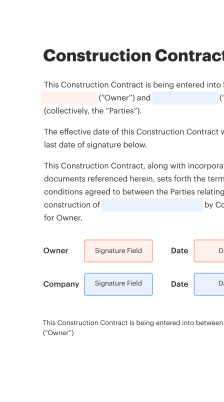
How invoice creation and signing flow works online

A typical online workflow moves from template creation to delivery, signature, and archiving with automation at key steps.

  • Create invoice: Use a template or upload document.
  • Add approvals: Embed required signers and reviewers.
  • Send to recipients: Deliver via email or link.
  • Archive and report: Store signed copies and update ledgers.
Collect signatures
24x
faster
Reduce costs by
$30
per document
Save up to
40h
per employee / month

Quick setup: First steps for enterprise deployment

Follow these preparatory steps to configure freelance invoice software for enterprise scale, focusing on security, integrations, and governance.

  • 01
    Define policies: Document approval and retention rules.
  • 02
    Set roles: Assign finance and legal permissions.
  • 03
    Connect systems: Integrate ERP, payroll, and CRM.
  • 04
    Pilot and train: Run a controlled rollout with feedback.

Audit trail and recordkeeping: step-by-step

Maintain comprehensive logs and records to support legal validity and internal audits of freelance invoices.

01

Capture events:

Log send, view, and sign events
02

Preserve evidence:

Save IP, timestamps, and metadata
03

Record authentication:

Store method and challenge results
04

Attach correspondence:

Include related emails and notes
05

Index documents:

Use searchable metadata tags
06

Export reports:

Generate exportable audit reports
be ready to get more

Why choose airSlate SignNow

  • Free 7-day trial. Choose the plan you need and try it risk-free.
  • Honest pricing for full-featured plans. airSlate SignNow offers subscription plans with no overages or hidden fees at renewal.
  • Enterprise-grade security. airSlate SignNow helps you comply with global security standards.
illustrations signature

Recommended workflow settings for enterprise invoicing

Suggested default settings balance automation with control to support volume processing and auditability in enterprise environments.

Setting Name Configuration
Invoice approval chain and levels Two approvals required
Automated reminder frequency and timing 48 hours then weekly
Invoice numbering sequencing and prefix Sequential with prefix
Currency handling and conversion rules Corporate currency conversion
Document retention backup and archival policy Retain seven years

Supported platforms and minimum requirements

Ensure the chosen freelance invoice software supports the devices, browsers, and API clients your teams and systems rely on.

  • Mobile OS support: iOS 13+; Android 8+
  • Browser compatibility: Chrome, Edge, Safari
  • API client libraries: Java, Python, Node

Confirm platform coverage during procurement and test key actions—template rendering, signature flows, and API calls—on representative devices and browsers prior to full rollout.

Core security and access controls

Encryption in transit: TLS 1.2+
Encryption at rest: AES-256
Role-based access: Granular roles
Two-factor authentication: Optional 2FA
Hardware key storage: HSM-backed keys
Document watermarking: Visible markers

Industry scenarios and examples

Representative use cases show how enterprise features map to operational needs across sectors and teams.

Global marketing agency

A multinational agency consolidates freelance invoices across regions for consistent billing

  • Uses multi-currency invoice templates and automated tax rules
  • Streamlines approval workflows and reduces manual rework

Resulting in faster contractor payments and clearer financial reconciliation across subsidiaries.

Software development firm

A development firm engages contractors for sprint-based work and needs rapid invoicing

  • Implements recurring and milestone invoicing tied to project trackers
  • Aligns invoice approvals with delivery acceptance to reduce disputes

Resulting in timely payments, fewer chargebacks, and improved contractor relationships.

Best practices for secure and accurate enterprise invoicing

Adopt procedural and technical controls that reduce errors, improve compliance, and maintain clear records for audits and reporting.

Standardize invoice templates and metadata
Use centrally managed templates with required fields, consistent naming conventions, and built-in tax and payment terms to prevent missing data and simplify downstream reconciliation.
Enforce multi-step approval and segregation of duties
Implement configurable approval chains and role separation so invoices are reviewed by finance and legal where appropriate before payment, reducing risk and enforcing controls.
Enable strong authentication for signers
Require two-factor or knowledge-based authentication for high-value transactions and contractors to strengthen signer identity verification and reduce repudiation risk.
Automate retention and archival policies
Configure automated retention schedules, secure backups, and searchable archives to ensure documents are available for audits and legal discovery while meeting corporate retention requirements.

FAQs and troubleshooting for enterprise invoicing flows

Common questions and remedies for issues encountered when running freelance invoice processes at enterprise scale.

Feature availability: signNow compared with major vendors

Quick comparison of core capabilities across popular eSignature platforms used for enterprise invoicing and contract execution.

Feature or capability being compared signNow (Recommended) DocuSign Adobe Sign
Bulk Send
REST API Available Available Available
Mobile app
Audit trail included
be ready to get more

Get legally-binding signatures now!

Suggested retention and deadline timeline for invoices

Define consistent timelines for issuing, approving, paying, and retaining invoices to support operations and compliance.

Invoice issuance window:

Issue within 5 business days

Approval turnaround:

Complete within 7 days

Payment terms enforcement:

Net 30 standard

Document archival schedule:

Archive within 30 days

Long-term retention period:

Retain seven years

Operational and compliance risks

Late payment penalties: Monetary fines
Regulatory fines: Compliance fees
Data breach exposure: Reputation loss
Contract disputes: Legal costs
Invalid signatures: Enforceability risk
Failed audits: Remediation work

Pricing and plan characteristics across providers

Overview of starting plan characteristics and enterprise-oriented features for common eSignature vendors relevant to enterprise freelance invoicing.

Subscription plans and vendors signNow (Featured) DocuSign Adobe Sign HelloSign PandaDoc
Starting monthly price (entry plan) From $8/user/month From $10/user/month From $12.99/user/month From $15/user/month From $19/user/month
Free trial length 14 days 30 days 30 days 14 days 14 days
Enterprise plan available Yes Yes Yes Yes Yes
API access on plan Available on business plans Available Available Available Available
Bulk sending included Included with plans Add-on or plan Included Included Included
walmart logo
exonMobil logo
apple logo
comcast logo
facebook logo
FedEx logo
be ready to get more

Get legally-binding signatures now!