Electronic Bill Format for Inventory Management

Streamline your document workflow with our intuitive eSigning platform that saves time and reduces costs. Experience hassle-free electronic billing tailored for your inventory management needs.

Award-winning eSignature solution

Legal validity and compliance considerations

Electronic bills formatted and signed properly are legally enforceable in the U.S. when executed under ESIGN and UETA; organizations should also align storage, access controls, and any sector-specific rules such as HIPAA or FERPA where applicable.

Legal validity and compliance considerations

Typical users and their roles

Inventory Manager

An Inventory Manager configures templates, verifies SKU and stock mappings, and approves bills that affect physical inventory. This role monitors accuracy, resolves exceptions, and ensures bills match warehouse counts before financial posting.

Accounts Payable

Accounts Payable receives finalized signed bills, validates totals and tax treatment, matches documents to purchase orders, and schedules payments. This role maintains retention records and supports audit requests for signed inventory bills.

Key tools for an effective electronic bill format for inventory

A robust electronic bill format for inventory combines template management, field mapping, automated data population, signature capture, audit logging, and secure storage to reduce errors and speed approvals.

Template Manager

Centralized templates let teams standardize bill layout, lock required fields, and apply version control so every inventory bill follows the same validated structure.


Field Mapping

Map inventory system fields to document placeholders to auto-populate SKU, descriptions, costs, quantities, taxes, and totals without manual entry, reducing mistakes.

Calculated Fields

Embed formulas for line totals, discounts, and taxes to ensure accurate arithmetic and consistent financial reporting across all inventory bills.

Workflow Routing

Define sequential or parallel approval steps with role-based signers and conditional routing for exceptions, oversize orders, or cost thresholds.

Audit Trail

Record signer identities, timestamps, IP addresses, and document events to provide a tamper-evident activity log for compliance and dispute resolution.

Secure Storage

Store finalized bills with encryption and retention controls that meet organizational backup and audit requirements for finance and inventory teams.

be ready to get more

Choose a better solution

Integrations that enhance electronic bill formats for inventory

Integration with document editors, cloud storage, and CRM or ERP systems streamlines population, version control, and lifecycle management of inventory bills.

Google Workspace

Connect templates to Google Docs for collaborative editing, then push final documents into the signing workflow while preserving revision history and reducing duplicate file exports.

CRM and ERP

Integrate with CRM and ERP systems to pull customer and item data, push signed bills back to accounting, and ensure records reconcile across inventory and finance modules.

Dropbox and Drive

Automatically store signed bills in Dropbox or Google Drive folders with structured naming conventions and retention rules for easy retrieval and backup.

Accounting platforms

Send finalized, signed bills to accounting software to trigger payment workflows, reconciliation, and ledger updates without manual re‑entry.
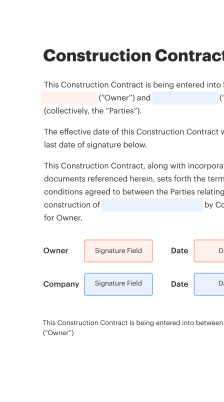
Creating and using an online electronic bill format for inventory

Convert your paper bill layout into a digital template, populate data from inventory systems, and route for approval and signature through secure electronic channels.

  • Template setup: Upload base document and map inventory fields for automated population.
  • Data merge: Link SKU and quantity fields to inventory or CSV imports.
  • Routing: Define approval order and signer responsibilities for each bill.
  • Completion: Capture signatures and finalize document with audit trail attached.
Collect signatures
24x
faster
Reduce costs by
$30
per document
Save up to
40h
per employee / month

Quick setup for an electronic bill format for inventory

Prepare core fields, standardize item lines, and choose an eSignature-enabled workflow to begin using an electronic bill format for inventory quickly and consistently.

  • 01
    Define fields: SKU, description, quantity, unit price, tax, and total per line.
  • 02
    Select template: Create a reusable document template with required fields and signatures.
  • 03
    Assign roles: Set who fills, approves, and signs each bill within the process.
  • 04
    Test flow: Run a sample transaction to confirm calculations and signature capture.

Audit trail management for inventory bill transactions

Maintain clear, tamper-evident logs for every action on a bill so auditors can trace changes, signings, and approvals reliably.

01

Event capture:

Log uploads, edits, sends, and views.
02

Signer verification:

Record authentication methods used.
03

Timestamping:

Store precise UTC timestamps for events.
04

IP and device data:

Include source IP and device type.
05

Version history:

Keep prior versions visible and immutable.
06

Exportable reports:

Generate audit exports for compliance reviews.
be ready to get more

Why choose airSlate SignNow

  • Free 7-day trial. Choose the plan you need and try it risk-free.
  • Honest pricing for full-featured plans. airSlate SignNow offers subscription plans with no overages or hidden fees at renewal.
  • Enterprise-grade security. airSlate SignNow helps you comply with global security standards.
illustrations signature

Typical automation and workflow settings for inventory bills

Configure automated routing, reminders, and conditional approval logic so inventory bills move through approvals without manual intervention while preserving oversight and records.

Setting Name Configuration
Reminder Frequency for Outstanding Signatures 48 hours initial reminder, then daily for five days
Approval Escalation for Over‑Threshold Amounts Escalate to manager after first approval if amount exceeds limit
Conditional Routing for Backordered Items Route to procurement when any line shows backorder status
Auto-approve Low‑Value Bills Auto-approve below configured threshold with audit entry
Document Retention Trigger Archive final bills after 7 years or per policy

Platform requirements for mobile and desktop use

Most electronic bill formats for inventory work across modern browsers and mobile apps; ensure devices run supported operating systems and have stable network access.

  • Web browser: Chrome, Edge, Safari supported
  • Mobile OS: iOS and Android supported
  • PDF reader: Built-in viewer or standard PDF app

For consistent behavior, keep applications updated, enable secure TLS network connections, and verify that integrations with inventory or accounting systems are authorized and tested on each device type.

Security controls and document protection

Encryption at rest: AES-256 encryption
Encryption in transit: TLS 1.2+ transport
Access controls: Role-based permissions
Two-factor authentication: Optional 2FA for signers
Document watermarking: Visible audit marks
Audit logging: Comprehensive event logs

Industry examples using electronic bill formats for inventory

Real-world examples show how customized electronic bill formats reduce errors and accelerate approvals across sectors that manage physical goods.

Wholesale distributor

A regional distributor digitized its paper bills to enforce standardized item lines and automated quantity checks

  • Template enforcement and SKU validation
  • Reduced disputes and faster invoicing

Resulting in shorter payment cycles and fewer inventory discrepancies for finance and warehouse teams.

Manufacturing supplier

A supplier integrated electronic bill formats with its ERP to populate part numbers and unit costs automatically

  • Integration with ERP and calculated totals
  • Fewer manual corrections and correct cost allocation

Leading to improved month-end reconciliation and clearer audit trails for compliance reviews.

Best practices for secure and accurate electronic bill formats

Follow repeatable processes and document controls to keep inventory billing accurate, auditable, and defensible during financial reviews or disputes.

Standardize templates and required fields
Use locked template fields for SKU, quantity, unit price, tax, and totals. Include required signer and approver fields to prevent incomplete bills from circulating and ensure consistent validation across teams.
Validate data before sending
Implement automated checks that compare document quantities and totals against inventory or order records. Flag exceptions for manual review to reduce invoice errors and downstream reconciliation work.
Preserve audit trails and metadata
Capture signer identity, timestamps, IP address, and version history for every bill. Retain metadata alongside documents to support compliance, audits, and dispute resolution without reconstructing events.
Limit access and manage roles
Grant minimal necessary permissions for creators, approvers, and viewers. Regularly review roles and remove access for separated employees to maintain confidentiality and integrity of billing records.

Frequently asked questions about electronic bill format for inventory

Answers to common questions about configuring, legally validating, and troubleshooting electronic bill formats for inventory.

Digital versus paper signing: capability snapshot

Compare core capabilities of leading eSignature solutions to understand how electronic bill formats for inventory perform versus paper processes and across vendors.

Feature signNow (Recommended) DocuSign Adobe Sign
ESIGN/UETA Compliance
Bulk Send capability
API availability REST API REST API REST API
HIPAA BAA options
be ready to get more

Get legally-binding signatures now!

Storage, backup, and retention considerations

Establish retention policies and backup schedules that align with accounting rules, tax requirements, and internal audit needs for electronic inventory bills.

Retention period for financial documents:

Minimum seven years or per local regulations

Backup frequency and redundancy:

Daily backups with multi-region redundancy

Access review cadence:

Quarterly permissions review and audit

Secure deletion policy:

Policy-driven deletion after retention expiry

Disaster recovery plan testing:

Annual recovery drills and verification

Pricing and plan comparison for common eSignature providers

A comparison of entry-level plan characteristics and common capabilities to help assess total cost and fit when adopting electronic bill formats for inventory.

Plan signNow (Featured) DocuSign Adobe Sign HelloSign PandaDoc
Starting monthly price (approx.) From $8/mo From $10/mo From $12.99/mo From $13/mo From $19/mo
Free trial or free tier Free trial available Free trial available Free trial available Free tier available Free eSign plan available
Bulk Send included Yes on select plans Yes on business plans Yes on business plans Available on paid plans Available on paid plans
API access availability Available on paid plans Available via API plans Available via API plans Developer API available API available on paid plans
Enterprise support options Phone and email support Enterprise SLAs Enterprise SLAs Business support options Dedicated success managers
HIPAA-compliant options BAA available BAA available BAA available BAA available via partner BAA available
walmart logo
exonMobil logo
apple logo
comcast logo
facebook logo
FedEx logo
be ready to get more

Get legally-binding signatures now!