Estimate Bill Format for Banking

Streamline your document processes with our user-friendly eSignature solution. Experience cost-effective efficiency in managing your banking estimates.

Award-winning eSignature solution

What an estimate bill format for banking is and why it matters

An estimate bill format for banking defines a standardized document that details projected charges, fees, and payment terms for banking products or services. It typically lists itemized fees, effective dates, calculation methods, and signature fields for customer acknowledgement. In banking contexts, a consistent estimate format reduces errors, supports regulatory disclosure requirements, and creates a clear audit trail for pricing decisions. When combined with digital signing and secure document workflows, the format supports faster approvals, accurate recordkeeping under ESIGN and UETA, and scalable distribution to internal reviewers and external clients.

Why a standardized estimate bill format improves banking operations

A standardized estimate bill format reduces calculation errors, accelerates client approvals, and preserves a verifiable audit trail for regulatory review. It clarifies fees for clients and supports consistent internal reviews.

Why a standardized estimate bill format improves banking operations

Common challenges when using estimate bill formats in banking

  • Inconsistent field layouts cause missing line items and incorrect totals during manual processing.
  • Manual signature collection delays client acceptance and lengthens the sales-to-revenue cycle.
  • Poor version control creates disputes about which estimate was signed or agreed.
  • Inadequate access controls risk exposure of confidential pricing and client financial details.

Representative users and their needs

Loan Officer

Loan officers use estimate bill formats to present fee breakdowns, APR-related costs, and closing estimates to borrowers. They require clear fields for itemized fees, simple signature steps, and an audit trail showing customer acknowledgement and date to meet lending compliance and disclosure rules.

Treasury Manager

Corporate treasury managers need standardized estimate bills to compare service fee proposals, authorize pricing changes, and maintain records for contracts. They prioritize batch generation, template reuse, and access controls to ensure internal approvals and vendor negotiations remain auditable.

Teams and roles that typically use estimate bill formats

Multiple banking teams prepare and review estimates, including client-facing and compliance groups focused on accuracy and traceability.

  • Relationship managers preparing customer fee schedules and disclosures for new accounts and services.
  • Compliance and audit teams validating fee calculations and record retention for regulatory reviews.
  • Operations staff generating standardized billing estimates for internal approvals and client delivery.

Coordinating these roles with a central format and an auditable signing process reduces disputes and supports regulatory readiness.

Advanced features for secure, scalable estimate bill management

For larger banks and enterprise teams, these additional capabilities support automation, developer integration, and heightened security for estimate bill formats.

API

REST APIs allow programmatic template generation, remote signing, and retrieval of signed estimate bills for integration with loan origination systems and back-office processes.


SSO

Single sign-on and SAML support enable centralized identity management and simplify role assignment for employees handling sensitive pricing documents.

Advanced authentication

Options like knowledge-based authentication, SMS codes, or ID verification help meet higher assurance requirements for significant fee agreements.

Document merging

Merge customer-specific data into a master estimate template to produce personalized, accurate estimates without manual data entry or formatting changes.

Mobile signing

Mobile-friendly signing experiences let customers review and sign estimates securely from tablets or phones with the same audit and encryption protections.

Role-based workflows

Define multi-step approval sequences and conditional routing so estimates automatically move through credit, compliance, and relationship teams before delivery.

be ready to get more

Choose a better solution

Core tools to improve estimate bill workflows

Use these four capabilities to ensure estimate bills are accurate, easy to sign, and securely stored across banking teams and clients.

Templates

Centralized, reusable templates ensure consistent field placement, built-in calculations for fees and totals, and standard disclosure language that reduces manual entry and speeds document generation across branches.

Bulk Send

Bulk Send enables distributing identical estimate formats to many recipients at once, tracking individual completions and preserving separate signed records for each customer to simplify mass communications.

Integrations

Connect estimate templates to CRM and document storage systems to pull customer data, push signed copies back to records, and reduce duplicate entry while maintaining traceability.

Audit Trail

A tamper-evident audit trail captures every action — views, edits, authentications, and signatures — preserving an evidentiary record for compliance and internal review.
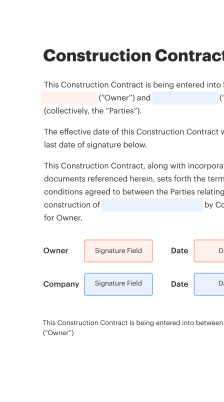
How to create and use an estimate bill format for banking online

This sequence outlines common online actions from template creation to final signed delivery for estimate bills in banking.

  • Template authoring: Draft a reusable template with calculated fields.
  • Attach recipients: Add signers and reviewers in order.
  • Apply authentication: Select signature and ID verification methods.
  • Finalize and archive: Obtain signatures and store the signed PDF.
Collect signatures
24x
faster
Reduce costs by
$30
per document
Save up to
40h
per employee / month

Getting started with an estimate bill format for banking

Follow these four essential steps to create, approve, and deliver standardized estimate bills within a secure banking workflow.

  • 01
    Create template: Define fields, calculations, and disclosure text.
  • 02
    Set permissions: Assign roles for drafting and approval.
  • 03
    Route for approval: Use sequential or parallel signing workflows.
  • 04
    Deliver signed copy: Store final document with audit trail.
be ready to get more

Why choose airSlate SignNow

  • Free 7-day trial. Choose the plan you need and try it risk-free.
  • Honest pricing for full-featured plans. airSlate SignNow offers subscription plans with no overages or hidden fees at renewal.
  • Enterprise-grade security. airSlate SignNow helps you comply with global security standards.
illustrations signature

Typical workflow settings for estimate bill format automation

Configure these workflow settings to automate routing, reminders, and retention of estimate bills used across banking operations.

Setting Name Configuration
Automatic document reminder frequency interval 48 hours
Default signer authentication method setting Email + SMS
Document retention and archival policy duration 7 years
Notification and email template default language English
Signing order and parallel signing configuration Sequential by role

Supported devices and software for estimate bill delivery and signing

Estimate bills and signing flows are accessible via modern web browsers and native mobile apps across popular platforms.

  • Desktop browsers: Chrome, Edge, Firefox supported
  • Mobile platforms: iOS and Android apps
  • Document formats: PDF, DOCX, and merged templates

Ensure supported browser versions and mobile OS updates are in place; validate file format compatibility for template merges and confirm corporate firewall rules permit secure API traffic.

Security controls for estimate bill format for banking

Data encryption: 256-bit AES at rest
Transport security: TLS 1.2+ encryption
Access controls: Role-based permissions
Authentication options: Multi-factor authentication
Document integrity: Tamper-evident audit logs
Storage segmentation: Tenant-level separation

Practical examples of estimate bill format use in banking

Two brief case examples illustrate how an estimate bill format streamlines approvals and preserves compliance evidence across different banking processes.

Retail account opening

A branch generates an itemized fee estimate for account setup and maintenance

  • Uses templated fields for deposit fees and monthly service charges
  • Customer signs electronically during onboarding to confirm acknowledgement

Resulting in one stored, auditable record that reduces onboarding time and dispute risk.

Commercial loan pricing

A commercial credit team prepares a borrower estimate showing origination fees and servicing costs

  • The format includes calculated totals and disclosure checkboxes
  • Internal risk and compliance reviewers approve the estimate via workflow before delivery

Leading to consistent disclosures, faster client acceptance, and a clear audit trail for examinations.

Best practices for secure and accurate estimate bill formats

Adopt these practices to minimize errors, ensure compliance, and streamline approvals when producing and signing estimate bills in banking.

Standardize templates with calculated fields and mandatory disclosures
Design templates that include built-in calculations for fees, required disclosure fields, and read-only totals. Lock formula fields to prevent accidental edits and ensure consistent presentation of charges across branches and channels.
Enforce role-based approvals and signer authentication
Require approval steps for risk, credit, and compliance reviewers before customer delivery. Use multi-factor or knowledge-based authentication for high-value or sensitive fee agreements to increase evidentiary weight.
Maintain retention policies aligned with regulations
Implement document retention timelines that reflect banking regulations and institutional policy. Archive signed estimates with immutable metadata and ensure retrieval procedures for audits and examinations.
Integrate with core systems to eliminate manual entry
Connect templates to CRM, loan origination, and accounting systems so client data and approved fee schedules populate automatically, reducing transcription errors and accelerating turnaround.

FAQs About estimate bill format for banking

Common questions address legality, signature validity, format issues, and troubleshooting steps for signing and storage of estimate bills.

Feature availability comparison across major eSignature providers

This concise comparison highlights core capabilities relevant to estimate bill formats and secure signing in U.S. banking operations.

Feature signNow (Recommended) DocuSign Adobe Sign
Legally binding electronic signatures in United States
Bulk Send and mass distribution capabilities
REST API and developer SDKs for automation
HIPAA compliance and data controls available Available Available Available
be ready to get more

Get legally-binding signatures now!

Retention and review timelines for estimate bill documents

Set clear timelines for retention, periodic review, and disposal of estimate bills to meet audit and regulatory expectations.

Initial retention period:

Keep signed estimates for seven years by default.

Periodic compliance review:

Conduct policy and template reviews annually.

Template update cadence:

Review and update wording after regulatory changes.

Access rights audit frequency:

Audit permissions every six months.

Secure disposal schedule:

Permanently delete after retention expiry.

Risks and penalties for improper handling

Regulatory fines: Monetary penalties
Contract disputes: Legal exposure
Client chargebacks: Refund obligations
Reputational harm: Lost trust
Data breaches: Compliance violations
Audit failures: Corrective actions

Pricing and plan comparison for popular eSignature platforms

Price and plan features vary; below are representative public plan attributes to help compare entry-level costs, trials, and enterprise capabilities.

Pricing Attribute signNow (Recommended) DocuSign Adobe Sign Dropbox Sign PandaDoc
Entry-level monthly price per user $8 per user/month $10 per user/month $9.99 per user/month $15 per user/month $19 per user/month
Free trial availability Yes Yes Yes Yes Yes
Free plan or limited tier No Limited trial only No Limited free tier No
Enterprise SSO and security features Included on enterprise plans Included enterprise Included enterprise Available enterprise Available enterprise
Dedicated account support level Business support; Enterprise plans available Enterprise support Enterprise support Priority support options Customer success support
walmart logo
exonMobil logo
apple logo
comcast logo
facebook logo
FedEx logo
be ready to get more

Get legally-binding signatures now!