General Store Bill Format for Efficient Transactions

Watch your invoice workflow become fast and effortless. With just a few clicks, you can complete all the necessary steps on your general store bill format and other important documents from any gadget with web connection.

Award-winning eSignature solution

What a general store bill format includes

A general store bill format is a standardized document that records a retail transaction, itemizing goods or services sold, unit prices, quantities, taxes, discounts, totals, and payment method. It serves as both a sales record and a proof of purchase for customers and the store, and may include store identification, invoice number, date, and return or warranty terms. For small and medium retailers, a clear bill format supports accounting, inventory reconciliation, tax reporting, and customer service while reducing disputes about charges or quantities.

Why a clear bill format matters for stores

A consistent general store bill format improves bookkeeping accuracy, speeds customer checkout, and helps meet tax documentation requirements. It reduces errors, simplifies returns, and creates a reliable record for inventory and reconciliation.

Why a clear bill format matters for stores

Common challenges when using bill formats

  • Inconsistent item descriptions lead to inventory mismatches and accounting confusion across sales channels.
  • Missing invoice numbers or dates complicate audits and make transaction lookup time consuming.
  • Incorrect tax calculations or omitted tax lines can trigger compliance reviews and penalties.
  • Poorly formatted totals and payment fields increase customer disputes and return processing time.

Typical roles interacting with the bill format

Store Owner

Store owners use the bill format to verify daily sales, reconcile cash and card receipts, and assess inventory depletion. They rely on consistent invoice numbering and tax totals when preparing reports for bookkeeping or tax filings.

Cashier

Cashiers generate and issue the bill at point of sale, check prices and discounts, and confirm payment method. A clear template helps reduce checkout errors and speeds customer service during busy periods.

Who needs a reliable bill format

Retail owners, cashiers, and accountants rely on a standardized general store bill format to maintain accurate sales and tax records.

  • Independent retailers and corner shops for daily sales tracking and customer receipts.
  • Regional chains for consistent reporting across multiple locations and centralized accounting.
  • Bookkeepers and accountants for month-end reconciliation and tax filing support.

A clear format reduces disputes and supports faster bookkeeping, returns, and customer service workflows.

Key features to support store billing operations

Choose features that streamline bill creation, protect records, and integrate with accounting or inventory systems for accurate, auditable transactions.

Custom templates

Custom templates let you predefine layout, required fields, and legal text so every receipt meets store standards, speeds cashier workflow, and reduces missing information during busy shifts.


Automated taxes

Automated tax calculation applies jurisdictional rates to each item and aggregates tax lines on the bill, reducing manual errors and easing compliance with state and local tax rules.

Inventory linkage

Real-time inventory linkage updates stock levels when bills are issued, enabling accurate reorder triggers and preventing overselling of limited items during peak demand.

Payment reconciliation

Integrated payment reconciliation matches card, cash, and digital payments to bills automatically, streamlining end-of-day accounting and reducing posting errors.

Printable PDF

PDF export provides a printable, tamper-resistant bill copy for customers and a digital archival version that preserves layout and totals for future reference.

Searchable archive

A searchable archive indexes metadata like invoice numbers, dates, and customer names so staff can quickly retrieve past bills for returns or audits.

be ready to get more

Choose a better solution

Useful integrations and template options

Connect your bill format to common business tools and use template options to reduce manual entry and improve consistency.

Google Docs

Use a reusable template in Google Docs to populate items from a price list, generating a printable bill that can be exported as PDF for customers and accounting systems.

CRM Sync

Integrate with a CRM to auto-fill customer details and transaction history on bills, ensuring personalized receipts and consolidated customer records for follow-up and loyalty programs.

Dropbox Backup

Automatically save generated bills to Dropbox for archival, secure offsite storage, and simplified retrieval for audits or customer inquiries without manual uploads.

Template Fields

Create custom fields for warranties, serial numbers, or return policies so every bill contains the specific data required by product category and store policy.
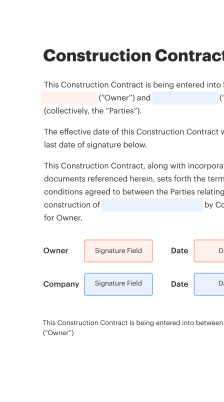
How to create and issue the bill online

An online billing flow lets you generate a general store bill, email or print it, and store a copy for accounting and audits.

  • Create: Choose a template and enter transaction details.
  • Preview: Verify line items and tax calculations.
  • Deliver: Email, print, or send a PDF to the customer.
  • Archive: Save a copy in cloud storage for records.
Collect signatures
24x
faster
Reduce costs by
$30
per document
Save up to
40h
per employee / month

Quick steps to set up a bill template

Follow these essential steps to create a usable general store bill format that supports sales, returns, and accounting.

  • 01
    Header details: Include store name, address, and contact.
  • 02
    Transaction data: Add invoice number, date, and cashier ID.
  • 03
    Line items: List SKU, description, quantity, and unit price.
  • 04
    Totals and taxes: Show subtotals, tax lines, discounts, and grand total.

Managing audit trails for bills

Maintain clear audit logs showing who created, edited, or accessed bills and when those events occurred.

01

Create log:

Record bill creation details.
02

Edit history:

Capture every modification event.
03

Viewer records:

Log access and downloads.
04

Export logs:

Provide audit-ready exports.
05

Retention policy:

Apply configured retention rules.
06

Compliance flagging:

Flag records for review.
be ready to get more

Why choose airSlate SignNow

  • Free 7-day trial. Choose the plan you need and try it risk-free.
  • Honest pricing for full-featured plans. airSlate SignNow offers subscription plans with no overages or hidden fees at renewal.
  • Enterprise-grade security. airSlate SignNow helps you comply with global security standards.
illustrations signature

Workflow settings for automated billing

Configure these workflow settings to automate bill generation, notifications, and archival, reducing manual steps and improving consistency.

Feature Configuration
Auto-generate invoice numbers Sequential
Daily backup schedule 02:00 AM
Reminder frequency 48 hours
Archive destination Cloud storage
Retention policy 4 years

Device compatibility and requirements

General store bill formats should be accessible from desktop POS systems, tablets, and mobile devices to support in-store and curbside transactions.

  • Desktop: Windows and macOS support
  • Tablet: iOS and Android compatibility
  • Mobile: Responsive web and apps

Ensure printers, barcode scanners, and network connections are validated across devices, and test the bill template layout on each form factor to confirm legibility and proper field alignment before deploying.

Document protections and authentication

Access controls: Role-based access
Audit logging: Detailed change record
Digital signatures: Verifiable signer identity
Encryption: Data encrypted at rest
Data retention: Configurable retention rules
Two-factor: Optional MFA for users

Real-world scenarios using a standard bill format

Two practical examples show how a consistent general store bill format streamlines sales, taxes, and customer issues.

Local Grocer

A neighborhood grocery replaced handwritten receipts with a printed bill template that lists itemized produce and packaged goods.

  • Reduced manual entry errors.
  • Faster end-of-day reconciliation.

Leading to clearer tax reporting and fewer customer disputes.

Electronics Kiosk

A small electronics kiosk uses a bill format including serial numbers, warranty terms, and service contact information.

  • Provides proof for returns.
  • Simplifies warranty claims and service tracking.

Resulting in faster repairs and improved customer trust.

Best practices for accurate store billing

Adopt consistent template rules and verification steps to reduce errors and improve compliance when issuing general store bills.

Use standardized item codes and clear descriptions
Ensure each line item uses SKU or code and a concise description to prevent ambiguity during inventory reconciliation, returns, or tax audits, and maintain consistency across sales channels and reporting.
Validate taxes and discounts automatically
Configure tax rates by jurisdiction and apply discount logic at the point of sale to prevent manual miscalculations and ensure the bill reflects the correct amounts charged to customers.
Include unique invoice numbers and timestamps
Sequential invoice numbers and accurate timestamps simplify audit trails, enable quick transaction lookups, and support reliable bookkeeping and tax reporting practices.
Retain digital copies with access controls
Store bills in a secure cloud repository with role-based access and retention policies to protect customer data and meet recordkeeping obligations while facilitating retrieval for disputes or audits.

FAQs About general store bill format

Common questions and clear answers about creating, delivering, and storing a general store bill format.

Feature availability across eSignature platforms

A concise comparison of key capabilities relevant to signing or approving bills across common eSignature vendors.

Feature signNow (Recommended) DocuSign Adobe Sign
API access
Bulk Send
Native Google integration
Per-user pricing Lower-cost tiers Standard tiers Higher tiers
be ready to get more

Get legally-binding signatures now!

Recordkeeping timeline and retention guidance

Set clear retention and review dates to meet accounting, tax, and audit requirements for transactional records.

Daily reconciliation checkpoint:

Reconcile sales each business day.

Monthly accounting close:

Complete ledger entries within 7 days.

Quarterly tax review:

Verify tax totals each quarter.

Annual archive:

Archive prior year bills yearly.

Retention period:

Keep records for at least four years.

Risks of inadequate billing practices

Tax fines: Penalties may apply
Audit exposure: Increased scrutiny risk
Charge disputes: More customer claims
Inventory loss: Reconciliation errors
Data breaches: Customer data risks
Operational delays: Slower accounting processes

Representative pricing and plan details

A high-level pricing comparison for common eSignature providers to inform budgeting decisions for bill signing and storage workflows.

Starting price signNow (Recommended) $8/user/month DocuSign $10/user/month Adobe Sign $13/user/month HelloSign (Dropbox Sign) $15/user/month PandaDoc $19/user/month
Free tier availability No free tier, trial available Trial available Trial available Limited free tier Trial available
Advanced fields included Yes, templates and fields Yes, templates and fields Yes, form fields Yes, basic fields Yes, rich fields
Bulk sending support Included on select plans Add-on or higher plan Higher-tier plans Higher-tier plans Included on select plans
API access Included on most plans Included, limits apply Included with Adobe account Included on paid plans Included on paid plans
Enterprise options Available with advanced controls Available with enterprise suite Available with enterprise contract Available for teams Available with custom pricing
walmart logo
exonMobil logo
apple logo
comcast logo
facebook logo
FedEx logo
be ready to get more

Get legally-binding signatures now!