Hospital Billing Format for Client Management

airSlate SignNow simplifies document management with eSigning and secure sharing, helping you save time and reduce costs.

Award-winning eSignature solution

What a hospital billing format for client for sales entails

A hospital billing format for client for sales is a structured document template or workflow used to present charges, itemized services, payment terms, and signature fields to patients, payers, or sales clients involved in healthcare transactions. It combines clear line-item billing, standard CPT/ICD references where applicable, payer information, and customer agreement elements so invoices can be reviewed and signed electronically. When integrated with an eSignature and document workflow platform, these formats streamline collections, maintain an auditable signing record, and support electronic acceptance under U.S. laws such as ESIGN and UETA while accommodating HIPAA privacy controls.

Why use a standardized hospital billing format for client for sales

Standardized billing formats reduce errors, speed approvals, and create consistent records for billing and collections. They support clearer communication with clients and payers while enabling reliable electronic signing and lifecycle management.

Why use a standardized hospital billing format for client for sales

Key features for accurate hospital billing format for client for sales

Effective billing formats pair template controls with workflow features to reduce rework, enforce approvals, and preserve an evidentiary record of delivery and acceptance.

Template Library

Centralized, reusable templates allow finance and sales teams to maintain standardized billing formats with preconfigured fields, calculations, and conditional content to ensure consistent itemization across clients and payer types.


Calculated Fields

Built-in field logic performs discounts, tax, and adjustments automatically, reducing manual calculation errors and ensuring invoice totals remain consistent with configured pricing rules and payer requirements.

Bulk Send

Bulk Send enables sending the same billing format to many recipients with individualized data injection, which accelerates mass billing cycles for groups such as outpatient services or recurring client invoices.

Audit Trail

A tamper-evident audit trail records every access, view, and signature event with timestamps and IP data, providing thorough documentation for collections and compliance reviews.

Integrations

Prebuilt connectors and APIs let the billing format import patient and pricing data directly from EHRs, CRMs, or billing systems to reduce duplicate entry and synchronization errors.

Role Permissions

Role-based access restricts who can edit, send, or approve billing formats, enforcing separation of duties and secure handling of financial and protected health information.

be ready to get more

Choose a better solution

Integrations that streamline billing delivery and reconciliation

Connect billing templates to common document, storage, and CRM systems to automate population and reconciliation during the sales-to-billing handoff.

Google Docs

Two-way integration allows billing templates to be drafted in Google Docs and automatically converted with mapped fields for signature collection, reducing format conversion work while preserving document history for audit purposes.

CRM Sync

CRM integration imports client details and sales terms into the billing format, attaches signed invoices back to account records, and updates opportunity or contract status to maintain a single source of truth.

Cloud Storage

Dropbox and other storage integrations archive signed billing documents automatically using your existing folder structure, enabling backup and retention control consistent with finance policies.

Custom API

A secure API lets billing systems push finalized invoice data and pull signed PDFs programmatically for automated reconciliation and posting to general ledger systems.
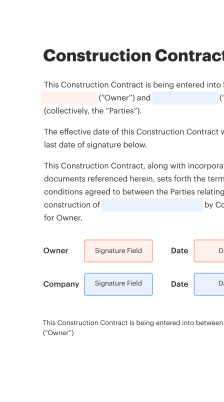
How to create and use your hospital billing format online

An online workflow lets you assemble, populate, send, and collect signatures on billing documents from any browser or device while keeping logs and attachments centralized.

  • Upload: Import your billing template or a PDF into the platform.
  • Annotate: Add signature, initial, date, and payment fields as needed.
  • Send: Deliver via email or Bulk Send to recipients.
  • Record: Capture a tamper-evident audit trail for every transaction.
Collect signatures
24x
faster
Reduce costs by
$30
per document
Save up to
40h
per employee / month

Quick setup steps to prepare a billing format

Follow these core steps to create a compliant billing format and prepare it for electronic delivery and signature.

  • 01
    Create template: Design the invoice layout with required fields and itemization.
  • 02
    Map fields: Assign data fields for patient, payer, and pricing information.
  • 03
    Set routing: Define signer order and approval checkpoints for the document.
  • 04
    Enable audit: Turn on signature logs and retention policies before sending.

Audit trail setup and record-keeping checklist

Implementing a clear audit trail supports legal defensibility and operational transparency for billing transactions.

01

Enable logging:

Activate detailed event capture for documents.
02

Record signer ID:

Capture authenticated signer identity.
03

Timestamp entries:

Store precise date and time data.
04

Save IP data:

Log IP addresses for access events.
05

Preserve versions:

Retain each document revision history.
06

Exportability:

Allow audit logs to be exported.
be ready to get more

Why choose airSlate SignNow

  • Free 7-day trial. Choose the plan you need and try it risk-free.
  • Honest pricing for full-featured plans. airSlate SignNow offers subscription plans with no overages or hidden fees at renewal.
  • Enterprise-grade security. airSlate SignNow helps you comply with global security standards.
illustrations signature

Recommended workflow configuration for billing format automation

Configure workflow settings to match your billing cycle, approval needs, and legal retention obligations before moving to production.

Setting Name Configuration
Default reminder email interval 48 hours
Approval chain length Two approvers
Routing preference Sequential
Automatic retry attempts 3 attempts
Document retention period 365 days

Supported platforms and device compatibility

Most modern billing workflows run through standard web browsers and native mobile apps so staff and clients can access invoices on desktop and handheld devices.

  • Web browsers: Chrome, Safari, Edge supported
  • Mobile apps: iOS and Android native clients
  • Offline access: Limited draft and view capability

Ensure your billing team uses supported browser versions and keeps mobile apps updated to maintain security, access to advanced signing features, and consistent rendering of itemized billing fields on all devices.

Security controls for billing documents

Encryption at rest: AES-256 encryption
Encryption in transit: TLS 1.2+ secured channels
Access controls: Role-based permissions
Audit logging: Immutable signature logs
HIPAA support: BAA available
Data residency: Selectable US regions

Industry use cases for billing formats in clinical and sales settings

Real-world examples show how standardized billing formats reduce friction between clinical, finance, and client sales workflows.

Outpatient clinic collections

A community outpatient clinic converted its paper invoices to an electronic hospital billing format for client for sales that prepopulated CPT codes and patient balances

  • Integrated the format with the clinic EHR for automated field population
  • Reduced denial-causing errors and sped collection cycles

Leading to measurable reduction in days outstanding and fewer billing disputes.

Vendor sales invoicing

A healthcare vendor standardized sales invoices into a single billing format that included line-item service descriptions and payment terms

  • Mapped CRM opportunity fields into invoice templates for accuracy
  • Reduced manual consolidation time and expedited client approvals

Resulting in faster revenue recognition and clearer audit trails for contract compliance.

Best practices for secure and accurate hospital billing format for client for sales

Follow consistent policies and technical safeguards to maintain accuracy, compliance, and defensible records for billing and signature workflows.

Standardize templates and fields across teams
Maintain a locked template library for billing formats and use field-level validations to prevent manual entry errors. Version control should be enforced so any template change is reviewed and approved by finance and compliance before going live.
Enforce multi-step approvals for high-value invoices
Configure routing so high-dollar bills require review by both clinical billing and revenue staff. This separation of duties reduces overbilling risks and creates clear accountability during dispute resolution.
Log and retain full audit trails
Ensure every send, view, and signature event is recorded with identity and timestamp information. Retain signed invoices and logs according to legal and payer-specific retention rules to support audits and appeals.
Protect PHI and limit access
Apply role-based permissions, encrypt stored documents, and sign a BAA with your eSignature provider if handling protected health information to align with HIPAA requirements.

FAQs about hospital billing format for client for sales

Answers to common questions on legality, compliance, and practical setup for billing formats and electronic signatures.

Digital signing capabilities: signNow versus other providers

Compare essential capabilities for hospital billing format for client for sales across leading eSignature platforms to determine fit for compliance and operations.

Feature signNow (Recommended) DocuSign Adobe Acrobat Sign
HIPAA support
ESIGN/UETA validity
Audit trail detail Detailed logs Detailed logs Basic logs
Bulk Send capacity High-volume High-volume Medium-volume
be ready to get more

Get legally-binding signatures now!

Retention and deadline checklist for billing formats

Use a dated schedule to manage submission windows, retention, and reconciliation deadlines related to billing formats and signed invoices.

Claims submission window:

90 days typical timeframe

Payment posting period:

30 days for reconciliation

Invoice dispute window:

60 days to raise disputes

Document retention start:

Retention begins on signature date

Audit record export:

Quarterly exports recommended

Common risks and potential penalties for improper billing

Claim denials: Incorrect invoices
Regulatory fines: HIPAA or billing violations
Payment disputes: Missing acceptance records
Data breaches: Unauthorized access
Revenue loss: Delayed collections
Audit failures: Incomplete logs

Pricing and plan comparisons for billing workflows

Summary of entry-level pricing models and capabilities that affect total cost of ownership for billing formats and eSignature workflows.

Plan signNow (Featured) DocuSign Adobe Acrobat Sign HelloSign PandaDoc
Starting price From $8/user/month From $10/user/month From $9.99/user/month From $15/user/month From $19/user/month
Free tier available Limited free trial Limited free trial Free trial Free plan Free trial
Bulk Send availability Included with plans Add-on or higher plan Included in business plans Add-on feature Included in advanced plans
HIPAA compliance BAA available BAA available BAA available Limited support BAA available
API access Included Included Included Included Included
walmart logo
exonMobil logo
apple logo
comcast logo
facebook logo
FedEx logo
be ready to get more

Get legally-binding signatures now!