Custom Fields
Customizable line items, metadata, and client-specific fields allow billing templates to capture contract IDs, purchase orders, and internal tracking codes for accurate accounting and reconciliation.



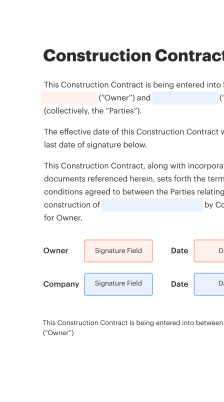
A consistent online billing format reduces disputes, accelerates payment cycles, and simplifies bookkeeping by ensuring every invoice contains the required client details, terms, and payment options for predictable processing.

Responsible for designing templates, validating data mappings, and overseeing invoice delivery and collections processes; typically coordinates with accounting and IT to ensure integration, compliance, and reporting across the billing lifecycle.
Uses simplified templates and payment links to issue invoices, track payment status, and maintain records; favors solutions that minimize setup overhead while providing reliable audit logs and easy reconciliation with bank statements.
Customizable line items, metadata, and client-specific fields allow billing templates to capture contract IDs, purchase orders, and internal tracking codes for accurate accounting and reconciliation.
Automatic calculation of quantities, unit prices, discounts, taxes, and totals eliminates manual math errors and ensures every sent invoice reflects correct payable amounts across jurisdictions.
Built-in payment method fields and links support ACH, card payments, and third-party gateways so clients can pay immediately and payments map back to invoices automatically.
Reusable templates let teams maintain legal and branding consistency across invoices, speeding creation while ensuring required billing elements and term language are included.
Immutable logs of deliverability, viewing, acceptance, and signature events provide evidentiary records for disputes, compliance reviews, and internal controls.
Connectors for accounting, CRM, and storage automate invoice population, status synchronization, and archival to reduce duplicate entry and improve cash application workflows.
Template-based population from Google Docs supports collaborative invoice drafting, while merge fields allow automated insertion of client data when generating final billing documents for distribution.
Two-way CRM integration ensures client contact, billing address, and contract terms sync into invoice templates and payment statuses update contact records once payments post.
Direct uploads to cloud storage keep a centralized, auditable archive of issued invoices with retention rules and backup options for compliance and disaster recovery.
Configurable billing templates let teams standardize layout, mandated disclosures, tax treatment, and signature placements to reduce variation and simplify audits.
| Workflow Setting and Configuration Header | Default configuration values used in automation |
|---|---|
| Default Email Reminder Frequency Setting | 48 hours prior to due date |
| Invoice Auto-Approval and Dispatch Delay | Immediate dispatch after generation |
| Late Fee Application Threshold Setting | Apply after 7 days overdue |
| Payment Reconciliation Posting Method | Automatic match by invoice ID |
| Retention and Archive Policy Setting | Archive after 7 years |
Use platforms that render templates and payment links consistently across devices; responsive design and mobile-friendly payment flows reduce friction for clients and accelerate payments.
Ensure the chosen billing workflow provides consistent mobile rendering, accessible payment options, and device-aware authentication; verify signature capture and audit logs function identically on tablet and desktop to maintain evidentiary integrity and client usability.
A SaaS company generates monthly invoices from subscription records, merging usage and discounts into standardized templates
Resulting in faster collections and fewer invoice disputes due to clear line items and unified terms.
A medical group issues patient statements that combine insurance adjustments and copays into a single digital invoice
Leading to improved patient collections, auditable records for compliance, and reduced manual billing corrections.
| Feature Comparison for Signing Options | signNow (Recommended) | DocuSign | Adobe Sign |
|---|---|---|---|
| ESIGN and UETA Legal Compliance (U.S.) | |||
| Comprehensive Audit Trail and Timestamping | Detailed | Detailed | Standard |
| Bulk Sending and Templates Support | Limited | ||
| HIPAA and Healthcare Compliance Options | Configurable | Available | Configurable |
| Cost and Plan Comparison | signNow (Recommended) | DocuSign | Adobe Sign | HelloSign | PandaDoc |
|---|---|---|---|---|---|
| Entry-level plan includes | Unlimited eSignatures, Templates, Mobile apps | Core eSignature with limited templates | eSign included with Adobe Acrobat plans | Basic eSignatures and limited templates | Proposal-focused workflows plus eSignatures and analytics |
| API access and developer tools | REST API with developer sandbox available | Robust API with SDKs and extensive docs | API via Adobe developer ecosystem | API with SDKs and developer docs | API for templates and document generation |
| Bulk sending and high-volume support | Bulk Send at scale with competitive per-envelope pricing | High-volume enterprise tools and tiers | Bulk sending supported in enterprise plans | Bulk send in Business and higher plans | Bulk proposals via template automation features |
| Regulated industries support | Configurable for HIPAA compliance with BAA | Enterprise BAA and controls available | BAA for enterprise customers under agreement | BAA available for enterprise | BAA by request for enterprise deployments |
| Trial and free-tier options | Free trial and low-cost entry plans | Free trial, no permanent free tier | Free trial with Adobe subscription trial | Free tier with limited monthly signatures | Free trial and limited free e-sign plan |