Invoice Format Google Docs for Healthcare

Streamline your billing process with airSlate SignNow's intuitive solution. Experience hassle-free document sending and eSigning tailored for healthcare professionals.

Award-winning eSignature solution

What invoice format Google Docs for healthcare means in practice

An invoice format Google Docs for healthcare is a reusable document layout designed to capture billing details, patient or insurer information, procedure codes, and payment terms while remaining compatible with cloud editing and eSignature workflows. It typically includes fields for provider identifiers, CPT/HCPCS codes, ICD-10 references, payer details, remittance addresses, and line-item charges. Templates built in Google Docs simplify collaboration among billing staff and clinicians, export easily to PDF, and integrate with eSignature providers and practice management systems while supporting U.S. regulatory requirements such as ESIGN and applicable HIPAA safeguards.

Why a standardized Google Docs invoice matters for healthcare billing

A consistent invoice format reduces coding errors, speeds reimbursements, and keeps billing records audit-ready while enabling secure digital signatures and cloud collaboration for remote teams.

Why a standardized Google Docs invoice matters for healthcare billing

Common challenges when using Google Docs for healthcare invoices

  • Maintaining HIPAA-compliant access controls across shared documents can be complex for small clinics.
  • Ensuring accurate CPT/ICD codes and line-item descriptions requires coordination between clinicians and billing staff.
  • Converting collaborative drafts into a locked, signable PDF often introduces formatting or field-mapping errors.
  • Tracking signature status and payment receipt without an audit trail increases administrative follow-up.

Representative user profiles

Medical Biller

A dedicated billing specialist who prepares and submits invoices, reconciles remittances, and follows up on denials. They use Google Docs templates to standardize line-item descriptions and ensure payer-specific requirements are met before converting invoices for signature and submission.

Clinic Manager

Oversees practice operations, approves provider invoices, and coordinates with accounting. The manager reviews editable Google Docs invoice drafts, confirms coding accuracy, and ensures the final signed invoice is stored according to retention policy and audit requirements.

Typical users of Google Docs invoice formats in healthcare

Healthcare billing teams, private practice managers, and outpatient clinic administrators commonly rely on standardized invoice templates in Google Docs.

  • Medical billing specialists managing claims and remittances for multiple payers.
  • Practice managers coordinating provider schedules, invoices, and patient billing questions.
  • Community clinics using cloud templates to share updates among distributed staff.

These templates support collaboration and handoffs while reducing duplicated work and minimizing delays in claims submission.

Core features to include in an invoice workflow for healthcare

Prioritize features that reduce manual effort, support compliance, and make signable invoices usable across systems and audits.

Template management

Centralized template library with version control to ensure every invoice uses the current approved layout and coding conventions.


Field mapping

Automatic mapping between Google Docs fields and eSignature placeholders or EMR export fields to preserve data consistency during conversion and signing.

Secure signing

Support for authenticated signer identity, tamper-evident signatures, and multiple signer routing for provider and payer acknowledgements.

Automated reminders

Configurable notifications for unsigned invoices and outstanding patient or payer actions to reduce turnaround time.

Audit logs

Comprehensive timestamped records of edits, exports, and signatures to support dispute resolution and compliance reviews.

Retention rules

Policy-driven storage with searchable archives and controlled deletion for compliance and space management.

be ready to get more

Choose a better solution

Integrations and templates that matter for healthcare invoices

Choose features that streamline submission, maintain compliance, and reduce manual rework when using Google Docs invoice templates with an eSignature and records platform.

Google Docs sync

Direct integration preserves formatting and allows template updates in Docs while enabling export to signable PDF and mapping of fields for downstream systems.

EMR/PM connectors

Pre-built connectors let you pull patient and encounter data into the invoice template, reducing manual entry and minimizing coding errors during claim preparation.

Cloud storage

Secure storage with retention policies ensures signed invoices are preserved for audits and can be retrieved by authorized staff when needed.

Audit trail

Detailed signature and access logs provide an evidentiary record that supports compliance and dispute resolution without altering the original invoice PDF.
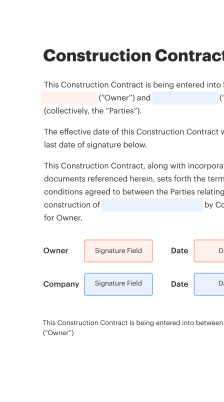
How online use and signing works with your Google Docs invoice

This sequence shows how a Google Docs invoice moves from draft to signed document using cloud export and an eSignature provider.

  • Drafting: Billing staff populate the template in Google Docs.
  • Exporting: Convert to locked PDF for signature compatibility.
  • Signing: Send via an eSignature provider for secure authentication.
  • Archiving: Store signed copies in a controlled cloud repository.
Collect signatures
24x
faster
Reduce costs by
$30
per document
Save up to
40h
per employee / month

Quick setup: create an invoice format in Google Docs

Use this short sequence to create a practice-ready invoice template in Google Docs that aligns with billing and compliance needs.

  • 01
    Create template: Start a new Google Doc with table-based line items.
  • 02
    Add fields: Include provider, patient, CPT/ICD, and payment terms.
  • 03
    Lock format: Freeze layout and export to PDF for signing.
  • 04
    Assign access: Grant role-based edit or view permissions.

Step-by-step: completing and finalizing a Google Docs invoice

Follow these steps to move an invoice from draft to signed, archived, and ready for claims or patient collection.

01

Populate data:

Enter patient, encounter, and line-item details.
02

Verify codes:

Confirm CPT and ICD-10 accuracy.
03

Lock layout:

Export to PDF to prevent edits.
04

Route for signature:

Send to provider or payer as required.
05

Confirm receipt:

Track open and signed status.
06

Archive:

Store signed PDF with metadata.
be ready to get more

Why choose airSlate SignNow

  • Free 7-day trial. Choose the plan you need and try it risk-free.
  • Honest pricing for full-featured plans. airSlate SignNow offers subscription plans with no overages or hidden fees at renewal.
  • Enterprise-grade security. airSlate SignNow helps you comply with global security standards.
illustrations signature

Recommended workflow settings for automated invoice processing

These workflow settings support a controlled, auditable invoice lifecycle with automated reminders and routing.

Setting Name Configuration
Automatic reminders 48 hours
Signer authentication level Email + SMS
Document retention period 6 years
Export format PDF/A
Post-sign archival Automatic

Mobile, tablet, and desktop considerations for invoice workflows

Ensure device compatibility and secure access methods so staff can draft, review, and sign invoices across platforms.

  • Desktop: Full editor support
  • Tablet: Responsive viewing and signing
  • Mobile: Quick approvals and signature capture

Standardize browser versions and mobile OS policies, require secure Wi-Fi or VPN access for remote edits, and use mobile-friendly signing flows to maintain compliance and productivity across devices.

Security and protection elements to include

Access controls: Role-based sharing
Document encryption: In-transit and at-rest
Audit logging: Comprehensive trails
Authentication: Multi-factor options
Redaction tools: Protected PHI removal
Retention controls: Policy-based deletion

Real-world examples of invoice formats in healthcare workflows

Two concise case examples illustrate how clinics use Google Docs invoice templates combined with digital workflows to improve billing efficiency.

Community Clinic billing

A community clinic standardized its invoice Google Doc template to include payer-specific line items and a provider signature block

  • Template maps CPT and ICD codes to line items for consistent claims
  • Reduced coding queries from payers and accelerated insurance reimbursements

Resulting in faster cash flow and fewer manual corrections during reimbursement cycles.

Specialty practice collections

A specialty outpatient practice adopted a Google Docs invoice layout that integrates estimated patient responsibility and insurance coverage notes

  • The template includes fields for pre-authorizations and secondary payer information
  • Patients receive clear, itemized statements and sign digitally for payment agreements

Leading to higher patient payment rates and clearer audit records for compliance reviews.

Best practices for preparing healthcare invoices in Google Docs

Follow practical formatting, access, and workflow rules to keep invoices accurate, auditable, and compliant with U.S. legal requirements.

Use structured tables and consistent codes
Design invoice templates with fixed table columns for quantity, CPT/HCPCS codes, unit price, modifiers, and ICD-10 references to minimize misalignment during PDF conversion and claims submission.
Apply role-based document sharing
Limit edit permissions to billing staff and reviewers, grant view-only access to providers when necessary, and require authenticated sign-ins to reduce unauthorized changes to invoice drafts.
Keep an audit-friendly final format
Export signed invoices to non-editable PDFs and store them with signature metadata and timestamps to preserve evidentiary integrity for internal audits and payer inquiries.
Document retention and deletion policies
Define retention periods that meet regulatory and payer requirements, automate backups, and schedule secure deletion to reduce liability and storage costs.

FAQs and common troubleshooting for invoice formats

Answers to frequent problems encountered when preparing, signing, and storing Google Docs invoice templates in healthcare settings.

Feature comparison: signNow and leading eSignature vendors

A concise comparison of key capabilities relevant to Google Docs invoice workflows in healthcare; signNow is listed first as Recommended.

Criteria signNow (Recommended) DocuSign Adobe Sign
HIPAA support
Google Docs integration Limited
Bulk Send
Audit trail details Extensive Extensive Extensive
be ready to get more

Get legally-binding signatures now!

Operational steps for timely invoice processing

Sequence the tasks that keep invoice lifecycles on schedule, from draft to payment reconciliation.

01

Draft creation

Assign within 24 hours of service

02

Coding review

Complete within 48 hours

03

Manager approval

Approve within 72 hours

04

Export and sign

Send within one week

05

Submission to payer

Submit within payer deadline

06

Follow-up

30-day claim status check

07

Reconciliation

Post payments within 7 days

08

Archival

Move to long-term storage

Retention and important timing milestones for invoicing

Track key dates to meet payer deadlines, audit windows, and internal retention requirements for signed invoices and financial records.

Claims submission deadline:

Varies by payer; often 90 days to one year

Audit request window:

Maintain records for at least six years

Payment posting timeframe:

Typically 30 to 60 days

Retention policy review:

Annually

Document deletion schedule:

After retention period ends

Compliance risks and potential penalties

HIPAA violations: Civil fines
Data breaches: Patient harm
Incorrect billing: Claim denials
Unauthorized access: Regulatory action
Retention failures: Legal exposure
Fraud allegations: Criminal risk

Pricing and plan highlights for eSignature options used with Google Docs

Price and plan characteristics for common eSignature providers; signNow appears first and is labeled Recommended. Values denote typical plan characteristics or entry-level plan notes.

Pricing Item signNow (Recommended) DocuSign Adobe Sign HelloSign PandaDoc
Free tier or trial Free trial available Free trial available Free trial available Free plan limited Free trial available
Entry-level price Starting affordable monthly plan Mid-tier monthly price Mid-tier monthly price Lower mid-tier monthly Mid-tier monthly
Bulk Send included Included on select plans Add-on or higher plan Included on business plans Add-on Included on business plans
HIPAA support Available via BAA Available via BAA Available via BAA Available via BAA Available via BAA
API availability Developer API available Developer API available Developer API available Developer API available Developer API available
walmart logo
exonMobil logo
apple logo
comcast logo
facebook logo
FedEx logo
be ready to get more

Get legally-binding signatures now!