Invoice Tracker Template for Staffing

Boost productivity and maintain accuracy with our user-friendly solution for managing invoices and eSignatures. Stay organized and save time with every document.

Award-winning eSignature solution

What an invoice tracker template for staffing does and why it matters

An invoice tracker template for staffing is a standardized document designed to record, reconcile, and manage invoices associated with temporary and contract workforce placements. It centralizes billable hours, placement fees, pay rates, client billing codes, payment terms, and invoice status fields so staffing teams and finance can track outstanding balances and payments. In digital form the template integrates with eSignature and workflow tools to reduce manual entry, improve traceability, and support audit-ready records for client invoicing and compliance in U.S. operations.

Why a structured invoice tracker helps staffing operations

A consistent invoicing template reduces errors, shortens billing cycles, and improves visibility into receivables so agencies can reconcile placements faster and reduce payment delays.

Why a structured invoice tracker helps staffing operations

Common invoicing challenges in staffing

  • Multiple timesheets and client price rates cause frequent mismatches between billed and payable amounts, delaying reconciliation.
  • Manual data entry increases risk of missed fees, incorrect pay rates, and duplicated invoices across clients and job orders.
  • Tracking approvals and signed authorizations across email chains makes it difficult to prove final client acceptance for audit purposes.
  • Inconsistent invoice formats hinder integration with accounting systems, creating extra work for AP teams and delaying cash flow.

Typical user profiles and roles

Billing Specialist

A billing specialist prepares and issues invoices using the tracker template, validates placement fees and billable hours, and follows up on past-due accounts. They coordinate with recruiters and payroll to ensure accuracy before sending final invoices to clients for approval.

Recruiter / Account Manager

Recruiters or account managers supply placement details, confirm client rates, and review the invoice entry for each assignment. They use the tracker to document approvals and client signoffs, ensuring billable items match placement agreements.

Who typically uses an invoice tracker template for staffing

Staffing agencies, recruitment operations, and finance teams use invoice trackers to standardize billing and manage receivables.

  • Recruiting operations teams that manage candidate placements and need consistent billing records for each client account.
  • Accounts receivable teams reconciling payments and matching invoices to bank deposits and accounting entries.
  • Client account managers who verify hours, fees, and approvals before finalizing invoices for submission.

Small agencies and large enterprise staffing firms both rely on templates to ensure timely collection and to support auditing workflows.

Key features to look for in an invoice tracker template for staffing

Effective templates combine data capture, calculations, approvals, integrations, security, and reporting so staffing firms can manage billing reliably and at scale.

Predefined fields

Standardized fields for client PO, placement ID, candidate details, billable hours, and markup reduce manual errors and enable consistent exports to accounting systems for reconciliation and reporting.


Automated calculations

Built-in formulas to compute totals, taxes, and markups eliminate manual arithmetic and ensure billing accuracy across hourly, weekly, or fixed-fee placements in staffing contexts.

Approval workflows

Configurable routing of invoices for internal review and client signoff ensures each invoice has the necessary authorizations before submission and supports dispute resolution if needed.

Audit trail

Comprehensive logging of edits, approvals, and signatures provides an immutable record for internal controls and external audits, capturing timestamps, IPs, and signer identities.

Integrations

Connectors to payroll, accounting, CRM, and cloud storage systems automate data transfer and reduce duplicate entry, improving the speed and accuracy of invoice processing.

Role controls

Granular permissions let administrators limit who can create, edit, sign, or export templates, which protects financial data and enforces separation of duties.

be ready to get more

Choose a better solution

Common integrations and document features for staffing invoice templates

Integrations improve accuracy and reduce manual reconciliation by connecting the template to systems you already use across recruiting and finance.

Google Workspace

Two-way integration that lets teams populate invoice templates from Google Sheets or Docs, pull candidate and placement data automatically, and save signed PDFs back to Drive for centralized storage and audit continuity.

CRM integration

Sync client account details and purchase orders from CRM systems so the invoice template auto-fills bill-to addresses, PO numbers, and client-specific billing rules, reducing manual lookups.

Accounting systems

Push finalized invoice data to systems like QuickBooks or NetSuite to automate AR posting and reduce duplicate data entry while ensuring consistent GL mapping and payment reconciliation.

Cloud storage

Save signed invoices to Dropbox or other cloud repositories with folder rules that mirror client accounts, enabling retention policies and easy retrieval for audits.
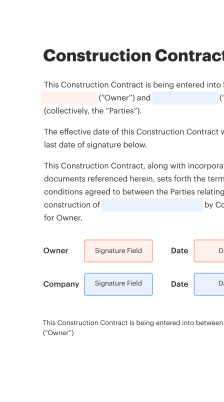
How an online invoice tracker template typically operates

This sequence explains the typical flow from data entry to signed invoice delivery for staffing invoices.

  • Data entry: Populate placement and timesheet details into the template fields.
  • Validation: Run automated checks for missing fields and arithmetic errors.
  • Approval: Route the invoice for internal or client approvals and signatures.
  • Archive: Store the signed invoice with audit trail for retention and reporting.
Collect signatures
24x
faster
Reduce costs by
$30
per document
Save up to
40h
per employee / month

Quick setup: create and deploy an invoice tracker template

Follow these concise steps to configure a template suitable for common staffing billing scenarios and to get the first invoices out.

  • 01
    Define fields: Identify required fields such as placement ID, client PO, hours, rate, markup, and terms.
  • 02
    Build template: Create a reusable document with locked field positions and calculation formulas where needed.
  • 03
    Set approvals: Configure the approval sequence and required signers for client acceptance.
  • 04
    Integrate: Connect to accounting or CRM systems for automated export and reconciliation.

Audit trail and recordkeeping steps for invoice transactions

Maintain a consistent audit trail for each invoice to support client disputes, internal controls, and regulatory audits.

01

Capture edits:

Log who changed invoice fields and when
02

Record approvals:

Timestamp client and internal approvals
03

Store signed PDF:

Archive final signed version as PDF
04

Maintain metadata:

Keep invoice ID, PO, and GL codes
05

Export audit logs:

Provide logs for accounting reconciliation
06

Retention policies:

Apply legal retention schedules
be ready to get more

Why choose airSlate SignNow

  • Free 7-day trial. Choose the plan you need and try it risk-free.
  • Honest pricing for full-featured plans. airSlate SignNow offers subscription plans with no overages or hidden fees at renewal.
  • Enterprise-grade security. airSlate SignNow helps you comply with global security standards.
illustrations signature

Recommended workflow configuration for invoice tracker templates

Use these workflow settings to standardize routing, reminders, and retention so invoices move predictably through validation to payment.

Workflow Setting Name and Description Default configuration values and options
Reminder Frequency and Escalation Rules Every 48 hours until signed
Approval Sequence and Required Roles Recruiter, Billing Specialist, Client Approver
Signature Method and Authentication Email-based signature with optional 2FA
Retention Period and Archival Retain seven years for compliance
Export Format and Accounting Sync CSV export or direct API push

Device and platform considerations for using the template

The invoice tracker template is usable across common devices but requires compatible browsers or apps and reliable internet for signing and syncing.

  • Desktop browsers: Chrome, Edge, Safari supported
  • Mobile devices: iOS and Android apps available
  • Offline access: Limited; requires reconnection for final signing

For teams that rely on field-based timesheet collection, mobile access and automatic sync to cloud storage is essential; ensure your chosen eSignature and document platform supports in-app uploads, authentication, and server-side backups to protect records and meet retention policies.

Security and compliance controls relevant to invoice templates

Transport encryption: TLS 1.2+ for data in transit
Data encryption at rest: AES-256 encrypted storage
Two-factor authentication: Optional 2FA for user accounts
Audit logging: Immutable event trails for records
ESIGN and UETA: Meets U.S. eSignature legal standards
HIPAA considerations: Configurable controls for health data

Real-world staffing scenarios using an invoice tracker template

Two sample scenarios illustrate how templates streamline billing, approvals, and audit requirements in different staffing contexts.

Temporary Healthcare Staffing

A regional healthcare staffing firm uses the invoice tracker template to consolidate nurse shift logs and placement fees into a single invoice per client week

  • Template fields capture shift dates, hours, and facility billing codes
  • The finance team validates totals against payroll and client purchase orders to prevent mismatches

Resulting in faster client approvals, fewer disputes, and clearer audit records for compliance with healthcare billing requirements.

IT Contract Placement

An IT staffing agency standardizes contractor billings across multiple projects by requiring recruiters to complete the invoice tracker template for each engagement

  • The template includes billable rate, markup, client PO, and milestone billing sections
  • Combined with a digital approval step, it ensures project managers confirm deliverables before invoicing

Ensures consistent billing across projects, reduces invoicing disputes, and shortens the time between delivery and payment.

Best practices for secure and accurate staffing invoices

Apply consistent controls and verification steps to reduce disputes and maintain a defensible billing record for clients and auditors.

Standardize fields and templates across teams
Use a single approved template for all client billings to reduce variance. Lock critical calculation fields and make optional fields explicit to prevent accidental deletion. Document the template version and change history so auditors can see which template generated each invoice.
Require documented approvals before finalizing invoices
Implement an approval workflow where recruiters, billing, and client approvers each confirm relevant details. Capture digital signatures and timestamps to provide proof of client acceptance and to minimize dispute windows.
Integrate with payroll and accounting systems
Automate data transfer from timesheet and payroll systems to the invoice template to reduce duplicate entry and reconciliation errors. Map fields consistently to general ledger codes to streamline month-end closing.
Maintain clear retention and backup policies
Store signed invoices and audit logs in encrypted cloud storage with defined retention periods. Ensure backups are regularly tested and that restore procedures exist for compliance and litigation readiness.

Frequently asked questions and troubleshooting for invoice templates

Answers to common questions help teams avoid delays and resolve issues when an invoice tracker template does not behave as expected.

Feature availability comparison for eSignature and template platforms

A concise comparison of platform capabilities relevant to staffing invoice templates and electronic signing in the U.S.

Criteria signNow (Recommended) DocuSign Adobe Acrobat Sign
ESIGN/UETA legal validity
Bulk Send for multiple recipients Yes, supports CSV Yes, supports batch sends Yes, supports bulk actions
API access for automation REST API available REST API available REST API available
HIPAA-specific controls Configurable Available via enterprise Available via enterprise
be ready to get more

Get legally-binding signatures now!

Pricing and plan feature snapshot across major eSignature vendors

Overview of trial availability, starting price guidance, and feature presence for platforms commonly used with invoice tracker templates.

Pricing Comparison: Vendors signNow (Recommended) DocuSign Adobe Acrobat Sign PandaDoc HelloSign
Free Trial Yes (14-day trial) Yes (30-day trial) Yes (30-day trial) Yes (14-day trial) Yes (30-day trial)
Base Plan Starting Price From $8/user/month From $10/user/month From $14/user/month From $19/user/month From $15/user/month
Enterprise support Available with enterprise plan Available with enterprise plan Available with enterprise contracts Available with enterprise plan Available with enterprise plan
Single sign-on (SSO) Included on business/enterprise Included on business tiers Included on enterprise Available on business tiers Available on business tiers
API and developer tools Full REST API and SDKs Full REST API and SDKs Full REST API and SDKs Full REST API and SDKs REST API available
walmart logo
exonMobil logo
apple logo
comcast logo
facebook logo
FedEx logo
be ready to get more

Get legally-binding signatures now!