Itemized Receipt Example for Financial Services

See your invoice workflow turn quick and seamless. With just a few clicks, you can execute all the required steps on your itemized receipt example for Financial Services and other important files from any device with internet access.

Award-winning eSignature solution

What an itemized receipt looks like for financial services

An itemized receipt example for financial services shows each line item related to a transaction: fees, principal amounts, taxes, service charges, and any adjustments. It should include clear descriptions, dates, unique transaction or invoice numbers, payer and payee identifiers, and totals that reconcile to the payment method. In digital workflows, receipts often embed metadata for audit trails and reference to related contracts or statements. Well-formed itemized receipts reduce disputes, support accounting reconciliation, and meet documentation needs for internal controls and external audits in regulated financial environments.

Why use an itemized receipt in financial services

An itemized receipt improves transparency by listing every charge and adjustment clearly, aiding reconciliations and customer inquiries while supporting regulatory and audit requirements.

Why use an itemized receipt in financial services

Common challenges when producing itemized receipts

  • Inconsistent line descriptions across systems create reconciliation gaps and customer confusion.
  • Missing invoice or transaction identifiers hinder traceability during audits or dispute resolution.
  • Manual formatting increases processing time and introduces transcription errors into financial records.
  • Inadequate retention or archive practices expose organizations to compliance and regulatory risk.

Typical user roles and responsibilities

Accounting Manager

Responsible for overseeing receipt templates, ensuring line-item accuracy, and reconciling totals to the general ledger. This role coordinates with operations to correct recurring formatting issues and establishes retention rules for audit readiness.

Client Services

Handles customer-facing receipt communications, answers line-item queries, and escalates disputes. They require clear, consistent receipt formatting and access to archived receipts to resolve client inquiries quickly.

Who relies on itemized receipts in financial operations

Financial institutions, payment processors, accounting teams, and client service departments commonly generate and review itemized receipts to support transactions and customer communications.

  • Retail banking branches and online portals issuing transaction receipts to customers.
  • Accounts payable and receivable teams reconciling payments and ledger entries.
  • Regulatory compliance units and auditors verifying fee disclosures and tax treatment.

Recipients include retail customers, corporate clients, and internal auditors who depend on clear, line-level detail for verification and recordkeeping.

Advanced capabilities that improve receipt workflows

Beyond basic templating, advanced receipt workflows offer automation, integrations, verification, and reporting that reduce manual effort and strengthen controls.

Bulk Send

Send thousands of receipts in a single operation using data-driven templates, enabling timely distribution for high-volume transaction days without manual intervention.


API Integrations

Programmatic creation and delivery of receipts through REST APIs let core banking or billing systems generate receipts in real time during transaction processing.

Identity Verification

Optional ID checks or knowledge-based authentication for recipients ensure secure access to receipts containing sensitive financial data.

Audit Trails

Immutable event logs capture creation, delivery, access, and any modifications to a receipt for regulatory exam readiness and internal review.

Custom Calculations

Template-level formula fields compute prorations, taxes, or pro-rata interest to present accurate line-level charge calculations automatically.

Searchable Archive

Full-text indexing and metadata search allow rapid retrieval of receipts by account number, date range, or transaction ID for support and audit purposes.

be ready to get more

Choose a better solution

Essential features for accurate itemized receipts

A reliable itemized receipt workflow should include templating, data mapping, secure delivery, and archive capabilities to meet operational and compliance needs.

Template fields

Customizable fields let teams predefine line-item labels, calculation formulas, and required metadata so receipts consistently capture all necessary transaction details across accounts and products.

Data mapping

Automated mapping imports transaction exports or API payloads directly into receipt templates, reducing manual entry and ensuring each line item references ledger IDs and fee codes accurately.

Secure delivery

Encrypted email delivery and authenticated portal access ensure receipts are transmitted and accessed securely, preserving confidentiality for sensitive financial information and supporting compliance.

Archival and retention

Configurable retention schedules and searchable archives allow teams to meet regulatory retention requirements and retrieve historical receipts for audits or client inquiries.
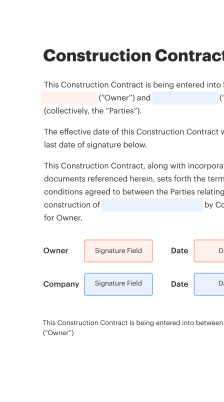
How digital itemized receipts work in an online workflow

Digital receipts integrate transaction metadata, template fields, and signing or delivery steps to produce a verifiable line-item record for both sender and recipient.

  • Template mapping: Map data fields to receipt line items.
  • Data ingestion: Import transaction records from core systems.
  • Rendering: Generate a PDF or HTML receipt with metadata.
  • Delivery and storage: Send to recipient and archive in the document store.
Collect signatures
24x
faster
Reduce costs by
$30
per document
Save up to
40h
per employee / month

Step-by-step: prepare an itemized receipt example

Follow these concise steps to assemble a compliant and clear itemized receipt suitable for financial services use and audit needs.

  • 01
    Collect transaction data: Gather IDs, dates, and payment method details.
  • 02
    List line items: Add fees, principal, taxes, and adjustments separately.
  • 03
    Calculate totals: Verify line sums reconcile to the payment amount.
  • 04
    Embed references: Include invoice numbers and related contract references.

Grid: verification and delivery checklist

Use this checklist to verify receipt accuracy, authorization, and successful delivery before archiving.

01

Verify identifiers:

Confirm transaction and account IDs match the ledger.
02

Confirm calculations:

Recompute totals and tax amounts for accuracy.
03

Apply signatures:

Add authorized sign-off where required.
04

Secure delivery:

Choose encrypted delivery or authenticated portals.
05

Log events:

Record creation, delivery, and access events.
06

Archive copy:

Store final PDF and metadata in retention store.
be ready to get more

Why choose airSlate SignNow

  • Free 7-day trial. Choose the plan you need and try it risk-free.
  • Honest pricing for full-featured plans. airSlate SignNow offers subscription plans with no overages or hidden fees at renewal.
  • Enterprise-grade security. airSlate SignNow helps you comply with global security standards.
illustrations signature

Sample workflow settings for automated receipt generation

Use these example settings to automate receipt creation, delivery, and archival in a financial services workflow while ensuring traceability and compliance.

Setting Name Configuration
Automated reminder frequency for recipients 48 hours
Sequential signing order enforcement for multi-party workflows Strict sequential
Automatic archival and retention schedule 90 days archive
Identity verification and KBA configuration SSN match + KBA
Template library access and permissions Team admin access

Supported platforms for generating and viewing receipts

Itemized receipts can be generated and accessed across major platforms, including web browsers, mobile apps, and integrated backend systems, to support diverse user workflows.

  • Web browsers: Modern TLS-capable browsers
  • Mobile applications: iOS and Android native apps
  • Integrations: API and SSO-enabled servers

Ensure platform compatibility by testing rendering, field mapping, and authentication flows on representative devices and browsers used by your customers and internal teams.

Key security controls for digital receipts

Encryption in transit: TLS for data transmission
Encryption at rest: AES-256 storage encryption
Access controls: Role-based access
Audit logging: Immutable event trails
Authentication methods: MFA and SSO
Document tamperproofing: Checksum and signatures

Practical examples: itemized receipt templates in finance

Two concise case examples illustrate how line-item receipts support different financial workflows and stakeholder needs.

Retail banking transaction

A branch generates an itemized receipt listing deposits, ATM fees, and adjustments for a single client transaction including date and reference number

  • Includes fee codes and short descriptions for each line
  • Supports customer reconciliation and dispute handling

Resulting in faster resolution and clearer audit trails for regulatory review.

Wealth management fee schedule

A registered advisor issues a quarterly itemized receipt showing management fees, performance fees, expense reimbursements, and prorated charges

  • Each line references account IDs and calculation basis
  • Provides transparency for clients and supports compliance reporting

Leading to improved client trust and defensible documentation during audits.

Best practices for secure and accurate itemized receipts

Adopt consistent formatting, robust metadata, and secure delivery to maximize receipt clarity and reduce operational friction while maintaining compliance.

Use consistent line-item naming conventions
Standardize labels and fee codes across systems so reconciliation and reporting can be automated; document naming rules centrally and version-control templates to prevent drift.
Include unique transaction identifiers on every receipt
Always print an invoice or transaction number tied to the ledger entry so recipients and auditors can trace each line back to source records and calculations.
Apply access controls and encryption for delivery
Restrict receipt access using role-based permissions and require TLS for transmission; store receipts encrypted at rest and log all access events for auditability.
Automate retention and archiving policies
Implement policies that archive receipts according to regulatory timelines, maintain tamper-evident storage, and provide easy export for compliance or legal requests.

FAQs About itemized receipt example for financial services

Common questions address formatting, legal validity, access issues, and reconciliation practices for itemized receipts in regulated financial contexts.

Feature availability: signNow compared to DocuSign

A concise comparison of selected features shows availability and key capabilities across two widely used eSignature vendors relevant to receipt workflows.

Feature signNow (Recommended) DocuSign
HIPAA compliance available
Bulk Send capability
API access and SDKs
Native mobile applications
be ready to get more

Get legally-binding signatures now!

Retention timelines and critical dates for receipts

Define retention and review schedules that align with regulatory and operational requirements to ensure receipts remain available for audits and dispute resolution.

Regulatory retention period:

Keep for 6 years typical for financial records.

Customer dispute window:

Preserve receipts for at least 1 year after transaction.

Annual audit snapshot:

Freeze records as of fiscal year-end.

Automatic archival trigger:

Archive receipts 90 days after issuance.

Retention review cycle:

Review retention policies annually.

Regulatory and operational risks

Noncompliance fines: Monetary penalties
Audit findings: Corrective actions
Customer disputes: Chargebacks and refunds
Data breaches: Notification costs
Record retention failures: Legal exposure
Reputational harm: Lost trust

Pricing snapshot across common eSignature providers

A high-level pricing and capability snapshot for teams evaluating vendor options for receipt workflows. Values are illustrative entry-level indicators and feature availability to guide comparisons.

Plan name / vendor signNow (Featured) DocuSign Adobe Sign HelloSign PandaDoc
Starting monthly price (per user) $8 per user/month $10 per user/month $9.99 per user/month $15 per user/month $19 per user/month
Free trial available Yes Yes Yes Yes Yes
API access included on plan Yes, available Yes, available Yes, available Yes, available Yes, available
Native mobile apps iOS and Android iOS and Android iOS and Android iOS and Android iOS and Android
Primary target customers SMBs and enterprises Enterprises and SMBs Enterprises and creative teams SMBs and startups Sales and document teams
walmart logo
exonMobil logo
apple logo
comcast logo
facebook logo
FedEx logo
be ready to get more

Get legally-binding signatures now!