Logistics Bill Format for Businesses

Empower your operations with easy eSigning and document management. Save time and reduce costs with our user-friendly solution.

Award-winning eSignature solution

What a logistics bill format for businesses includes

A logistics bill format for businesses is a standardized document that records shipment details, carrier charges, itemized rates, weights and measures, taxes, and payment terms. It serves as both an operational document for carriers and a financial record for shippers, carriers, and accounts teams. Proper formatting ensures accurate invoicing, faster dispute resolution, and consistent data for accounting and compliance. Modern workflows often integrate the logistics bill format with electronic signatures, audit trails, and cloud storage to improve traceability and reduce manual errors across transportation and warehousing operations.

Why a standardized logistics bill format matters

A clear, consistent logistics bill format reduces billing disputes, speeds payments, and supports auditability across carriers and customers.

Why a standardized logistics bill format matters

Common challenges when using logistics bills

  • Inconsistent field names across carriers cause reconciliation delays and manual corrections.
  • Missing shipment identifiers or inaccurate weights lead to billing disputes and credit notes.
  • Paper-based bills are slow to process and increase storage and retrieval overhead.
  • Lack of signed approvals complicates audit trails and vendor payment verification.

Typical user roles and responsibilities

Logistics Manager

Oversees shipment planning and carrier selection, ensures the logistics bill format captures operational details needed for tracking and carrier performance metrics. Works with operations and finance to standardize fields and resolve exceptions.

Accounts Payable

Processes carrier invoices and reconciles amounts against received logistics bills, ensuring tax treatment and payment terms are applied correctly. Implements exception workflows when shipment data or signatures are missing.

Who uses logistics bills and how they rely on the format

Logistics bills are used by multiple teams across transportation, warehousing, and finance to record shipments and charges.

  • Carrier operations teams verifying manifests and delivery receipts during transit and at delivery.
  • Accounts payable teams reconciling carrier invoices against purchase orders and shipment data.
  • Supply chain analysts aggregating bill data for cost allocation and route optimization.

A consistent format helps each group automate checks, reduce disputes, and maintain accurate financial records.

Key tools for accurate logistics bills

Essential features support data accuracy, verification, and integration across logistics and accounting systems to streamline billing workflows.

Template Builder

A drag-and-drop template builder lets teams design a logistics bill format with required fields, conditional sections, and signer roles so every shipment uses a consistent structure and mandatory data is enforced before submission.


Conditional Fields

Conditional logic shows or hides sections based on shipment type, carrier, or customer, reducing clutter and ensuring only relevant charges and fields appear on the final logistics bill for accurate invoicing.

Bulk Send

Bulk Send functionality lets operations distribute the same logistics bill template to many recipients or carriers at once, saving time for recurring daily or weekly dispatches and ensuring consistent data across many documents.

Integrations

Prebuilt connectors to ERPs, TMS, CRM, and cloud storage synchronize shipment records and reduce manual entry, enabling the logistics bill format to be auto-populated with validated data from upstream systems.

Audit Trail

Comprehensive audit logs capture who viewed, edited, and signed each logistics bill, with timestamps and IP data to support dispute resolution and regulatory compliance during audits.

Access Controls

Role-based permissions limit who can create, edit, approve, or view logistics bills, enforcing separation of duties and preventing unauthorized changes to financial documents.

be ready to get more

Choose a better solution

Integrations and templates that make bills practical

Focus on integrations and reusable templates to reduce manual work and maintain consistent billing information across partners and systems.

Google Docs

Template syncing with Google Docs allows teams to store and maintain logistics bill templates collaboratively, then import finalized content into the billing workflow for signing and archival without retyping data.

CRM and ERP

Two-way connections to CRM and ERP systems let shipment, customer, and order data populate the logistics bill automatically, reducing reconciliation errors and keeping accounting entries aligned with operational records.

Cloud Storage

Automatic saving of signed logistics bills to Dropbox, Google Drive, or enterprise storage centralizes archives and meets retention policies while simplifying search and retrieval for audits or disputes.

API Access

APIs enable programmatic generation and retrieval of logistics bills, so TMS or warehouse systems can trigger documents and capture signed PDF versions into archival or accounting systems without manual steps.
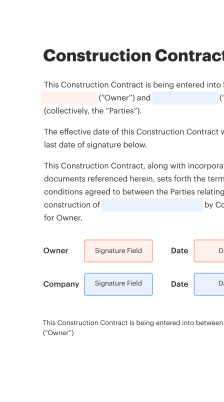
How digital logistics bills work end-to-end

A digital workflow moves the logistics bill from creation to signature, archival, and accounting while preserving an audit trail.

  • Create: Generate template pre-filled with shipment data.
  • Review: Route to operations and finance for verification.
  • Sign: Collect electronic signatures and timestamps.
  • Archive: Store signed versions with version control.
Collect signatures
24x
faster
Reduce costs by
$30
per document
Save up to
40h
per employee / month

Quick setup: Create a logistics bill format

Follow these core steps to assemble a consistent logistics bill template for business use and eSignature workflows.

  • 01
    Draft template: List required fields: shipper, consignee, PO, tracking.
  • 02
    Add charge lines: Include freight, accessorials, discounts, and taxes.
  • 03
    Include proof fields: Add delivery time, receiver name, signature space.
  • 04
    Enable approvals: Assign reviewer and signer roles for finalization.
be ready to get more

Why choose airSlate SignNow

  • Free 7-day trial. Choose the plan you need and try it risk-free.
  • Honest pricing for full-featured plans. airSlate SignNow offers subscription plans with no overages or hidden fees at renewal.
  • Enterprise-grade security. airSlate SignNow helps you comply with global security standards.
illustrations signature

Recommended workflow configurations

Suggested workflow settings help automate validations, reminders, and routing for logistics bill processing.

Feature Configuration
Reminder Frequency 48 hours
Signer Routing Order Sequential routing
Template Versioning Auto-increment enabled
Validation Rules Mandatory fields enforced
Retention Policy 7 years

Device and platform considerations

Logistics bill formats should be accessible on common devices and comply with enterprise security policies.

  • Web browser: Chrome, Edge, Safari supported
  • Mobile support: iOS and Android apps available
  • Offline access: Limited offline viewing

Ensure the chosen document and signing platform supports your security baseline, integrates with core systems, and provides mobile signing for drivers and field personnel to finalize bills at point of delivery.

Security controls to protect logistics bills

Data encryption: AES-256 encryption at rest
Transport security: TLS 1.2+ encryption in transit
Access controls: Role-based permissions enforced
Multi-factor authentication: Optional MFA for signers
Audit logging: Immutable transaction records
Document retention: Configurable retention policies

Industry examples using a logistics bill format

Real-world scenarios show how a consistent logistics bill format improves accuracy across freight, retail, and third-party logistics providers.

Freight Forwarder

A mid-size freight forwarder standardized bills across 30 carriers to include itemized surcharges and tracking numbers

  • Standardized surcharge fields and delivery proof
  • Reduced disputes by delivering clear evidence and charge breakdowns

Resulting in faster settlement cycles and improved carrier reconciliation for monthly accounting close.

E-commerce Retailer

An online retailer implemented a digital logistics bill format that included SKU-level freight allocation

  • Integrated SKU fields with order data
  • Simplified freight cost apportionment across orders and returns

Leading to more accurate product margin analysis and faster vendor dispute resolution workflows.

Best practices when designing a logistics bill format

Apply these practical guidelines to ensure accuracy, compliance, and efficiency when implementing logistics bill formats for business use.

Standardize required fields company-wide
Define a mandatory field list including shipment ID, PO number, weight, charge lines, and receiver signature. Enforce these fields at the template level to reduce exceptions and ensure consistent data flows into accounting and analytics systems.
Use conditional logic to simplify forms
Apply conditional sections for fuel surcharges, international shipments, or special services so that only relevant fields appear, reducing signer confusion and limiting unnecessary data entry for routine shipments.
Preserve audit trails for every transaction
Ensure every change, view, and signature is logged with timestamps and actor details. Maintain immutable records for compliance, dispute resolution, and internal controls to support audits and vendor reconciliations.
Align retention with regulatory requirements
Set document retention policies consistent with tax and transportation regulations, typically several years depending on jurisdiction. Implement automated archival and secure deletion to meet records management and privacy obligations.

FAQs and troubleshooting for logistics bill formats

Answers to common questions about creating, signing, and managing logistics bills within digital workflows.

Feature availability across popular eSignature platforms

A concise feature comparison for common eSignature capabilities related to logistics bill formats, listing three widely used platforms with clear availability indicators.

Feature signNow (Recommended) DocuSign Adobe Sign
Bulk Send
Template Builder
Native TMS Integrations Limited Wide Moderate
Advanced Audit Trail
be ready to get more

Get legally-binding signatures now!

Risks if logistics bills are not managed correctly

Payment delays: Late or disputed payments
Compliance fines: Tax reporting issues
Operational disruption: Delayed shipments or audits
Data loss: Missing historical records
Fraud exposure: Unauthorized invoice changes
Reputational harm: Supplier relationship strain

Plan names and entry tiers across platforms

An overview of common plan tiers and introductory offering descriptions to compare entry-level availability and naming conventions among five providers.

Plan Name signNow (Recommended) DocuSign Adobe Sign Dropbox Sign PandaDoc
Free Option Free plan available with limitations Free trial only Free trial only Free plan available Free trial only
Entry-level Plan Business tier with basic signing Personal plan monthly Acrobat Sign individual Standard plan monthly Essentials plan monthly
Business Plan Business or Business Premium tiers for teams Standard Business Pro Small business bundles Business plans for teams Business growth plans available
Enterprise Offering Custom enterprise with API and SSO Enterprise solutions with compliance Enterprise-grade solutions Advanced with SSO and APIs Enterprise with advanced workflows
Authentication Add-ons Optional advanced auth and integrations Additional identity options ID verification modules SMS authentication options Advanced verification modules
walmart logo
exonMobil logo
apple logo
comcast logo
facebook logo
FedEx logo
be ready to get more

Get legally-binding signatures now!