Medical Store Bill Format in Excel for Accounting and Tax

Streamline your financial processes with our intuitive billing template. Save time and enhance accuracy with airSlate SignNow's eSigning capabilities.

Award-winning eSignature solution

What a medical store bill format in Excel delivers for accounting and tax

A medical store bill format in Excel for accounting and tax is a structured spreadsheet template designed to record sales, manage inventory, calculate taxes, and produce audit-ready reports. It typically includes fields for invoice number, date, customer details, item codes, quantities, unit prices, discounts, taxable amounts, tax rates, and totals. For accounting, it maps line items to ledger accounts and supports export to general ledger or accounting software. For tax, it ensures tax calculation transparency, aggregates taxable sales, and stores supporting documentation for returns and audits.

Why use a standardized Excel bill format in a medical store

A consistent Excel bill template reduces manual errors, speeds reconciliation, and creates a verifiable record for accounting and tax compliance across transactions and reporting periods.

Why use a standardized Excel bill format in a medical store

Common challenges when using bill formats for pharmacies

  • Inconsistent item coding across suppliers causes mismatched inventory and accounting records, complicating reconciliation and stock valuation.
  • Manual tax calculations and rate changes increase risk of undercollecting taxes or misreporting taxable sales to authorities.
  • Missing or poorly formatted invoices make it difficult to substantiate deductions and sales during tax audits or vendor disputes.
  • Lack of automated backups or version control risks data loss and increases time needed to recreate transaction histories.

Typical users and their roles

Pharmacist

A pharmacist uses the Excel bill format to generate customer invoices at point of sale, track prescription and OTC item sales, and reconcile daily cash and credit card receipts against inventory movement and supplier deliveries.

Bookkeeper

A bookkeeper imports or copies transactional data into accounting ledgers, applies correct tax codes, prepares monthly trial balances, and ensures supporting invoices are stored for tax filing and audit readiness.

Who benefits from a tailored Excel bill template

  • Independent pharmacists managing daily sales, inventory, and cashflow reconciliation for a single store.
  • In-house accountants preparing monthly ledgers, VAT/GST reporting, and tax return schedules.
  • POS or billing clerks entering sales and issuing compliant invoices at the point of sale.

Standardized templates streamline collaboration between store staff and accounting teams, reducing time spent resolving transaction discrepancies.

Additional features to improve efficiency and control

Extend basic templates with features that support scale, traceability, and integration into broader systems.

Conditional Logic

Use Excel formulas or simple macros to show or hide fields based on transaction type, such as prescriptions versus over-the-counter sales, improving clarity and reducing input errors.


SKU Master

Maintain a separate SKU sheet linked by VLOOKUP or INDEX/MATCH to pull descriptions, tax rates, and ledger accounts automatically onto invoices and reports.

Discount and Promotion Rules

Embed standard discount calculations and validation to prevent unauthorized price overrides and to correctly allocate discount amounts for accounting and margin analysis.

Multi-Tax Support

Support for multiple tax types and nested tax calculations helps accurately invoice products subject to both state and local taxes or special pharmaceutical levies.

Batch Export

Aggregate daily invoices into a consolidated export that matches the accounting system's import format to streamline journal entry creation.

Change Log

Implement a simple change log sheet that records edits to invoices for traceability and audit trails when manual corrections are required.

be ready to get more

Choose a better solution

Key template features that support accounting and tax

Incorporate features that reduce manual work and create auditable outputs for accountants and tax authorities.

Template Fields

Predefined fields for invoice metadata, customer identification, item details, and payment terms reduce variability and speed data capture while ensuring every sale includes the information needed for accounting and tax reporting.

Tax Calculations

Built-in tax rate tables and per-line formulas automatically compute applicable taxes, aggregate taxable and non-taxable sales, and produce subtotals required for periodic tax returns and internal controls.

Ledger Mapping

Columns to map item sales, discounts, and tax components to general ledger accounts help create accurate journal exports and reduce time required for month-end closing procedures.

Export Options

Formatted CSV or XLSX exports of invoice lines and summaries enable direct import into common accounting packages, saving rekeying time and improving data integrity across systems.
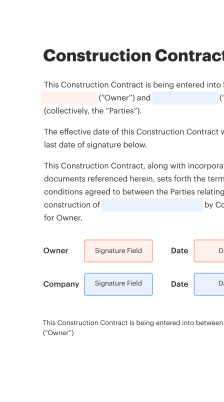
How an Excel bill format integrates into daily workflows

A structured template moves data from point of sale into accounting and tax workflows with minimal manual steps.

  • Data entry: Enter sales per transaction or import from POS CSV.
  • Validation: Use data validation lists for SKUs and tax rates.
  • Aggregation: Summarize daily sales and tax totals for reporting.
  • Export: Export journal entries or CSV for accounting systems.
Collect signatures
24x
faster
Reduce costs by
$30
per document
Save up to
40h
per employee / month

Quick setup: build a practical Excel bill template

Follow these core steps to create an Excel bill format that supports accounting entries and tax calculations without added complexity.

  • 01
    Create header: Add store details, invoice number, and date fields.
  • 02
    Item grid: Include columns for SKU, description, qty, unit price, and discount.
  • 03
    Tax fields: Add tax rate lookup and per-line tax calculation formulas.
  • 04
    Accounting map: Map items to ledger codes for export or journal entry.

Manage audit trails and transaction history in Excel

Maintain searchable, timestamped records for every billing transaction to simplify audits and forensic reviews.

01

Timestamp entries:

Record date and time of creation.
02

User initials:

Log who entered or edited a record.
03

Change reason:

Capture why adjustments were made.
04

Version snapshot:

Save periodic copies of the workbook.
05

Link supporting files:

Reference scanned receipts and prescriptions.
06

Export audit reports:

Summarize edits for auditor review.
be ready to get more

Why choose airSlate SignNow

  • Free 7-day trial. Choose the plan you need and try it risk-free.
  • Honest pricing for full-featured plans. airSlate SignNow offers subscription plans with no overages or hidden fees at renewal.
  • Enterprise-grade security. airSlate SignNow helps you comply with global security standards.
illustrations signature

Typical workflow settings for automated bill handling

Define workflow settings to automate reminders, exports, and backups so billing stays consistent and auditable.

Setting Name and Default Configuration Configured value or default behavior
Daily export schedule End-of-day CSV export
Backup frequency Daily incremental backup
Reminder frequency for reconciliations 48 hours before month end
Approval requirement for credits Manager approval required
Audit log retention period Seven years

Device and software requirements for working with Excel bills

  • Desktop Windows: Excel 2016 or later recommended
  • macOS support: Excel for Mac 2016 or later
  • Mobile access: Excel mobile app for viewing and light edits

For integrations, use a desktop or server environment to run exports, macros, and automated jobs; mobile apps are suitable for viewing and simple entry but not for complex automation or macro execution.

Essential security and protection elements

Data encryption: AES 256-bit encryption at rest
Transport security: TLS 1.2+ for data in transit
Access controls: Role-based user restrictions
Audit logging: Immutable transaction logs
Backup strategy: Daily offsite backups retained
Authentication: Multi-factor authentication required

Practical examples from medical retail operations

The following scenarios show how an Excel bill format supports accounting accuracy, tax reporting, and operational control in real pharmacy settings.

Small independent pharmacy

A local pharmacy standardized its Excel invoice to include GST fields and item HSN codes to ensure consistent tax computation across products

  • included automated subtotal and tax formulas for mixed tax-rate baskets
  • reduced monthly reconciliation time by consolidating POS exports for the accountant

Resulting in clearer tax filings and fewer audit queries due to consistent supporting records.

Multi-branch chain

A three-location chain adopted a master Excel billing template to ensure uniform sales entries and SKU mapping across stores

  • integrated daily sales exports into a centralized workbook for consolidated reporting
  • improved visibility into branch-level margins and inventory turnover

Leading to faster month-end closes and easier preparation of aggregated tax returns.

Best practices to keep billing accurate and compliant

Follow consistent processes and controls to ensure Excel invoices remain reliable sources for accounting and tax.

Use controlled item codes and validation lists
Maintain a single SKU master with data validation in the template to prevent typos, ensure consistent accounting mappings, and speed reconciliation between sales and inventory records.
Record tax details per line item
Capture tax rates and taxable values on each invoice line to maintain transparent tax calculations and make it easier to produce supplier-level and tax authority reports during reviews or filings.
Keep versioned backups and retention records
Implement a retention schedule and periodic backups for invoice files to satisfy statutory recordkeeping requirements and ensure availability of supporting documents in case of audits.
Reconcile daily and close monthly promptly
Perform daily bank and cash reconciliations and a formal month-end close process to surface discrepancies quickly and produce timely trial balances for tax preparation.

FAQs and troubleshooting for common billing issues

Answers to frequent questions about template setup, tax handling, and reconciliation help reduce common errors and clarify responsibilities.

Feature comparison for electronic signing and compliance

Compare key capabilities relevant when pairing Excel billing files with an e-signature or document workflow provider; signNow is listed first as Featured.

Feature / Capability Comparison Table signNow (Featured) DocuSign Adobe Sign
ESIGN / UETA compliance
HIPAA support with BAA
API access for integrations
Bulk Send / mass delivery
be ready to get more

Get legally-binding signatures now!

Typical retention and filing timelines to plan for

Adhere to retention and filing schedules to satisfy tax rules and support potential audits.

Daily sales reconciliation retention:

Retain daily sales exports for at least one year.

Tax filing documentation retention:

Keep supporting invoices for seven years per many tax authorities.

Supplier invoice archival:

Store supplier invoices for matching and claims for five years.

Electronic backup frequency:

Perform daily backups with weekly full snapshots.

Audit readiness window:

Maintain records easily accessible for at least the previous five tax years.

Regulatory and operational risks to consider

Tax penalties: Late fees or fines
Audit exposure: Disallowed deductions
Data breach fines: Regulatory penalties
Inventory shrinkage: Financial loss
Customer disputes: Refund liabilities
Noncompliance: License revocation risk

Pricing and plan comparison for e-signature options

High-level pricing and plan features for commonly used e-signature providers when integrating signed billing documents with accounting and tax records.

Plan Pricing and Feature Matrix signNow (Recommended) DocuSign Adobe Sign Dropbox Sign PandaDoc
Entry-level monthly price $8 per user per month $10 per user per month $14.99 per user per month $12 per user per month $19 per user per month
Free tier availability Limited trial only Limited trial only Limited trial only Free tier available Free trial available
API access included Available on business plans Paid add-on for some plans Included in many plans Included in paid plans Included in paid plans
HIPAA-ready options BAA available BAA available BAA available BAA available on request BAA available on enterprise
Bulk send capability Yes, bulk send supported Yes, bulk send supported Yes, bulk send supported Yes Yes
walmart logo
exonMobil logo
apple logo
comcast logo
facebook logo
FedEx logo
be ready to get more

Get legally-binding signatures now!