Order Form Creator for Support

Experience the ease of sending and eSigning documents with airSlate SignNow. Enhance your workflow today with our cost-effective solution.

Award-winning eSignature solution

What the order form creator for support does

An order form creator for support is a specialized document workflow tool that lets support teams assemble, send, and collect structured order or service requests electronically. It typically combines customizable form fields, conditional logic, and integrated signing so agents or customers can complete transactions without manual paperwork. Within an eSignature-enabled environment the tool captures signatures, timestamps, and signer authentication and stores a tamper-evident record. This reduces processing time, centralizes order data for ticketing systems, and supports the audit and compliance requirements common to U.S.-based support operations.

Why support teams adopt an order form creator

A structured order form standardizes requests, reduces back-and-forth, and preserves a clear audit trail for compliance and billing.

Why support teams adopt an order form creator

Common challenges without a dedicated order form creator

  • Inconsistent request data forces manual follow-up and delays resolution time across support queues.
  • Paper or email-based orders lack reliable signer verification and make audit reviews time-consuming.
  • Complex pricing or configuration options increase error rates when teams enter orders manually.
  • Siloed storage prevents efficient reporting and complicates retention or compliance workflows for audits.

Typical user profiles for support order forms

Support Agent

Frontline support staff use the order form creator to capture standardized order details during calls or chats, reducing back-and-forth with customers and ensuring required fields and approvals are included before submission.

IT Administrator

Administrators configure templates, set field validation and access controls, and integrate form outputs with ticketing and CRM systems to enforce consistency and maintain data governance across the support organization.

Who typically uses an order form creator for support

Support managers, customer success teams, and field technicians commonly use order form creators to standardize request intake and reduce processing friction.

  • Customer support teams handling product replacements and service add-ons.
  • IT service desks coordinating hardware or software provisioning tasks.
  • Field service operators submitting on-site material or labor orders.

Deployments scale from small teams using templates to enterprise support centers integrating forms into case workflows and reporting.

Core features for an effective order form creator

A complete solution combines template tools, verification, and automation to support scalable, compliant order intake.

Templates

Reusable templates speed form creation with preconfigured fields, approval flows, and field-level validation to ensure consistent data capture for recurring order types.


Conditional Logic

Logic rules present fields based on prior answers, simplifying the form for users and ensuring only relevant options are captured for each request type.

Bulk Send

Send the same order form to many recipients at once for mass confirmations or renewals while tracking individual responses and signature status.

Authentication

Support for SSO, email verification, SMS codes, and knowledge-based checks provides adaptable signer authentication to match transaction risk profiles.

Audit Trail

Every action on a form—view, fill, sign—is recorded with timestamps and IP data to create a defensible record for audits and disputes.

Mobile Ready

Responsive form layouts and native mobile signing ensure field staff and customers can complete orders from phones or tablets securely.

be ready to get more

Choose a better solution

Integrations that streamline support order workflows

Integrations connect the order form creator to systems support teams already use, reducing manual entry and improving traceability.

Google Workspace

Two-way integration lets agents create order forms from Google Docs, push completed form data back to Sheets, and attach signed PDFs to Drive for centralized storage and collaboration.

CRM systems

Connectors populate customer fields automatically, create or update CRM records on submission, and ensure order data flows directly into billing and support case records without rekeying.

Dropbox

Completed forms and signed documents can be routed into Dropbox folders with naming conventions for retention and team access, simplifying archival and audit retrieval.

REST API

API integration supports custom triggers, programmatic template generation, and automated retrieval of signed documents into support backends or reporting tools.
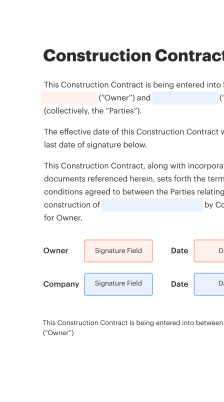
How to create and use order forms online

The online process typically moves from template design to distribution and completion with built-in signing and storage.

  • Design form: Define fields, sections, and visibility.
  • Apply rules: Set conditional logic and calculations.
  • Share form: Send link or embed in support portal.
  • Capture signature: Collect eSignature and authentication.
Collect signatures
24x
faster
Reduce costs by
$30
per document
Save up to
40h
per employee / month

Quick steps to set up an order form for support

Follow these concise steps to create a usable order form that captures required data and enforces validation.

  • 01
    Create template: Select a template or start a blank form.
  • 02
    Add fields: Insert required fields and conditional logic.
  • 03
    Set validation: Configure mandatory fields and formats.
  • 04
    Publish: Save template and assign user permissions.

Managing audit trails for order form transactions

Maintain a clear, tamper-evident record by following these procedural steps when collecting signatures and storing completed forms.

01

Enable logging:

Turn on full audit logging.
02

Collect metadata:

Record IP, timestamp, user agent.
03

Seal documents:

Apply tamper-evident seals.
04

Store securely:

Use encrypted storage.
05

Export reports:

Generate audit summaries.
06

Retention policy:

Apply legal retention rules.
be ready to get more

Why choose airSlate SignNow

  • Free 7-day trial. Choose the plan you need and try it risk-free.
  • Honest pricing for full-featured plans. airSlate SignNow offers subscription plans with no overages or hidden fees at renewal.
  • Enterprise-grade security. airSlate SignNow helps you comply with global security standards.
illustrations signature

Typical workflow settings for support order forms

Configure these settings to match your support team's process and ensure reliable notifications and recordkeeping.

Setting Name Configuration
Reminder Frequency 48 hours
Signing Order Sequential
Auto-archive Policy 30 days
Template Assignment By team
Field Validation Rules Required formats

Supported platforms for order form creation and completion

Modern order form creators work across web browsers, native mobile apps, and tablet environments for flexible completion.

  • Web browsers: Chrome, Edge, Safari
  • Mobile apps: iOS and Android
  • Offline support: Limited or none

Confirm specific browser versions and mobile OS requirements with your provider; some advanced features such as in-app camera capture or offline signing may need recent OS releases and updated app versions.

Security and protection features to expect

Encryption at rest: AES-256 encryption
Encryption in transit: TLS 1.2+ transport
Access controls: Role-based access
Authentication options: Password or SSO
Audit logging: Immutable logs
Document sealing: Tamper-evident seals

Support use cases that benefit from order forms

Real-world support teams use order form creators for recurring tasks where accuracy and traceability matter.

Field Hardware Replacement

A field technician records device details and failure symptoms using a guided form

  • includes serial numbers and warranty checks
  • reduces return processing time and warranty disputes

Resulting in faster replacements and clearer warranty records for finance and support.

Subscription Upgrade Requests

Customer success captures upgrade choices and billing consent via a prefilled order form

  • shows tier options and proration calculations
  • keeps authorization and payment approval together with the request

Leading to accurate billing updates and fewer support escalations.

Best practices for secure and accurate support order forms

Adopt consistent procedures and technical controls to reduce errors and protect sensitive information when using order forms in support contexts.

Design forms for clarity and minimum required fields
Limit fields to essential data, provide clear labels and examples, and use field validation to prevent invalid entries and minimize back-and-forth with requestors.
Apply appropriate authentication based on transaction risk
Use stronger authentication (SSO, SMS PIN) for change-of-service or billing authorizations, and simpler verification for low-risk confirmations to balance security and usability.
Integrate with ticketing and billing systems
Automatically route completed orders into support and billing workflows to eliminate manual reentry, reduce errors, and ensure orders trigger downstream processing consistently.
Maintain retention and audit policies
Define retention schedules aligned to legal and operational needs, retain audit logs with signature metadata, and regularly review access permissions to protect stored records.

FAQs About order form creator for support

Common questions and answers about setup, signing, and integrations for support-focused order forms.

Feature availability comparison: signNow (Recommended) vs DocuSign

This concise table contrasts select capabilities that matter to support teams when choosing an eSignature-enabled order form solution.

Feature availability across signature vendors signNow (Recommended) DocuSign
Regulatory compliance coverage (HIPAA FERPA)
API availability and developer support
Bulk Send and mass distribution limits
Mobile app availability and features
be ready to get more

Get legally-binding signatures now!

Retention and deadlines to configure for support forms

Set clear retention and review dates to meet legal and operational requirements for signed order documents.

Short-term retention period:

90 days for quick-reference records

Standard retention schedule:

7 years for transactional records

HIPAA document retention:

As required by policy

Audit log retention:

At least 3 years

Periodic review cadence:

Annual policy review

Compliance and operational risks to mitigate

Data breach exposure: Regulatory fines possible
Invalid signatures: Contract disputes risk
Retention gaps: Noncompliance penalties
Unauthorized access: Data misuse risk
Audit failures: Reputational harm
Process inefficiency: Higher operational cost

Pricing and feature snapshot across major providers

Quick reference comparing starting price, trial availability, enterprise support, API access, and HIPAA support across five providers.

Pricing comparison across eSignature vendors signNow (Recommended) DocuSign Adobe Sign Dropbox Sign PandaDoc
Starting monthly price From $8/user/mo From $10/user/mo From $12.99/user/mo From $9/user/mo From $19/user/mo
Free trial availability Yes Yes Yes Yes Yes
Enterprise plan available Yes Yes Yes Yes Yes
API access included Yes Yes Yes Yes Yes
HIPAA compliance support Available Available Available Limited Available
walmart logo
exonMobil logo
apple logo
comcast logo
facebook logo
FedEx logo
be ready to get more

Get legally-binding signatures now!