Order Form Software for Banking Made Easy

Effortlessly send and eSign documents with airSlate SignNow's user-friendly, cost-effective solution. Transform your workflow and enhance productivity today.

Award-winning eSignature solution

What order form software for banking is and how it fits operations

Order form software for banking combines secure digital forms, workflow routing, and signature capture to manage client orders, account requests, and service agreements. It streamlines data capture while preserving auditability and integration with back-office systems, reducing manual entry and paper handling. Implemented correctly, the solution enforces field validation, preserves versioned documents, and records signer identity to support regulatory review. For banks, the software serves retail, commercial, and operations teams by centralizing intake, automating approvals, and keeping consistent retention and reporting practices across customer lifecycle events.

Why banks adopt order form software for banking

Order form software for banking reduces errors, shortens processing times, and centralizes compliance evidence, enabling teams to handle higher volumes with consistent controls and traceable sign-off.

Why banks adopt order form software for banking

Common operational challenges addressed

  • Inconsistent data entry across branches increases reconciliation time and error rates during account setup and order processing.
  • Paper forms require manual routing and physical storage, causing delays and exposure to document loss or misfiling.
  • Sparse audit trails and missing signer identity make regulatory reviews and dispute resolution longer and more complex.
  • Manual approvals and duplicated tasks across systems reduce staff productivity and create bottlenecks during peak periods.

Representative user roles and responsibilities

Branch Manager

Branch Managers use order form software to verify customer-submitted forms, confirm identity and documents, and initiate approvals for account changes. They rely on templates and field validation to reduce errors and escalate exceptions to operations when needed.

Compliance Officer

Compliance Officers review audit logs, configure retention and consent policies, and validate authentication levels. They use records from the system to demonstrate adherence to ESIGN and UETA and to support internal and external examinations.

Teams that benefit from order form software for banking

Front-line staff, back-office operations, compliance teams, and relationship managers commonly rely on digital order forms to maintain speed and traceability.

  • Retail branch staff handling account openings and service authorizations.
  • Compliance and risk teams performing audits and exception tracking.
  • Operations teams processing transactions and post-sale modifications.

Cross-functional access and properly scoped permissions ensure each group can perform tasks while preserving auditability and segregation of duties.

Advanced capabilities to consider for banking workflows

Beyond core features, advanced automation, reporting, and developer tools drive scale and customization for enterprise banking environments.

Bulk Send

Send a single template to many recipients with personalized fields and consolidated status reporting for mass communications or standardized acknowledgements.


Conditional logic

Dynamic fields and conditional sections adapt the form to answers, reducing unnecessary fields and guiding users through complex product options.

API access

Robust REST APIs enable embedding, automated document generation, and tight integration with legacy systems and new fintech services.

Role-based access

Granular permissions and team templates control who can edit templates, send for signature, or access audit logs across organizational units.

Data validation

Field-level validation, lookup integrations, and format enforcement prevent incorrect or incomplete submissions at capture time.

Retention policies

Automated archival and deletion rules enforce document retention schedules and legal hold requirements consistently across records.

be ready to get more

Choose a better solution

Core features for effective order form software for banking

Select features should prioritize security, compliance, usability, and integration to fit banking operational needs.

Template library

Reusable, version-controlled templates reduce drafting time and ensure consistent language across branches while supporting conditional fields for varied account types and transaction categories.

Authentication options

Multiple signer verification methods, including SMS codes, knowledge-based authentication, and single sign-on (SAML), let banks match assurance levels to transaction risk and regulatory requirements.

Audit trail

Immutable event logs record timestamps, IP addresses, and signer actions to support legal admissibility and simplify regulatory examinations or internal audits.

Integrations

Connectors to CRM, core banking, and document storage systems remove manual rekeying, enable status synchronization, and centralize records for downstream processing and reporting.
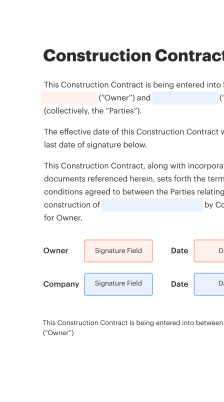
How digital order forms operate across channels

Order form software coordinates data capture, signer authentication, and document storage across web and mobile interfaces.

  • Form delivery: Send forms via secure link or embedded portal
  • Signer action: Recipients complete fields and apply signatures online
  • Verification: System enforces authentication and field validation
  • Archival: Signed documents stored with full audit trail
Collect signatures
24x
faster
Reduce costs by
$30
per document
Save up to
40h
per employee / month

Quick setup: implement order form software for banking

Follow these core steps to configure templates, authentication, and routing for bank-specific order forms.

  • 01
    Define templates: Identify commonly used forms and required fields
  • 02
    Set authentication: Choose signer verification methods per workflow
  • 03
    Create routing: Map approval steps and escalation rules
  • 04
    Test and deploy: Run pilot scenarios before full rollout

Audit trail and transaction management checklist

Key steps to verify that each signed order form preserves necessary records and supports compliance reviews.

01

Record creation:

Capture initial template and field values
02

Signer identity:

Log authentication events and methods used
03

Action timestamps:

Record time and timezone of each action
04

Document versions:

Store the exact signed PDF and metadata
05

Access audit:

Track who viewed or exported records
06

Retention flags:

Apply retention and legal hold markers
be ready to get more

Why choose airSlate SignNow

  • Free 7-day trial. Choose the plan you need and try it risk-free.
  • Honest pricing for full-featured plans. airSlate SignNow offers subscription plans with no overages or hidden fees at renewal.
  • Enterprise-grade security. airSlate SignNow helps you comply with global security standards.
illustrations signature

Typical workflow settings when configuring order form software for banking

Configure workflow defaults to align form routing, reminders, authentication, and retention with bank policies and service level targets.

Setting Name and Configuration Values Standard default settings used by templates and workflows
Reminder Frequency for signature requests 48 hours between reminders with two follow-ups allowed
Signer Authentication Level per workflow Email link by default; SMS or SSO for high-risk flows
Template Access Control and editing rights Template edits restricted to admin role with change approvals
Auto-archival retention window Move completed records to archive after 90 days
Bulk send batch size limit Default batch size set to 500 recipients per job

Supported platforms for order form software for banking

Ensure the platform supports commonly used devices and browsers to meet client access expectations and internal support capabilities.

  • Web browsers: Chrome, Edge, Safari support
  • Mobile devices: iOS and Android apps or responsive web
  • Desktop integrations: Windows and macOS native integrations

Confirm browser compatibility matrix, minimum OS versions, and any required plugins or network ports before deployment to avoid access issues across customer and staff devices.

Security controls and protections

Encryption in transit: TLS 1.2+ for data movement
Encryption at rest: AES-256 encryption for stored files
Access controls: Role-based access implemented
Authentication options: Password, SMS, and SSO
Audit logging: Comprehensive event capture
Data residency: Region-selectable storage options

Practical banking use cases for order form software

Examples below illustrate common deployments and measurable outcomes across retail and commercial banking scenarios.

Retail account onboarding

A regional bank replaced paper account opening packets with digital order forms and identity verification integration

  • Prepopulated fields and guided flows reduced input errors
  • Reduced branch processing time and fewer incomplete applications

Resulting in faster account activation and improved customer experience while preserving audit records.

Commercial loan documentation

A commercial lending team used templated order forms for routine loan modifications and collateral updates

  • Role-based approvals routed to underwriting and legal
  • Standardized fields improved data quality and reduced manual review time

Leading to shorter approval cycles, clearer audit trails, and more consistent compliance reporting.

Operational best practices for secure and accurate order forms

Adopt controls and routines that minimize risk, improve data quality, and make compliance evidence readily available.

Standardize templates and version control
Maintain a central template library with strict versioning, change approvals, and a single source of truth for contractual language to avoid discrepancies and ensure consistent acceptance criteria across branches and teams.
Align authentication to transaction risk
Classify workflows by risk and require stronger authentication for higher-risk transactions; document the rationale and use SSO or MFA for privileged and sensitive operations to meet regulatory expectations.
Automate retention and archival
Configure automated retention schedules and secure archival to enforce legal hold, simplify eDiscovery, and ensure records are preserved or removed per policy without manual intervention.
Test workflows and train staff
Run pilot tests, validate edge cases, and provide role-based training so staff understand routing, exception handling, and how to handle identity verification issues during customer interactions.

FAQs about order form software for banking

Common questions and practical answers addressing legality, security, and implementation considerations for bank deployments.

Feature availability snapshot: signNow (Recommended) vs DocuSign

A concise availability comparison for common order form capabilities that banks evaluate when selecting a provider.

Feature signNow (Recommended) DocuSign
ESIGN/UETA validity
Advanced authentication options SMS, SSO, KBA SMS, SSO, KBA
Bulk Send support
BAA / HIPAA support BAA available upon request BAA available for eligible plans
be ready to get more

Get legally-binding signatures now!

Regulatory and operational risks to manage

Noncompliant records: Regulatory fines possible
Insufficient authentication: Increased fraud exposure
Poor retention controls: Legal discovery risk
Incomplete audit trail: Dispute resolution challenges
Data breaches: Customer data exposure
Incorrect templates: Contractual ambiguity

Pricing-related feature comparison across popular eSignature providers

High-level pricing and plan characteristics to help compare entry features, trials, and compliance support among providers used in financial services.

Pricing Feature signNow (Recommended) DocuSign Adobe Sign PandaDoc Dropbox Sign
Free trial availability Yes, free trial available for new users to evaluate core features Yes, free trial available with limited features Yes, trial included via Acrobat subscription for select users Yes, trial available across plans for new accounts Yes, free trial for new accounts with limited usage
Entry-level plan name Business plan focused on eSignature and templates for teams Personal and Standard plans for individuals and small teams Single App plan via Acrobat Pro for document workflows Essentials plan for SMB document workflows and eSignatures Essentials plan for basic eSignature use and integrations
Starting monthly price (approx.) Starts at approximately $8 per user per month depending on billing cycle and discounts Starts around $10 per user per month for basic plans Starting price often bundled within Adobe Acrobat subscriptions Entry plans start near $19 per user per month for advanced features Intro plans start at similar low-tier pricing with per-seat billing
Enterprise contract and support Custom enterprise contracts and dedicated account support available Enterprise-grade contracts with advanced support tiers Enterprise licensing supported within Adobe enterprise agreements Enterprise tier with onboarding and SLA options Enterprise contracts and priority support available
Notable compliance support ESIGN, UETA, SOC 2, eIDAS options and HIPAA support available per agreement ESIGN, UETA, SOC 2, HIPAA and extensive compliance controls ESIGN, UETA, SOC 2 and enterprise compliance within Adobe ecosystem ESIGN, UETA, SOC 2 and custom controls for regulated industries ESIGN, UETA, SOC 2 with enterprise compliance options
walmart logo
exonMobil logo
apple logo
comcast logo
facebook logo
FedEx logo
be ready to get more

Get legally-binding signatures now!