Paper Invoice Template for Communications Media

Experience the ease of sending and eSigning documents with airSlate SignNow, a cost-effective solution designed to enhance your business efficiency.

Award-winning eSignature solution

What a paper invoice template for communications media includes

A paper invoice template for communications media is a structured billing document tailored to agencies, broadcasters, publishers, and telecom providers that bill clients for advertising, production, airtime, subscriptions, or media services. It standardizes line items such as campaign dates, spot buys, creative fees, usage rights, placement channels, and taxes, while preserving client contact and purchase order references. Templates reduce errors, improve collections, and support consistent recordkeeping across projects and campaigns. When paired with secure eSignature tools like signNow, paper-style templates can be digitized for compliant remote signing and archival, preserving legal and audit trail requirements.

Why standardized paper invoice templates matter in communications media

Standardized templates reduce billing disputes, accelerate payment processing, and improve auditability for media buys and services.

Why standardized paper invoice templates matter in communications media

Common challenges when using paper invoice templates in media businesses

  • Inconsistent line-item descriptions cause client confusion and payment delays.
  • Manual calculations and tax rules introduce errors and compliance gaps.
  • Lost paper records create audit and retention problems for campaigns.
  • Synchronizing invoices with ad ops, finance, and CRM is labor intensive.

Roles that rely on invoice templates

Agency CFO

The CFO oversees revenue recognition and needs templates that map campaign line items to accounting codes, tax treatment, and client POs to ensure accurate monthly closes and compliant financial statements.

Account Manager

Account managers prepare client-facing invoices and require clear descriptions of placements, dates, and deliverables to avoid disputes and enable timely approvals from client procurement or finance teams.

Typical users of paper invoice templates in communications media

Finance teams, account managers, and production coordinators use templates to standardize billing across campaigns and clients.

  • Agency billing teams preparing consolidated client invoices for campaigns and retainer work.
  • Broadcast revenue departments issuing airtime and placement invoices for advertisers.
  • Independent producers or studios billing production and licensing fees to media clients.

Consistent templates help these teams reduce disputes, speed reconciliation, and maintain a clear audit trail for contracted services.

Extended features for robust invoice templates

For larger media operations, add advanced fields and workflow hooks to ensure scalable billing and compliance across campaigns.

Automated line totals

Auto-calculates extended amounts per item and applies discounts or agency commission rules to reduce manual errors and speed invoice preparation.


Custom payment terms

Support for NET terms, early payment discounts, and staged payments for large productions to align billing with contract terms and cash flow needs.

Attachment support

Fields to attach insertion orders, media schedules, or proof-of-play reports to substantiate charges and reduce disputes during reconciliation.

Client-specific templates

Per-client templates that include preferred line descriptions, billing codes, and formatting to meet large advertisers' procurement standards.

Approval routing

Conditional routing rules that send invoices to the correct approvers based on campaign type, amount thresholds, or profit center assignments.

Audit metadata

Fields that capture creator, approver, and modification timestamps to maintain a complete audit trail for compliance and reviews.

be ready to get more

Choose a better solution

Template features to include for communications media invoices

Design templates with features that reflect the complexities of media billing to reduce disputes and speed payment processing.

Line-item coding

Structured fields for campaign codes, SKU or spot identifiers, unit rates, quantities, and discounts so accounting systems can map revenue accurately and support automated reconciliation with ad operations reports.

License terms

Explicit fields for usage dates, territories, and media channels to document rights and fees, which reduces later disputes over scope and enables correct royalty or reuse billing.

Tax and fee logic

Built-in fields for sales tax, VAT where applicable, and agency fees so totals calculate consistently and tax reporting is simplified for finance teams across jurisdictions.

Client PO support

Dedicated fields for purchase order numbers and contract references to speed client matching and approval workflows in procurement and accounts payable systems.
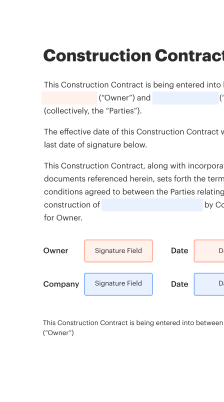
How a paper invoice template moves through a media workflow

A template follows a predictable path from creation to payment: populate, approve, deliver, and archive.

  • Populate: Generate invoice with campaign and billing details.
  • Approve: Obtain internal sign-offs and verify totals.
  • Send: Deliver to client via email or portal.
  • Archive: Store signed invoice with audit trail.
Collect signatures
24x
faster
Reduce costs by
$30
per document
Save up to
40h
per employee / month

Step-by-step: preparing a paper invoice template for media billing

Follow these steps to create a clear, compliant invoice template tailored to communications media billing needs.

  • 01
    Identify fields: List client info, campaign ID, dates, and POs.
  • 02
    Standardize descriptions: Use consistent line-item naming for placements and services.
  • 03
    Include legal terms: Add payment terms, late fees, and license conditions.
  • 04
    Set approval flow: Define who signs and how invoices are authorized.

Technical steps to implement a paper invoice template workflow

Technical implementation requires template design, field mapping, signing rules, and integrations with finance systems.

01

Design template:

Create standardized fields and layout.
02

Map fields to accounting codes:

Align invoice fields to GL codes.
03

Configure signing roles:

Set signer order and authentication.
04

Enable webhooks:

Notify ERP or CRM on sign events.
05

Set retention policy:

Automate archival schedules.
06

Test end-to-end:

Validate rendering, signing, and posting.
be ready to get more

Why choose airSlate SignNow

  • Free 7-day trial. Choose the plan you need and try it risk-free.
  • Honest pricing for full-featured plans. airSlate SignNow offers subscription plans with no overages or hidden fees at renewal.
  • Enterprise-grade security. airSlate SignNow helps you comply with global security standards.
illustrations signature

Suggested workflow settings for invoice template automation

Configure workflow settings to automate approvals, reminders, and archival for media invoice templates.

Feature Configuration
Invoice template field mapping rules Predefined mappings
Approval escalation thresholds and routing Amount-based routing
Automated reminder cadence for unpaid invoices 7 days / 14 days
Signed document archival and retention policy 7 years
Webhook notifications to ERP or CRM Real-time posts

Platform and device requirements for digitizing invoice templates

Confirm supported browsers, mobile OS versions, and PDF compatibility before implementing a digital signing workflow for invoice templates.

  • Desktop browsers: Chrome, Edge, Safari
  • Mobile operating systems: iOS 13+ and Android 8+
  • Document formats supported: PDF, DOCX

Ensuring compatibility across devices and file types reduces signing friction for clients and internal approvers, and supports reliable rendering of template fields and audit data.

Security and authentication considerations

Encryption at rest: AES-256 encryption
Encryption in transit: TLS 1.2+ secure channels
Multi-factor auth: Optional MFA
Access controls: Role-based limits
Audit logging: Immutable logs
Document watermarking: Optional visible marks

Use cases: sample scenarios for communications media invoices

Two practical examples show how a paper invoice template supports common billing situations in media operations.

Campaign Consolidation Invoice

A regional advertising agency issues a single consolidated invoice for a multi-market campaign with separate line items for creative, placement, and production

  • Template includes standardized line-item codes and PO cross-references
  • This reduces reconciliation time and simplifies client approval

Leading to faster payment cycles and clearer project accounting for finance teams.

Rights and Licensing Invoice

A production studio bills a broadcaster for licensed clips with usage windows and territory restrictions documented in the invoice

  • The template highlights license term, media channels, and additional usage fees
  • Explicit terms reduce disputes and support royalty reporting

Resulting in clearer income allocation and fewer billing adjustments during audits.

Best practices for secure and accurate invoice templates

Follow these practices to reduce errors, improve compliance, and make invoice templates reliable across media workflows.

Use standardized field names and codes across systems
Adopt a shared naming convention for campaigns, placements, and line items so that invoices, ad ops reports, and accounting ledgers reconcile automatically, reducing manual adjustments and reconciliation time.
Maintain clear license and payment terms on every invoice
Include explicit language covering rights, territories, usage windows, payment due dates, and late fee policies to reduce disputes and provide clear contractual notice to clients upon billing.
Enable secure signing and identity verification
Require multi-factor authentication for approvers where appropriate and use eSignature systems that produce auditable logs and tamper-evident signed documents to support legal enforceability.
Archive signed invoices with retention metadata
Store invoices with creation, approval, and modification timestamps and connect retention schedules to legal and tax requirements to ensure availability for audits and regulatory reviews.

FAQs about paper invoice templates for communications media

Common questions and practical answers about template setup, digital signing, and compliance for media billing.

Feature comparison: eSignature vendors for invoice signing

Compare core capabilities relevant to digitizing paper invoice templates and obtaining compliant signatures across providers.

Invoice Feature and Compliance Criteria signNow (Recommended) DocuSign Adobe Sign
ESIGN and UETA validity
Audit trail details Comprehensive Comprehensive Comprehensive
Bulk send capacity High volume support High volume support High volume support
API integration flexibility REST API with SDKs REST API with SDKs REST API with SDKs
be ready to get more

Get legally-binding signatures now!

Typical retention and deadline schedule for media invoices

A clear schedule helps meet legal, tax, and contractual obligations for invoice records in communications media.

Invoice generation timeframe:

Issue invoices within 30 days of service completion.

Payment due date standards:

Commonly NET 30 or NET 45 terms, per contract.

Dispute notification window:

Clients should report disputes within 15 days.

Audit retention period:

Maintain signed invoices for seven years.

Contract and license retention:

Keep associated contracts for the full license term plus retention period.

Risks of improper invoice handling

Payment delays: Lost revenue
Regulatory penalties: Fines possible
Contract disputes: Client disagreements
Data breaches: Exposure risk
Audit failures: Noncompliance findings
Rework costs: Administrative expense

Pricing snapshot for common eSignature providers

High-level plan comparisons focused on small to enterprise needs for digitizing and signing invoice templates; details vary by contract and seat counts.

Plan / Vendor Comparison signNow (Recommended) DocuSign Adobe Sign PandaDoc HelloSign
Entry-level plan cost Affordable per-user pricing with volume discounts Mid-range per-user fee Higher enterprise focus pricing Mid-range with document features Low-to-mid per-user pricing
Enterprise features included API, SSO, bulk send, advanced permissions API, SSO, advanced reporting API, SSO, advanced integrations API, templates, CRM connectors API, templates, audit trail
Bulk sending capabilities Designed for batch invoices and templates Available with higher plans Available with add-ons Included with business plans Available with business plans
Contract flexibility Monthly and annual options with scalable seats Annual-focused enterprise contracts Annual and enterprise agreements Monthly and annual available Monthly and annual available
Support and onboarding Self-service and paid onboarding options Enterprise onboarding included Enterprise onboarding and support Paid onboarding services Self-service and paid support
walmart logo
exonMobil logo
apple logo
comcast logo
facebook logo
FedEx logo
be ready to get more

Get legally-binding signatures now!