Professional Bill Format for Logistics

Streamline your billing process with airSlate SignNow's user-friendly platform, designed to help businesses eSign documents quickly and at a fraction of the cost.

Award-winning eSignature solution

What a professional bill format for logistics includes

A professional bill format for logistics is a standardized, itemized invoice document used by carriers, freight forwarders, third-party logistics providers, and shippers to record charges, services, delivery details, and payment terms. In the United States this format typically includes carrier and consignee information, shipment reference numbers, line-item freight charges, fuel and accessorial fees, insurance and declared value entries, agreed payment terms, and signature or acceptance fields. When implemented digitally, the format supports secure eSignature, automated calculations, audit trails, and integrations with accounting or TMS systems to speed reconciliation and reduce disputes.

Why adopt a standardized logistics bill format

Standardized professional bills reduce billing disputes, accelerate accounts receivable cycles, and improve data accuracy across carriers and shippers while supporting regulatory and contractual transparency.

Why adopt a standardized logistics bill format

Common billing challenges in logistics

  • Inconsistent line-item descriptions make charge reconciliation slow and error-prone across multiple vendors and shippers.
  • Manual calculations and paper-based approvals increase days sales outstanding and create duplicate billing risks.
  • Missing shipment references or PODs (proof of delivery) delay dispute resolution and payment processing.
  • Poor template control produces noncompliant invoices that complicate audits and contractual adherence.

Typical users and responsibilities

Logistics Manager

A Logistics Manager oversees carrier selection and service billing, verifies line-item charges against rate sheets and service-level agreements, and uses structured invoices to speed dispute resolution and maintain audit-ready records across shipments.

Accounts Receivable Clerk

An Accounts Receivable Clerk processes incoming invoices, matches bills to purchase orders and proof of delivery, posts payments, and relies on consistent invoice formats to reduce posting errors and accelerate collection cycles.

Teams that commonly use a professional bill format for logistics

Logistics, billing, and finance teams rely on structured billing formats to streamline collections and reconcile freight costs accurately.

  • Accounts receivable teams managing invoice approval and cash application across multiple carriers.
  • Operations and carrier relations teams tracking accessorials, dispatch charges, and proof of delivery.
  • Compliance and audit teams ensuring invoices meet contractual and regulatory recordkeeping standards.

Standardized digital formats help cross-functional teams collaborate more efficiently and reduce manual interventions during billing cycles.

Advanced tools for efficient logistics billing

Beyond basics, these features support scale, compliance, and tighter automation for logistics invoices.

Mobile Signing

Accept signatures from drivers and consignee representatives with a mobile-optimized interface that captures acceptance and timestamped PODs at delivery.


Conditional Fields

Show or hide invoice fields automatically based on shipment attributes, triggering accessorial charge sections only when applicable to reduce filling errors.

Role-based Fields

Assign editable fields based on user role so carriers, operations staff, and finance teams see and edit only the sections relevant to their responsibilities.

API & Webhooks

Use APIs and webhooks to push invoice data from TMS and receive status updates back into ERP systems for faster reconciliation.

Compliance Controls

Apply retention rules, consent capture, and configurable access logs to meet audit and regulatory expectations in U.S. logistics operations.

Multi-language Support

Provide invoice fields and templates in multiple languages to support international partners and non-English-speaking consignees.

be ready to get more

Choose a better solution

Essential features to include in your billing template

Include features that enforce consistency, reduce errors, and integrate with existing logistics systems.

Templates

Reusable templates standardize header fields, line-item formats, payment terms, and signature blocks so teams apply the same billing rules across shipments and carriers without reformatting documents for each invoice.

Bulk Send

Bulk Send capabilities let you issue multiple bills at once with individualized data, reducing repetitive uploads and speeding distribution to many recipients while preserving per-document audit trails.

Audit Trail

Comprehensive audit trails record who viewed, edited, and signed each invoice and include timestamps and IP details essential for dispute resolution and compliance purposes.

Integrations

Native integrations with accounting, TMS, cloud storage, and CRM systems automate data transfer and eliminate manual rekeying between systems used by logistics and finance teams.
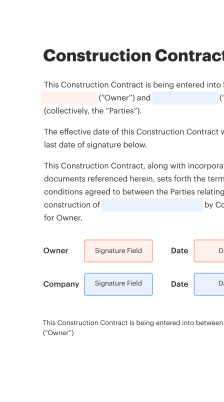
How online professional bill format for logistics works

A digital billing workflow captures shipment data, applies rules, and secures signatures to produce audit-ready invoices.

  • Populate: Auto-fill fields from TMS or spreadsheets.
  • Validate: Run rule checks and totals automatically.
  • Authorize: Collect approvals and eSignatures.
  • Archive: Store final invoices with audit logs.
Collect signatures
24x
faster
Reduce costs by
$30
per document
Save up to
40h
per employee / month

Quick setup steps for a logistics billing template

Follow these concise steps to build a compliant, reusable professional bill format for logistics.

  • 01
    Define fields: List required header and line-item fields.
  • 02
    Map codes: Standardize service and accessorial codes.
  • 03
    Add calculations: Embed automated charge formulas.
  • 04
    Enable approvals: Set reviewer and approver roles.
be ready to get more

Why choose airSlate SignNow

  • Free 7-day trial. Choose the plan you need and try it risk-free.
  • Honest pricing for full-featured plans. airSlate SignNow offers subscription plans with no overages or hidden fees at renewal.
  • Enterprise-grade security. airSlate SignNow helps you comply with global security standards.
illustrations signature

Recommended workflow settings for billing automation

Configure these workflow settings to automate distribution, reminders, and long-term storage for logistics invoices.

Feature Configuration
Reminder Frequency 48 hours
Signing Order Sequential
Expiration 30 days
Notification Email and SMS
Auto-archive On completion

Device and platform considerations for signing logistics bills

Ensure your chosen workflow supports the devices and browsers used by drivers, carriers, and finance teams to avoid signing friction.

  • Desktop: Modern browsers supported
  • Mobile: iOS and Android apps
  • Tablet: Responsive signing experience

Confirm offline signing options, minimal bandwidth requirements, and compatibility with enterprise identity providers to ensure field personnel and office staff can sign and validate invoices reliably.

Key security and protection controls

Data encryption: At-rest and in-transit
Role-based access: Permissioned user roles
Multi-factor authentication: Strong identity verification
Audit logging: Complete event records
Document watermarking: Tamper-evidence marks
Secure backups: Redundant storage copies

Logistics billing scenarios and outcomes

Two practical examples show how a professional bill format reduces disputes and speeds payment.

Freight forwarder consolidation billing

A freight forwarder issues a consolidated bill with standard shipment IDs and itemized accessorial charges

  • uses automation to attach scanned PODs and rate confirmations
  • reduces reconciliation time and prevents duplicate claims

Resulting in faster payments and fewer carrier disputes.

3PL invoice reconciliation

A third-party logistics provider sends template-based invoices aligned to client rate cards

  • applies conditional fields for detention and storage fees
  • allows client teams to validate charges against electronic delivery evidence

Leading to clearer chargebacks and shorter AR cycles for both parties.

Best practices for accurate and secure logistics invoices

Adopt consistent controls and procedures to minimize disputes and keep billing processes auditable and efficient.

Standardize line-item coding and descriptions
Use a controlled list of service codes and standardized descriptions for rates and accessorials so invoice recipients can quickly match charges to contracts and reduce manual validation time during reconciliation.
Automate calculations and validations
Embed automatic calculations for rates, taxes, and accessorials and run validation checks before sending to catch mismatched totals, missing shipment references, or invalid rate codes.
Capture consent and identity consistently
Record signer consent, IP addresses, timestamps, and authentication method to strengthen evidentiary value and comply with ESIGN/UETA standards for electronic acceptance.
Maintain a single source of truth
Integrate invoices with your TMS or accounting system and archive final signed files with audit logs to ensure consistent records for audits and dispute resolution.

FAQs About professional bill format for logistics

Common questions and practical answers about creating, sending, and managing a professional bill format for logistics.

Feature availability across eSignature providers

Comparison of common billing-related capabilities across leading eSignature vendors, focused on logistics needs.

Criteria signNow (Recommended) DocuSign Adobe Acrobat Sign
Legal compliance (U.S.) ESIGN/UETA ESIGN/UETA ESIGN/UETA
Mobile app availability
Bulk Send
API access and SDKs REST API REST API REST API
be ready to get more

Get legally-binding signatures now!

Document retention and important billing deadlines

Set retention and deadline policies to meet accounting cycles and regulatory expectations for logistics invoices.

Invoice issuance timeframe:

Issue within seven days of delivery

Payment terms standard:

Net 30 days typical

Dispute notification period:

Notify within 15 days

Record retention period:

Retain for seven years

Archive verification:

Annual integrity check

Pricing and tier overview for logistics billing

High-level pricing and plan characteristics to consider when selecting an eSignature provider for logistics invoicing.

Plan signNow (Recommended) DocuSign Adobe Acrobat Sign HelloSign PandaDoc
Free tier availability Limited free plan Trial only Trial only Limited free plan Limited free plan
Starting monthly price $8/user/mo $10/user/mo $14.99/user/mo $15/user/mo $19/user/mo
Bulk Send included Yes Yes Yes Limited Add-on
API access Available Available Available Available Available
Enterprise features Available Extensive Extensive Moderate Extensive
walmart logo
exonMobil logo
apple logo
comcast logo
facebook logo
FedEx logo
be ready to get more

Get legally-binding signatures now!