QuickBooks Custom Invoice Template for Financial Services

Unlock seamless document workflows with airSlate SignNow, the easy and cost-effective solution for sending and eSigning invoices.

Award-winning eSignature solution

What the quickbooks custom invoice template for financial services does

A quickbooks custom invoice template for financial services lets finance teams format invoices to match industry requirements, show itemized fees, and include regulated disclosures. Templates centralize branding, tax rules, payment links, and line-item detail while preserving accounting identifiers and integration points with QuickBooks. For firms handling sensitive client data, templates can be paired with compliant eSignature and secure storage workflows to support audits, dispute resolution, and consistent billing across accounts.

Why choose a specialized invoice template for financial services

A tailored quickbooks custom invoice template for financial services reduces billing errors, ensures consistent disclosures, and aligns invoices with regulatory and client expectations in finance practice workflows.

Why choose a specialized invoice template for financial services

Common challenges addressed by custom QuickBooks invoice templates

  • Inconsistent line-item detail across clients causes reconciliation delays and accounting inaccuracies that require manual correction.
  • Missing regulatory disclosures or fee breakdowns increase compliance risk and may trigger client disputes or audits.
  • Separate systems for invoicing and signatures create duplicate data entry and slow approval cycles for billable services.
  • Poorly formatted invoices reduce collection rates and complicate automated payment reconciliation within QuickBooks.

Representative user roles and responsibilities

Financial Advisor

A Financial Advisor uses custom QuickBooks invoice templates to present clear, itemized client charges, attach required disclosures, and request electronic signatures when authorizations are needed. They need templates that reflect fee schedules and support secure client delivery and payment links for straightforward reconciliation.

Accounting Manager

An Accounting Manager manages template configuration, ensures tax and regulatory fields are present, and coordinates integration with the general ledger. They also set approval workflows and retention rules to meet audit and compliance requirements for financial services billing.

Typical users and teams for these templates

Financial services firms, accounting teams, and client billing departments commonly adopt quickbooks custom invoice template for financial services to improve billing accuracy and compliance.

  • Independent financial advisors managing recurring client fees and statements.
  • Corporate accounting teams handling client billing and regulatory disclosures.
  • Outsourced billing providers supporting multiple financial services clients.

Adoption often spreads from billing administrators to finance leads and client relationship managers who require consistent, auditable invoices across portfolios.

Advanced template capabilities for enterprise needs

Larger practices often require conditional logic, multi-currency support, integration hooks, and audit features in invoice templates.

Conditional Logic

Show or hide fields based on service type or client classification to maintain relevant disclosures and simplify the invoice view.


Multi-Currency

Support currency selection and exchange-rate display for cross-border clients and consolidated reporting in the general ledger.

Auto Numbering

Sequential invoice numbering with prefixes for service lines aids compliance and simplifies reference during audits.

Tax Calculations

Configurable tax rules for jurisdictions ensure tax amounts post correctly to accounting categories.

Integration Hooks

API-ready template fields enable data exchange with CRM, billing platforms, and document-management systems for end-to-end automation.

Audit Trail

Secure, time-stamped records of edits, sends, signatures, and payments preserve a compliant chain of custody for invoices.

be ready to get more

Choose a better solution

Core template features that benefit financial services billing

Templates should include configurable fields, branding, built-in calculations, and payment options to meet the needs of financial services practices.

Template Fields

Configurable fields for client ID, service codes, fee schedules, tax calculations, and mandatory disclosures help ensure invoices meet internal and regulatory requirements while reducing manual edits.

Branding

Consistent logo, color palette, and footer text preserve firm identity and present a professional invoice layout for client-facing documents and archival records.

Line-Item Calculations

Automatic calculations for prorated fees, taxes, and discounts reduce arithmetic errors and ensure amounts posted to QuickBooks match client expectations and ledger entries.

Payment Links

Embedded payment options support ACH or card transactions and connect payment receipts to invoice records for faster reconciliation and fewer outstanding balances.
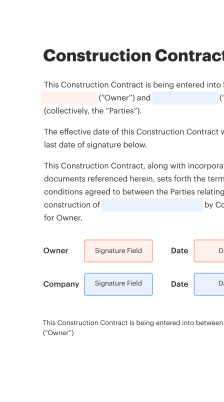
How online template creation and eSignature fit together

Online templates connect QuickBooks invoicing with eSignature workflows so clients can receive, review, sign, and pay without leaving a secure environment.

  • Generate Invoice: Create invoice from QuickBooks using the custom template.
  • Attach Signature: Add eSignature fields and assign signers as needed.
  • Deliver Securely: Send via secure email or platform link for client action.
  • Record Events: Capture signature and payment events in the audit trail.
Collect signatures
24x
faster
Reduce costs by
$30
per document
Save up to
40h
per employee / month

Quick setup: create a custom QuickBooks invoice template

Follow these concise steps to create and apply a quickbooks custom invoice template for financial services in your billing workflow.

  • 01
    Create Template: Open QuickBooks template editor and start a new invoice template.
  • 02
    Add Fields: Include client ID, fee type, tax, and regulatory disclosure fields.
  • 03
    Branding: Apply company logo, colors, and standardized footer text.
  • 04
    Save and Assign: Save template and assign to client groups or service types.

Complete the template: step-by-step actions to finalize invoices

Follow these detailed steps to prepare a ready-to-send invoice using your custom QuickBooks template.

01

Select Template:

Choose the appropriate financial services template.
02

Populate Client Data:

Import or enter client identifiers and service details.
03

Confirm Calculations:

Validate taxes, discounts, and totals.
04

Attach Supporting Docs:

Include statements or disclosure documents.
05

Add Signature Fields:

Place eSignature and date fields.
06

Send and Track:

Send to client and monitor the audit trail.
be ready to get more

Why choose airSlate SignNow

  • Free 7-day trial. Choose the plan you need and try it risk-free.
  • Honest pricing for full-featured plans. airSlate SignNow offers subscription plans with no overages or hidden fees at renewal.
  • Enterprise-grade security. airSlate SignNow helps you comply with global security standards.
illustrations signature

Typical workflow configuration for invoice templates and signatures

A basic workflow configuration maps template creation, approval routing, reminders, and storage so invoices flow consistently from draft to paid status.

Workflow Automation Setting Name Header Configuration
Reminder Frequency Configuration Interval Setting 48 hours
Auto-Invoice Creation Trigger Setting After service completion
Approval Required Toggle Setting Yes, two approvers
Signature Routing Mode Setting Sequential routing
Document Storage Location Setting Encrypted cloud folder

Device and platform requirements for template and signing access

Users can create, send, and sign invoices from modern desktop browsers and mobile apps, provided their environment meets standard security and browser updates.

  • Desktop Browsers: Chrome, Edge, Firefox supported
  • Mobile Platforms: iOS and Android apps available
  • Minimum Connectivity: Stable internet connection required

For secure handling in financial services, ensure devices run supported operating system versions, have up-to-date browsers or apps, and use multi-factor authentication to protect invoice delivery and signature actions.

Security features relevant to financial invoice templates

Data Encryption: AES-256 at rest
Transport Security: TLS 1.2+ in transit
Access Controls: Role-based permissions
Authentication Options: Multi-factor available
Audit Logging: Immutable event trail
Document Retention: Configurable retention policies

Industry examples using custom QuickBooks invoice templates

Two practical case examples show how templates streamline billing and compliance in different financial services settings.

Wealth Management Firm

A midsized wealth management firm standardized invoice templates to include advisory fee schedules and performance disclaimers

  • Template enforces standard fee breakdown and disclosure placement
  • Clients receive consistent invoices with embedded payment links and signature requests

Resulting in faster approvals, fewer client queries, and clearer audit trails that simplify month-end reconciliation and regulatory reporting.

Tax Preparation Service

A regional tax practice created QuickBooks templates that itemize preparation fees and retainers

  • Templates incorporate tax-year labels and required client authorizations
  • Clients can review, sign electronically, and pay via integrated gateways

Leading to reduced paper handling, improved collection timing, and cleaner integration with the firm’s general ledger for year-end reporting.

Best practices for secure and accurate invoice templates

Follow these best practices to reduce errors, strengthen compliance, and maintain clear auditability when using templates for financial services billing.

Standardize field usage and naming conventions
Use consistent field names and required field settings across templates so exported data maps cleanly to the general ledger and downstream systems, reducing reconciliation work.
Configure access roles and approval workflows
Limit template editing to trusted administrators and require approvals for final invoice issuance to prevent unauthorized changes and ensure quality control before client delivery.
Enable strong authentication and logging
Require multi-factor authentication for users with billing privileges and maintain detailed logs of template changes, sends, signatures, and payments for audit and forensic needs.
Test templates before production use
Run templates through staging scenarios, including edge cases like tax-exempt clients and multi-currency invoices, to verify calculations, fields, and integration points behave as expected.

FAQs About quickbooks custom invoice template for financial services

Common questions and concise solutions for creating, sending, and managing QuickBooks invoice templates used by financial services teams.

Platform capability comparison for invoice templates and signing

A quick comparison of platform capabilities relevant to financial services invoice templates and signing features.

Authentication and Platform Comparison Table Header signNow (Featured) DocuSign Adobe Sign
Electronic Signature Availability
Multi-factor Authentication Support
API for Template Automation REST API REST API REST API
HIPAA Business Associate Agreement Available Available Available
be ready to get more

Get legally-binding signatures now!

Retention and review schedule for signed invoices

Establish a schedule for regular review, retention, and archival of signed invoices to meet compliance and operational needs in financial services.

Annual Template Review:

Review templates annually for regulatory changes and fee schedule updates.

Quarterly Reconciliation Check:

Reconcile invoice totals with ledger entries each quarter.

Five-Year Record Retention:

Retain signed invoices for minimum five years or per local requirements.

Immediate Incident Review:

Investigate suspected unauthorized access within 72 hours.

Periodic Access Audit:

Audit user permissions and access logs semi-annually.

Regulatory risks and consequences

Noncompliance Penalties: Fines and sanctions
Data Breach Exposure: Notification obligations
Contract Disputes: Loss of fees
Reputational Harm: Client attrition risk
Recordkeeping Failures: Audit findings
Unauthorized Access: Legal liability

Pricing and plan characteristics across leading eSignature platforms

Compare plan-level pricing and commercial attributes that affect cost of ownership and suitability for financial services teams.

Platform Pricing and Feature Header signNow (Featured) DocuSign Adobe Sign HelloSign PandaDoc
Entry-level plan availability and cost Subscription plans with per-user billing and discounted annual rates Tiered per-user pricing with varying limits Subscription with per-user licensing and enterprise options Per-user plans with simple pricing tiers SMB plans focused on document workflows and integrated templates
API access for automation and integrations Available with developer API and SDKs Available with API and extensive documentation API available with Adobe developer tools API available for paid plans API included in business plans
Bulk sending or mass signature capability Bulk Send feature available for multiple recipients Bulk Send available Bulk Send available Limited bulk send Bulk send via higher tiers
Free trial and onboarding resources Free trial and online support resources Free trial with tutorials Trial available with guided onboarding Free trial with templates Trial and help center resources
Enterprise support and compliance options Enterprise plans include advanced support and compliance features Enterprise-grade options and compliance Advanced enterprise options and SOC compliance Enterprise support available Enterprise offerings with onboarding support
walmart logo
exonMobil logo
apple logo
comcast logo
facebook logo
FedEx logo
be ready to get more

Get legally-binding signatures now!