Sales Receipt Template for Purchasing Made Easy

See your billing procedure turn fast and smooth. With just a few clicks, you can complete all the required actions on your sales receipt template for Purchasing and other crucial documents from any gadget with internet access.

Award-winning eSignature solution

What a sales receipt template for purchasing is and when to use it

A sales receipt template for purchasing standardizes the documentation of a transaction by recording buyer and seller details, itemized purchases, prices, taxes, and payment method. It serves as proof of purchase for customers, a record for accounting, and a source for returns or warranty claims. Templates reduce manual entry, ensure consistent formatting across transactions, and can be adapted for single sales, bulk orders, or services. When used with an eSignature-capable platform, a template can also capture signer identity, timestamping, and an auditable trail that supports internal controls and external compliance requirements.

Why use a dedicated template for purchase receipts

A predefined sales receipt template for purchasing increases accuracy, speeds issuance, and ensures consistent records for accounting and customer service while simplifying audit and tax preparation workflows.

Why use a dedicated template for purchase receipts

Common challenges when issuing purchase receipts

  • Inconsistent fields and layout cause missing data and reconciliation delays across accounting systems.
  • Manual receipts increase transcription errors and make it hard to match payments to orders.
  • Lack of standardized templates complicates returns, refunds, and warranty validation for customers.
  • Paper receipts are easy to lose and require manual storage, limiting searchability and audit readiness.

Typical user roles who manage purchase receipts

Retail Manager

A retail manager oversees daily sales and returns, configures receipt templates for storewide use, and ensures receipts include required tax and return-policy language to support customer service and compliance.

Accounting Clerk

An accounting clerk uses standardized receipts to reconcile payments, import line-item data into ledgers, and maintain electronic records for audits, tax filings, and vendor reconciliations.

Who typically uses sales receipt templates for purchasing

Retailers, service providers, wholesalers, and finance teams rely on standardized sales receipt templates to document transactions accurately and support downstream processes.

  • Retail point-of-sale operators issuing receipts for in-person purchases and returns.
  • E-commerce merchants integrating receipts into order confirmation and accounting systems.
  • B2B sales and procurement teams documenting purchase orders converted to invoices and receipts.

Consistent templates reduce disputes, streamline bookkeeping, and make electronic storage and retrieval simpler across teams and platforms.

Additional advanced capabilities to consider in templates

Beyond core fields, these capabilities enhance workflow automation, authentication, and integration for robust receipt handling.

Auto-fill from CRM

Pull customer contact and billing data automatically to reduce manual errors and ensure receipts reflect the same details tracked in customer relationship systems.


Tax calculation rules

Apply jurisdictional tax rules dynamically so receipts show correct tax rates and calculations for multi-state transactions and e-commerce sales.

Conditional line items

Show or hide fields based on transaction type, such as shipping fees or service charges, keeping receipts concise and relevant to each purchase.

Custom branding

Include company logo and standardized brand text to make receipts recognizable and professionally consistent across channels.

Signature capture

Record customer or authorized signer acceptance when required for high-value purchases or service agreements, and log signer identity and timestamp.

Integration hooks

Expose webhooks or APIs so receipts trigger downstream processes like shipping, inventory adjustment, or accounting entries automatically.

be ready to get more

Choose a better solution

Core features to include in a purchasing receipt template

Select features that improve accuracy, legal clarity, and interoperability with accounting and CRM systems when designing a receipt template.

Itemization

Detailed line items, quantities, unit prices, discounts, and tax breakdowns give clarity for both buyers and accounting systems and support seamless imports into bookkeeping tools.

Payment details

Capture payment method, transaction ID, and confirmation status to reconcile with processor reports and reduce manual matching errors during month-end close.

Return and warranty terms

Include concise return windows, restocking fees, and warranty coverage so customers understand post-sale options and disputes are minimized.

Digital delivery options

Support emailed PDFs, downloadable links, and direct uploads to cloud storage to meet customer preferences and preserve receipts for audits.
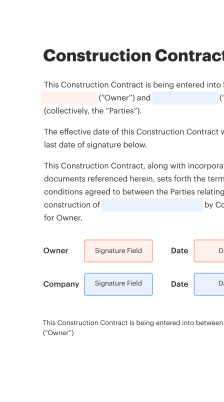
How a template moves through a purchase workflow

A template becomes part of a transaction flow that creates, signs, stores, and notifies relevant parties—streamlining the receipt lifecycle.

  • Initiate: Create a receipt from an order or invoice.
  • Populate: Auto-fill customer and item data from systems.
  • Sign/Confirm: Capture signature or payment confirmation.
  • Archive: Store the signed receipt in cloud storage.
Collect signatures
24x
faster
Reduce costs by
$30
per document
Save up to
40h
per employee / month

Quick setup: create a sales receipt template for purchasing

Follow these foundational steps to configure a reusable sales receipt template that captures required transaction details and integrates with accounting.

  • 01
    Define fields: List buyer, seller, items, totals, tax, and payment method.
  • 02
    Set formatting: Arrange layout for print and digital delivery consistency.
  • 03
    Add policies: Include return, warranty, and tax-disclosure language.
  • 04
    Enable delivery: Choose email, PDF attachment, and cloud storage options.

Step-by-step: complete and send a purchase receipt

Follow these concise operational steps when finalizing and delivering a sales receipt to a purchaser.

01

Collect order data:

Confirm items, quantities, prices, and discounts.
02

Verify taxes:

Apply correct tax jurisdiction rates.
03

Populate template:

Auto-fill buyer and seller fields.
04

Capture payment:

Record payment method and transaction ID.
05

Obtain confirmation:

Request signature or acknowledgment where required.
06

Archive copy:

Save signed receipt to secure storage.
be ready to get more

Why choose airSlate SignNow

  • Free 7-day trial. Choose the plan you need and try it risk-free.
  • Honest pricing for full-featured plans. airSlate SignNow offers subscription plans with no overages or hidden fees at renewal.
  • Enterprise-grade security. airSlate SignNow helps you comply with global security standards.
illustrations signature

Workflow settings to automate receipt issuance

Configure these workflow settings to automate receipt population, delivery, and archival as part of a purchasing process.

Feature Configuration
Reminder Frequency for Pending Signers Every 48 hours until signed
Auto-archive Destination Folder Finance/Receipts/Yearly
Delivery Method for Customers Email PDF and cloud link
Signature Authentication Level Email link with optional MFA
Webhook for Accounting Integration Send JSON to ERP endpoint

Platform and device compatibility for issuing receipts

Verify that your chosen receipt template and eSignature platform work reliably across desktop, tablet, and mobile devices before wide deployment.

  • Desktop browsers: Chrome, Edge, Safari supported
  • Mobile operating systems: iOS and Android apps available
  • Offline capability: Limited offline signing support

Confirm browser versions and mobile OS compatibility, and test PDF rendering and signature capture on devices used by frontline staff and customers.

Security controls relevant to purchase receipt templates

Encryption at rest: AES-256 encrypted storage
Encryption in transit: TLS 1.2+ session encryption
Access controls: Role-based permissions
Authentication options: Multi-factor authentication
Document watermarking: Optional visible watermarks
Audit logging: Immutable activity records

Industry examples using sales receipt templates for purchasing

Two concise case scenarios show how templates simplify transactions for different industries while improving accuracy and recordkeeping.

Retail store receipt

A mid-size clothing retailer standardizes a sales receipt template with SKU-level itemization and return policy language

  • Template auto-populates sales tax and loyalty discounts
  • Customers receive an emailed PDF copy with a unique transaction ID

Resulting in faster reconciliations and fewer return disputes for store and online orders.

Professional services invoice receipt

A consulting firm issues purchase receipts after milestone payments using a template that lists services, hours, and retainers

  • Template includes payment method and invoice reference
  • Client receives an e-signed receipt for expense documentation

Leading to clearer client accounting and faster internal revenue recognition.

Best practices for accurate and compliant purchasing receipts

Follow these practical recommendations to keep sales receipt templates precise, legally sound, and useful for accounting and customer service.

Keep required tax and identification fields visible
Ensure templates always include seller tax ID, itemized taxes, and invoice or receipt numbers to support tax filings and reduce audit queries from tax authorities.
Use standardized field names and formats
Adopt consistent date, currency, and quantity formats across templates to streamline imports into accounting software and avoid reconciliation errors during reporting cycles.
Automate population from source systems
Integrate templates with POS, ERP, or CRM systems to reduce manual entry, eliminate transcription mistakes, and maintain a single source of truth for transaction details.
Retain signed receipts per policy
Define retention periods aligned with tax law and internal audit policy, and ensure receipts are stored in encrypted, searchable archives to meet compliance and retrieval needs.

FAQs About sales receipt template for purchasing

Common questions and fixes related to creating, sending, signing, and storing purchase receipts using digital templates.

Feature availability: signNow compared with other providers

A concise capability matrix comparing signNow with other widely used eSignature providers for receipt workflows.

Capability Criteria and Availability Overview signNow (Recommended) DocuSign Adobe Sign
Mobile App Availability Across Platforms
API Access for Automation REST API REST API REST API
Bulk Send for Multiple Recipients
HIPAA Compliance Options Available Available Available
be ready to get more

Get legally-binding signatures now!

Recommended document retention and key schedule items

Set clear retention periods and deadlines for backup, review, and deletion to align with tax and audit requirements.

Standard retention period:

Maintain receipts for seven years for tax and audit purposes.

Regular backups schedule:

Daily backups with weekly integrity checks.

Periodic audit review:

Quarterly reconciliation of stored receipts.

Secure deletion timing:

Purge expired records after retention period.

Access review cadence:

Review user permissions every six months.

Risks and regulatory gaps to avoid

Incomplete receipts: Disputes
Poor retention: Noncompliance
Weak authentication: Unauthorized changes
Insufficient logs: Audit failures
Unencrypted data: Exposure risk
Incorrect tax info: Penalties

Pricing snapshot for receipt and eSignature platforms

High-level pricing and plan information for common eSignature vendors used with purchase receipt templates; costs vary by plan and contract.

Pricing Metric Overview signNow (Recommended) DocuSign Adobe Sign Dropbox Sign PandaDoc
Starting monthly price per user From $8 per user per month From $10 per user per month From $9.99 per user per month From $15 per user per month From $19 per user per month
Free trial availability Yes, 7–14 days Yes, 30 days Yes, 7 days Yes, 14 days Yes, 14 days
API access on entry plan Included on business tiers Limited on higher tiers Included on business tiers Available on paid plans Available on paid plans
Typical document limits Unlimited on paid plans Varies by plan Varies by plan Tiered limits Tiered limits
Support and SLAs Email and chat; paid SLA options Phone and chat; SLA options Phone and enterprise SLA options Email support; enterprise SLA Email and priority support on plans
walmart logo
exonMobil logo
apple logo
comcast logo
facebook logo
FedEx logo
be ready to get more

Get legally-binding signatures now!