



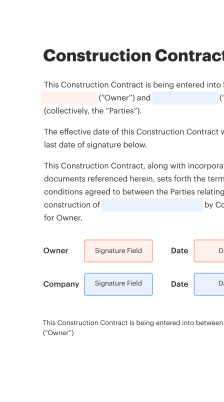
Sample of Invoice Receipt for Businesses

Sample of invoice receipt for businesses provides a clear template for accurate record-keeping. SignNow ensures secure and compliant electronic signatures for your documents.

Award-winning eSignature solution

What a sample of invoice receipt for businesses is and why it matters

A sample of invoice receipt for businesses is a formal document confirming payment has been received for goods or services, combining invoice details with a receipt acknowledgment. It typically lists payer and payee information, invoice number, date issued, items or services paid, amounts, taxes, payment method, and a signature or authentication element. For businesses, using a consistent sample invoice receipt improves bookkeeping accuracy, supports tax reporting, provides proof during audits or disputes, and helps maintain professional financial records across accounting systems and integrations.

Why standardized invoice receipts improve business operations

Using a clear, standardized sample of invoice receipt for businesses reduces reconciliation time, supports compliance with recordkeeping rules, and provides consistent proof of payment for customers and internal teams.

Why standardized invoice receipts improve business operations

Common challenges when managing invoice receipts

  • Missing or inconsistent invoice numbers that complicate reconciliation and audit trails.
  • Delayed issuance of receipts after payment causing customer confusion and follow-up work.
  • Manual entry errors when copying invoice details into receipts and accounting systems.
  • Poor storage or inconsistent retention policies leading to lost or inaccessible records.

Representative user profiles and roles

Accounts Payable Manager

Responsible for matching incoming payments to outstanding invoices, managing vendor receipts, and ensuring records meet internal control requirements. This role often needs batch receipt generation, retention scheduling, and audit-ready documentation for quarterly and annual reviews.

Independent Contractor

Issues invoice receipts to clients after payment, tracks due dates, and maintains organized records for taxes. The contractor benefits from templates that include service descriptions, tax details, and payment confirmation to streamline bookkeeping.

Typical users and teams that rely on invoice receipts

Different teams use a sample of invoice receipt for businesses to confirm payments, reconcile accounts, and support compliance across operations.

  • Accounts payable and receivable teams reconciling payments and matching bank deposits to invoices.
  • Sales and client services confirming completed transactions and updating CRM records.
  • Small business owners and freelancers issuing receipts to document customer payments quickly.

Clear receipt templates help finance, sales, and operations communicate payment status accurately and reduce questions from customers and auditors.

be ready to get more

Choose a better solution

Integrations that simplify invoice receipt workflows

Connecting a sample of invoice receipt for businesses to common business apps reduces manual entry and keeps accounting records synchronized across platforms.

Google Workspace

Generate receipts directly from Google Docs or Sheets and push finalized receipts into shared Drive folders with structured file names, reducing duplicate entry and making receipts immediately available to teams for reconciliation and audit purposes.

CRM systems

Sync invoice receipt issuance with CRM records so payment confirmations update opportunity and account stages automatically, preserving revenue dates and preventing missed renewals or incorrect account balances when multiple invoices exist.

Cloud storage

Store signed receipts in Dropbox or other cloud repositories with automatic folder rules and versioning, enabling easy retrieval, backup, and centralized retention policies across business units and locations.

Accounting platforms

Push receipt data and PDF copies to accounting software to auto-match payments against open invoices, which streamlines bank reconciliation and improves the accuracy of financial statements.

Creating and delivering invoice receipts online

A typical online workflow for a sample of invoice receipt for businesses moves from document creation to delivery and archival with verification steps included.

  • Create document: Use a template or upload invoice and add payment confirmation.
  • Apply authentication: Add signature or digital certificate for nonrepudiation.
  • Send to recipient: Deliver via email or secure link with access controls.
  • Store record: Archive a signed copy with retention metadata.
Collect signatures
24x
faster
Reduce costs by
$30
per document
Save up to
40h
per employee / month

How to prepare a standard invoice receipt quickly

Follow these core steps to produce a clear, audit-ready sample of invoice receipt for businesses that meets typical accounting and legal needs.

  • 01
    Collect details: Gather invoice number, date, payer and payee names.
  • 02
    List payments: Specify amounts, taxes, discounts, and payment method.
  • 03
    Add references: Include purchase order or contract identifiers if applicable.
  • 04
    Authenticate: Add signature, stamp, or digital authentication element.
be ready to get more

Why choose airSlate SignNow

  • Free 7-day trial. Choose the plan you need and try it risk-free.
  • Honest pricing for full-featured plans. airSlate SignNow offers subscription plans with no overages or hidden fees at renewal.
  • Enterprise-grade security. airSlate SignNow helps you comply with global security standards.
illustrations signature

Recommended workflow settings for invoice receipt processing

Configure these workflow settings to automate common receipt tasks, reduce manual work, and ensure consistent handling of paid invoices across teams.

Workflow Setting Name and Configuration Value Value
Reminder Frequency for Pending Signatures 48 hours
Automatic Invoice Numbering Format INV-{YYYY}{MM}-{0001}
Signer Authentication Level Required Email + SMS
Template Assignment for Recurring Clients Client-specific
Document Retention Period and Policy 7 years

Security and protection features for invoice receipts

Encryption at rest: AES-256 or equivalent
Encryption in transit: TLS 1.2+ secure channels
Access controls: Role-based permissions
Multi-factor authentication: Optional for signers
Audit logging: Full transaction history
Document watermarking: Tamper-evident marks

Industry examples showing practical use of invoice receipts

These brief case studies illustrate how different organizations adapt a sample of invoice receipt for businesses to operational needs and compliance demands.

Healthcare practice billing

A regional clinic issues invoice receipts that include patient account references and insurer details to document payments

  • Includes line items for CPT-coded services
  • Reduces insurance reconciliation time and clarifies patient responsibility

Resulting in faster posting of payments and clearer audit records for HIPAA-compliant billing.

B2B services firm

A consulting company integrates receipts with its CRM so payment confirmations automatically update opportunity records

  • Receipt contains invoice number and project code
  • This ensures accurate revenue recognition and keeps client accounts current

Leading to fewer billing disputes and improved month-end close efficiency.

Best practices for secure, accurate invoice receipts

Adopt consistent formatting, authentication, and retention rules to ensure invoice receipts are reliable records for accounting, customers, and regulators.

Always include a unique invoice number and payment reference
Assign and display a unique invoice number and include the payment transaction ID to make reconciliation straightforward and to support clear audit trails when matching receipts against bank deposits.
Record precise payment method and settlement details
Document the payment method, last four digits for cards, payer name, and settlement date so reverse charges or disputes can be resolved quickly and records remain comprehensive for tax filings.
Apply consistent retention and access controls
Implement document retention policies that meet tax and regulatory requirements, ensure encrypted storage, and restrict access to authorized personnel to reduce risk and preserve evidentiary integrity.
Use authenticated signatures for nonrepudiation of receipts
Include a signed confirmation or digital certificate to provide legal assurance of payment acknowledgment and to support admissibility in disputes, while capturing an audit trail of signer identity and timestamps.

FAQs and troubleshooting for invoice receipt issues

Common questions and resolutions for problems encountered when creating, sending, or storing a sample of invoice receipt for businesses.

Feature and compliance comparison among major eSignature providers

This concise table compares core capabilities and compliance posture for commonly used eSignature providers when issuing invoice receipts and payment confirmations.

Feature and Compliance Criteria Table signNow (Recommended) DocuSign Adobe Sign
Electronic signature legal compliance status
HIPAA compliance options available Available Available Available
API availability and developer tools
Bulk send and mass distribution limits High capacity Moderate capacity Moderate capacity
be ready to get more

Get legally-binding signatures now!

Risks and penalties from improper receipt handling

Tax filing errors: Incorrect tax reporting
Failed audits: Noncompliant records
Data breaches: Unauthorized data access
Payment disputes: Unresolved customer claims
Contract violations: Breach of terms
Regulatory fines: Penalties for noncompliance

Pricing and plan comparison for common eSignature tools

Overview of typical plan features and starting points for five established eSignature providers to consider when digitizing invoice receipt issuance and storage.

Pricing and Feature Matrix signNow (Recommended) DocuSign Adobe Sign Dropbox Sign PandaDoc
Free tier availability Yes — basic eSignatures and editable templates at no cost No free tier for business use No free tier for business use Yes — limited eSignatures included for basic use Yes — limited free plan for individuals and trials
Starter plan starting price Starts around $8 per user per month billed annually Starts around $10 per user per month billed annually Starts around $9.99 per user per month billed annually Starts near $7 per user per month billed annually Starts near $19 per user per month billed annually
Enterprise capabilities included Advanced admin controls, SSO, and custom domains available Comprehensive enterprise features and global compliance Enterprise workflows and advanced security included Enterprise options with admin controls and SSO Sales-focused automation and advanced templates included
API access and developer support REST API with SDKs and documentation; tiered rate limits Robust API with broad ecosystem support and SDKs API available with Adobe platform integrations and tooling API available via Dropbox developer program API and developer tools focused on document workflows
HIPAA-compliant offerings HIPAA compliance options and BAAs available upon request HIPAA-ready options with BAAs for covered use cases HIPAA support through enterprise offerings Limited HIPAA support — contact vendor HIPAA options require enterprise plan and agreement
Support and onboarding services Self-service resources plus paid onboarding and enterprise support tiers Premium support options and professional services available Enterprise onboarding and dedicated support available Standard support with paid enterprise support options Customer success and onboarding for enterprise customers
walmart logo
exonMobil logo
apple logo
comcast logo
facebook logo
FedEx logo
be ready to get more

Get legally-binding signatures now!