Conditional fields
Fields that appear based on earlier answers let templates adapt dynamically to different token types, royalty arrangements, or transfer conditions without creating multiple documents.



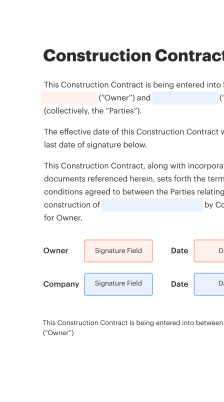
Using a template speeds execution and enforces consistent token metadata and legal clauses across multiple NFT agreements.

A sole creator or small studio issuing tokenized artworks who needs a reliable agreement covering IP transfer, resale royalties, and delivery mechanics. They require a simple template that includes metadata fields, signature blocks, and a clear record of transfer to show provenance and royalty tracking.
A compliance or legal specialist at a marketplace who configures templates to align with KYC, takedown policies, and platform terms. They use templates to ensure every listing follows the platform’s legal framework and to produce auditable documents for disputes or regulatory review.
Companies, creators, and legal teams creating repeatable token sale or transfer documents rely on templates to scale execution reliably.
Templates help teams enforce consistent terms, reduce review cycles, and produce audit-ready execution records for each signed NFT contract.
Fields that appear based on earlier answers let templates adapt dynamically to different token types, royalty arrangements, or transfer conditions without creating multiple documents.
Versioned templates with field mapping and API endpoints enable automated issuance workflows and integration with minting platforms or CRM systems.
Bulk Send functionality lets operations batch the same template to many recipients with unique prefilled metadata, speeding large drops or issuance runs.
Template-level branding ensures the signed contract presents consistent corporate identity and legal notices to buyers and partners.
Routing rules route contracts to different reviewers or approvers based on contract values, jurisdiction, or business unit needs.
Exportable execution logs and signed PDFs support internal audits, legal reviews, and regulatory reporting.
Structured fields for token ID, token URI, edition number, royalty percentage, and any custom metadata allow consistent data capture and reduce manual entry errors when issuing or transferring NFTs.
Define signer roles such as creator, custodian, or buyer with clear signing order and permissions to ensure each party signs the correct sections in the proper sequence for enforceable agreements.
Support for multiple authentication methods—email verification, SMS codes, and stronger identity checks—lets administrators balance usability and security depending on transaction risk and platform requirements.
An immutable audit trail captures timestamps, IP addresses, and signature events, and can include blockchain transaction hashes to link the off-chain contract to on-chain transfers for provenance.
| Feature | Configuration |
|---|---|
| Automatic reminder email frequency setting | 48 hours; two reminders |
| Signer identity verification method selection | Email + SMS verification |
| Template routing, approval and escalation sequence | Sequential with manager approval |
| Retention and archival lifecycle policy configuration | 7 years encrypted storage |
| Webhook callback and API event configuration | Notify on signed and archived |
sign nft contract template workflows are typically compatible across browsers and mobile apps, but device capabilities affect authentication and document rendering.
For consistent results, test templates on target platforms, confirm authentication flows (SMS, authenticator apps), and ensure mobile PDF rendering preserves NFT metadata fields and required signature blocks.
An independent artist uses a template to issue 50 limited-edition NFTs with identical license terms and metadata fields
Resulting in streamlined sales and clear downstream licensing records that reduce post-sale disputes.
A digital marketplace provides a seller template that includes KYC requirements, transfer mechanics, and dispute resolution clauses
Leading to standardized listings, faster moderation, and improved regulatory traceability across transactions.
| Feature | signNow (Recommended) | DocuSign | Adobe Acrobat Sign |
|---|---|---|---|
| Basic eSignature | |||
| Bulk Send | |||
| Advanced authentication options | SMS & email | SMS/Phone | SMS, Email, KBA |
| API template support | Versioned API templates | API templates | API templates |
7 years
Annually
10 years
Every 6 months
After retention expires
| Plan | signNow (Recommended) | DocuSign | Adobe Acrobat Sign | Dropbox Sign | OneSpan Sign |
|---|---|---|---|---|---|
| Free tier or trial availability | Free trial and limited free plan available | Free trial only | Free trial only | Free trial with limited sends | Trial available for enterprise |
| API access availability | API on Business plans and up | API on Business Pro | API via Acrobat Sign plans | API with Business tiers | API for enterprise customers |
| Bulk sending capability | Included on mid-tier plans | Available on higher-tier plans | Included on business plans | Included on business plans | Enterprise feature set |
| HIPAA support options | Business/Enterprise BAAs available | BAAs for enterprise customers | BAAs on enterprise | Available via enterprise agreements | Enterprise-level compliance |
| Typical enterprise focus | SMBs to enterprise with API focus | Large enterprises and ecosystems | Enterprises with Adobe stack integration | SMBs and mid-market | Financial and regulated enterprises |