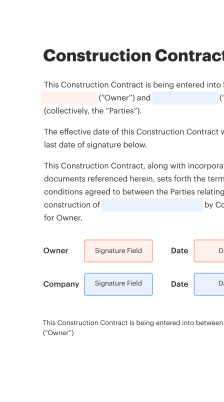
Simple Invoice Format in Excel for Healthcare

See your invoice workflow turn quick and seamless. With just a few clicks, you can perform all the required actions on your simple invoice format in excel for Healthcare and other important files from any device with web connection.

Award-winning eSignature solution

What a simple invoice format in Excel for healthcare includes

A simple invoice format in Excel for healthcare is a structured spreadsheet template designed to capture patient or payer details, service codes, procedure dates, itemized charges, insurance adjustments, and payment terms. It balances clinical billing requirements with administrative clarity, allowing small clinics, private practices, and billing departments to record charges and produce a printable invoice. The template typically uses consistent column headings, formula-driven totals, and optional conditional formatting to flag unpaid balances. When paired with secure eSignature and storage solutions, it supports electronic approval and retains a verifiable record for audits.

Why use an Excel invoice template in healthcare

A simple Excel invoice format standardizes billing entries, reduces transcription errors, and accelerates reimbursements while remaining compatible with accounting and EHR exports.

Why use an Excel invoice template in healthcare

Common billing challenges this format addresses

  • Inconsistent line-item descriptions that delay payer processing and increase denial risk.
  • Manual arithmetic errors when totals, taxes, or adjustments are calculated by hand.
  • Difficulty tracking partial payments and insurance adjustments across multiple invoices.
  • Lack of a consistent template that leads to missing required payer information.

Roles and profiles that benefit most

Clinic Administrator

Responsible for day-to-day billing, the clinic administrator uses the Excel invoice to verify patient information, apply insurance adjustments, and ensure totals and payment terms are correct before issuing invoices or uploading for electronic signature and storage.

Medical Biller

The medical biller prepares claim summaries and itemized invoices, maps CPT/HCPCS codes to charges, follows up on unpaid claims, and uses the template to export data into accounting tools or to attach supporting documentation for audits.

Who typically uses a simple invoice format in Excel for healthcare

Small medical practices, outpatient clinics, and solo practitioners rely on concise Excel invoices to manage patient and payer billing without complex practice management systems.

  • Small clinics needing low-cost, auditable invoicing for patient balances and private payers.
  • Physician offices preparing statements for patients and supplementary billing to insurers.
  • Billing specialists reconciling payments against itemized charges and adjustments.

These templates also support administrative staff and third-party billers who need a portable, reviewable invoice format that integrates with reporting and archival workflows.

Additional tools that enhance invoice management

Consider adding complementary capabilities to the template and workflow to scale billing and maintain compliance as volume grows.

Template versions

Maintain multiple invoice layouts for different payer types or service lines to reduce rework and ensure required fields are present.

Prebuilt formulas

Include built-in formulas for co-insurance, copays, write-offs, and tax calculations to standardize financial results across invoices.

Protected fields

Lock critical formula cells and header information to prevent accidental edits while allowing entry in designated data fields.

Digital signature support

Enable signed approvals for patient financial responsibility, guarantor agreements, or internal authorization using compliant eSignature systems.

Version control

Track template revisions so teams can revert to prior versions and maintain a clear change history for audits.

Integration hooks

Plan for simple import/export mappings to EHRs, accounting platforms, and cloud storage to reduce manual rekeying.

be ready to get more

Choose a better solution

Core features to include in the template workflow

When pairing an Excel invoice format with digital tools, prioritize features that improve accuracy, compliance, and integration across billing systems.

Auto-calculation

Formulas that compute line totals, subtotals, discounts, insurance adjustments, and final balance reduce manual errors and ensure consistent numeric results across invoices.

Standardized codes

A dedicated column for CPT, HCPCS, and ICD-10 codes standardizes billing entries, helps with payer validation, and simplifies exports to clearinghouses or accounting systems.

Conditional alerts

Conditional formatting or data validation flags missing fields, unusual charge amounts, or mismatched patient data, helping staff catch issues before sending invoices.

Export options

Templates should support PDF export and CSV extraction for signing, archival, and integration with practice management or accounting software.

How to use the Excel invoice with eSignature and storage

This outlines a straightforward flow for finalizing, signing, and archiving invoices while maintaining compliance and traceability.

  • Draft: Populate invoice fields and verify charges.
  • Validate: Confirm insurance adjustments and totals.
  • Sign: Apply an electronic signature for approval.
  • Archive: Store securely with audit metadata.
Collect signatures
24x
faster
Reduce costs by
$30
per document
Save up to
40h
per employee / month

Quick setup: build the Excel invoice template

Follow these essential steps to create a reusable invoice template tailored for healthcare billing and reconciliation.

  • 01
    Header details: Add clinic name, address, and tax ID.
  • 02
    Patient section: Include patient name, DOB, account number.
  • 03
    Itemized charges: List date, CPT/HCPCS, units, and unit price.
  • 04
    Totals and notes: Calculate totals, adjustments, and payment terms.

Audit trail and recordkeeping steps

Maintain a clear sequence of actions for each invoice to meet audit and compliance expectations in healthcare billing environments.

01

Create record:

Save initial draft with timestamp.
02

Validate data:

Confirm codes and patient details.
03

Request approval:

Route to authorized signer.
04

Capture signature:

Record signer identity and time.
05

Export PDF:

Generate a locked PDF for archive.
06

Store securely:

Retain with audit metadata.
be ready to get more

Why choose airSlate SignNow

  • Free 7-day trial. Choose the plan you need and try it risk-free.
  • Honest pricing for full-featured plans. airSlate SignNow offers subscription plans with no overages or hidden fees at renewal.
  • Enterprise-grade security. airSlate SignNow helps you comply with global security standards.
illustrations signature

Workflow settings for invoicing and approvals

Configure these settings to enforce consistency and automate routine notifications in the invoice approval lifecycle.

Setting Name Configuration
Reminder Frequency 48 hours
Approval Requirement One signer
Auto-archive Delay 30 days
Notification Recipients Billing team
Retry Attempts 3 retries

Supported platforms and device considerations

Ensure your Excel invoice workflow and any eSignature tools are compatible with the devices your team uses, including mobile and desktop environments.

  • Desktop: Windows and macOS supported
  • Mobile: iOS and Android apps
  • Browser: Modern Chrome, Edge, Safari

For consistent performance, keep office software updated, use current browser versions, and enforce secure device policies including screen locks and disk encryption to protect invoice data across devices.

Security and protection options for Excel invoices

Password protection: Encrypt file access
Cell locking: Prevent unauthorized edits
Redaction tools: Remove PHI on exports
Secure storage: Encrypted cloud retain
Access controls: Role-based permissions
Audit logging: Track user actions

Practical examples of the template in use

Two brief case examples show how a simple Excel invoice format handles common healthcare billing scenarios.

Private Practice Statement

A solo primary care practice issues an itemized invoice after an office visit, including CPT codes and copay amounts

  • compact CPT/charge mapping
  • shows patient responsibility and insurance adjustment

Resulting in faster patient payments and a clearer audit trail for the practice.

Outpatient Clinic Batch Billing

An outpatient therapy clinic generates weekly Excel invoices for several patients, consolidating visit dates and unit counts

  • batch line items for efficiency
  • includes insurance claim IDs for reconciliation

Leading to reduced administrative time and simpler remittance posting during reconciliation.

Best practices for secure and accurate Excel invoicing

Adopt pragmatic controls and consistent procedures to improve accuracy, speed, and compliance when using Excel for healthcare invoices.

Use standardized code lists and validation
Maintain up-to-date CPT, HCPCS, and ICD-10 lists in a separate lookup sheet and apply data validation to reduce coding errors. Regularly reconcile charge master entries with clinical documentation to avoid denials and ensure consistent invoicing.
Protect and limit access to invoice files
Encrypt files at rest and in transit, restrict editing to authorized roles, and grant view-only access for non-billing staff. Log access and changes to maintain an audit trail aligned with privacy policies.
Integrate signing and archival workflows
Combine PDF exports, compliant eSignature, and encrypted cloud storage to capture approvals, maintain tamper-evidence, and support later audits without relying on local files that are harder to control.
Document processes and retention policies
Create written procedures for invoice preparation, approval, correction, and retention. Include timelines, responsible parties, and escalation steps to standardize handling and ensure regulatory consistency.

FAQs and troubleshooting for Excel healthcare invoices

Common questions and concise troubleshooting steps for typical issues when preparing, signing, and archiving Excel invoices in healthcare settings.

Feature availability across common eSignature platforms

A concise capability comparison for features relevant to healthcare Excel invoice workflows and compliance.

eSignature Platform signNow (Recommended) DocuSign Adobe Sign
HIPAA Support
API Access Full Full Full
Bulk Send
EHR Integrations EHR connectors Marketplace apps Third-party apps
be ready to get more

Get legally-binding signatures now!

Regulatory risks to consider

HIPAA exposure: PHI leakage
Incorrect billing: Claim denials
Retention failures: Noncompliance fines
Unauthorized access: Breach notifications
Audit gaps: Missing records
Signature disputes: Legal challenges

Pricing snapshot for popular eSignature platforms

Representative starting plan and common purchasing details for teams that will sign or manage Excel-based healthcare invoices.

Platform signNow (Recommended) DocuSign Adobe Sign HelloSign PandaDoc
Starting Price (per user) $8/user/mo $10/user/mo $9.99/user/mo $15/user/mo $19/user/mo
Free Trial Yes Yes Yes Yes Yes
Mobile App Yes Yes Yes Yes Yes
Bulk Send Yes Yes Yes Yes Yes
API Access Yes Yes Yes Yes Yes
walmart logo
exonMobil logo
apple logo
comcast logo
facebook logo
FedEx logo
be ready to get more

Get legally-binding signatures now!