Time and Material Invoice Template for Teams

Streamline your invoicing process with airSlate SignNow’s easy-to-use features. Enhance collaboration and save costs while managing documents seamlessly.

Award-winning eSignature solution

What the time and material invoice template for teams covers

A time and material invoice template for teams standardizes billing for services charged by labor hours and consumable materials. It defines hourly rates, resource categories, material costs, markup rules, tax treatment, and subtotal calculations so teams can produce consistent invoices across projects. For distributed teams the template supports multiple time entries, aggregated totals, and per-line descriptions to preserve billing transparency. When combined with a secure eSignature and document workflow platform, the template becomes part of an auditable billing process that reduces disputes and clarifies payment terms.

Why teams use a shared time and material invoice template

A standardized template reduces billing errors, accelerates invoice preparation, and ensures consistent cost breakdowns across client engagements.

Why teams use a shared time and material invoice template

Common challenges when managing time and material invoices

  • Inconsistent line-item descriptions lead to client confusion and invoice disputes if not standardized.
  • Missing time entries or delayed submission by staff causes underbilling and reconciliation delays.
  • Complex tax rules and regional rates increase the risk of incorrect totals for multi-state work.
  • Manual PDF edits and paper signatures create long processing times and weaken audit trails.

Representative user roles and responsibilities

Billing Administrator

Billing administrators configure the team template, set default hourly rates and tax settings, and validate invoices before they are issued. They coordinate with project managers to ensure time entries are complete, reconcile adjustments, and maintain invoice version control for audit purposes.

Project Manager

Project managers collect timesheets from team members, review material receipts and time logs, approve final line items, and communicate billing nuances to clients. They ensure entries match project scope and confirm any change orders prior to invoicing.

Which team roles benefit most from a shared template

Managers and billing administrators use team templates to ensure consistent invoicing and to enforce rate policies across projects.

  • Project managers who consolidate timesheets and approve line items before billing.
  • Accounting staff who need uniform invoice format for ledger posting and tax reporting.
  • Field technicians or contractors who submit hourly and materials records for client billing.

Operations and finance teams rely on standardized templates to reconcile revenue, track billable hours, and support audits efficiently.

Advanced features that enhance team templates

Advanced templating adds automation, reporting, and controls that scale across teams and projects.

Conditional logic

Apply conditional fields and automated rate selection based on project type, client tier, or job role to reduce manual adjustments and ensure consistent billing criteria.


Bulk invoicing

Generate and send multiple invoices from aggregated time entries for large projects or recurring billing cycles to improve throughput and reduce per-invoice overhead.

Custom calculations

Support for custom formula fields to express complex billing rules such as escalators, blended rates, and cumulative discounts within the template.

Localized tax rules

Automatic application of regional tax rates and exemptions for multi-state services to maintain compliance with state and local tax regulations.

Reporting and analytics

Built-in dashboards that summarize billable hours, material spend, margins, and aging to inform forecasting and resource allocation.

Template APIs

Programmatic access to create, populate, and send templates from external systems for end-to-end automation.

be ready to get more

Choose a better solution

Template capabilities to look for in a team solution

Effective templates combine calculation accuracy with team controls, auditability, and integration options to streamline billing.

Line-item calculations

Automatic hour and material arithmetic with support for tiered rates, overtime calculations, per-line tax codes, and configurable markup percentages to ensure accurate totals without manual spreadsheets.

Approval workflows

Role-based routing that sends invoices to designated approvers, supports conditional approvals for overages, and records reviewer comments to preserve decision history for finance teams.

Template versioning

Maintain multiple template versions for different service types, lock historical templates for audit integrity, and allow staged updates with administrative review before team rollout.

Integrations

Connect templates to time-tracking, accounting, and CRM systems so entries flow directly into invoices and reduce manual reconciliation effort across platforms.
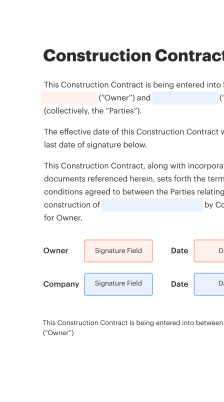
How the template functions in an electronic workflow

A digital template collects entries, calculates totals, and routes invoices for approval before final signature and delivery.

  • Collect entries: Team members submit timesheets and material receipts.
  • Auto-calculate: Template computes totals, taxes, and line-item subtotals.
  • Approval routing: Invoices are routed to managers for review.
  • Signature and send: Signed invoices are delivered to clients and archived.
Collect signatures
24x
faster
Reduce costs by
$30
per document
Save up to
40h
per employee / month

Quick steps to set up a team invoice template

Follow these four steps to configure a reusable time and material invoice template for team use.

  • 01
    Define fields: Create standard fields for task description, hours, rate, and materials.
  • 02
    Set rates: Enter hourly rates, overtime rules, and material markups.
  • 03
    Apply taxes: Configure tax rates and taxable material flags.
  • 04
    Publish template: Assign template permissions and distribute to team members.

Audit and approval steps for a signed invoice

Follow these checkpoints to ensure each invoice is auditable, approved, and properly signed.

01

Collect evidence:

Attach timesheets and receipts
02

Validate calculations:

Cross-check totals and tax
03

Manager approval:

Obtain project manager sign-off
04

Finance review:

Confirm ledger coding
05

Client signature:

Secure client authorization
06

Archive:

Store with retention policy
be ready to get more

Why choose airSlate SignNow

  • Free 7-day trial. Choose the plan you need and try it risk-free.
  • Honest pricing for full-featured plans. airSlate SignNow offers subscription plans with no overages or hidden fees at renewal.
  • Enterprise-grade security. airSlate SignNow helps you comply with global security standards.
illustrations signature

Suggested workflow configuration for team templates

These settings provide a baseline configuration to automate approvals and reminders for time and material invoicing.

Setting Name Configuration
Invoice Approval Reminder Frequency Setting 48 hours
Late Payment Notification Schedule Setting 7 days
Automatic Tax Application Rule Setting Per-line tax
Template Lockdown Delay Setting Immediate
Audit Log Retention Policy Setting 7 years

Supported devices and system requirements

The template and signing workflow run on common desktop and mobile environments to support on-the-go teams.

  • Windows desktop: Windows 10+
  • macOS: macOS 10.14+
  • Mobile OS: iOS 13+, Android 8+

Access via modern browsers (Chrome, Edge, Safari) or native mobile apps provides full template editing, signing, and audit capabilities without specialized hardware or plugins.

Core security and protection controls for invoice templates

Data encryption: AES-256 at rest
Transport security: TLS 1.2+ in transit
Access controls: Role-based permissions
Authentication: Multi-factor enabled
Audit logging: Comprehensive event logs
Data isolation: Tenant separation

Industry use cases that illustrate typical workflows

These case examples show how teams apply a time and material invoice template across different service models.

Construction subcontractor

A regional subcontractor standardizes hourly labor rates and material markups to simplify billing across multiple sites.

  • Uses line-item material tracking and daily labor logs.
  • Reduces disputes by providing detailed descriptions and per-day subtotals.

Resulting in faster approvals and more predictable cash flow for ongoing projects.

IT managed services

An IT support team bills time and replacement parts for break-fix work using a team template that includes service categories and SLA hours.

  • Applies preapproved hourly tiers for different technician levels.
  • Improves transparency by listing replaced parts and warranty credits.

Leading to clearer client statements and quicker client sign-off on billed work.

Best practices for secure and accurate team invoicing

Adopt standardized controls and processes to reduce errors and maintain compliance when issuing time and material invoices.

Enforce structured line-item descriptions
Require a consistent format for task descriptions and material entries so clients and auditors can quickly verify billed work without follow-up questions or rework.
Use role-based approvals
Configure approval chains that match organizational responsibilities to prevent unauthorized rate changes and to ensure billing accuracy before invoices are sent.
Maintain an immutable audit trail
Keep an unalterable record of template edits, invoice versions, signer identities, and timestamps to support dispute resolution and regulatory reviews.
Integrate with accounting systems
Automate ledger posting and reconciliation by connecting invoice templates to your accounting or ERP system to reduce manual entry errors and accelerate cash application.

FAQs and troubleshooting for common issues

Answers to frequent questions help teams resolve template, signing, and delivery issues quickly without escalating to support.

Feature availability: signNow compared with other providers

Quick comparison of common invoice template and eSignature capabilities across leading providers.

Feature signNow (Recommended) DocuSign Adobe Sign
Team templates
Bulk send
API access REST API REST API REST API
HIPAA support
be ready to get more

Get legally-binding signatures now!

Retention and scheduling milestones for invoices

Define retention and schedule parameters to align billing cycles with internal controls and regulatory obligations.

Invoice issue timeframe:

Within 30 days of service completion

Payment due period:

Net 30 or custom term

Audit retention period:

Seven years recommended for tax purposes

Template review cadence:

Annually or on regulatory change

Backup frequency:

Daily encrypted snapshots

Operational risks and potential compliance penalties

Invoice disputes: Delayed payments
Incorrect tax handling: Fines or back taxes
Weak audit trail: Regulatory scrutiny
Unauthorized access: Data breach exposure
Noncompliant signatures: Contract enforceability issues
Poor retention: Loss of evidentiary records

Plan comparisons across providers for team invoicing

Overview of commonly referenced plan tiers and availability for teams across eSignature providers to guide evaluation.

Pricing Element signNow (Recommended) DocuSign Adobe Sign Dropbox Sign OneSpan
Entry-level team plan Business Standard Small Business Essentials Enterprise
Mid-tier team plan Business Premium Business Pro Business Standard Enterprise+
Enterprise offering Enterprise Advanced Solutions Enterprise Advanced Enterprise
API/Developer access Available Available Available Available Available
Free trial availability Yes (trial) Yes (trial) Yes (trial) Yes (trial) Contact sales
Support model Email and chat Phone and chat Phone and chat Email support Dedicated support
walmart logo
exonMobil logo
apple logo
comcast logo
facebook logo
FedEx logo
be ready to get more

Get legally-binding signatures now!