Establishing secure connection… Loading editor… Preparing document…
Navigation

Fill and Sign the 1 Proposed Acquisitions by the Company Constituting a Very Form
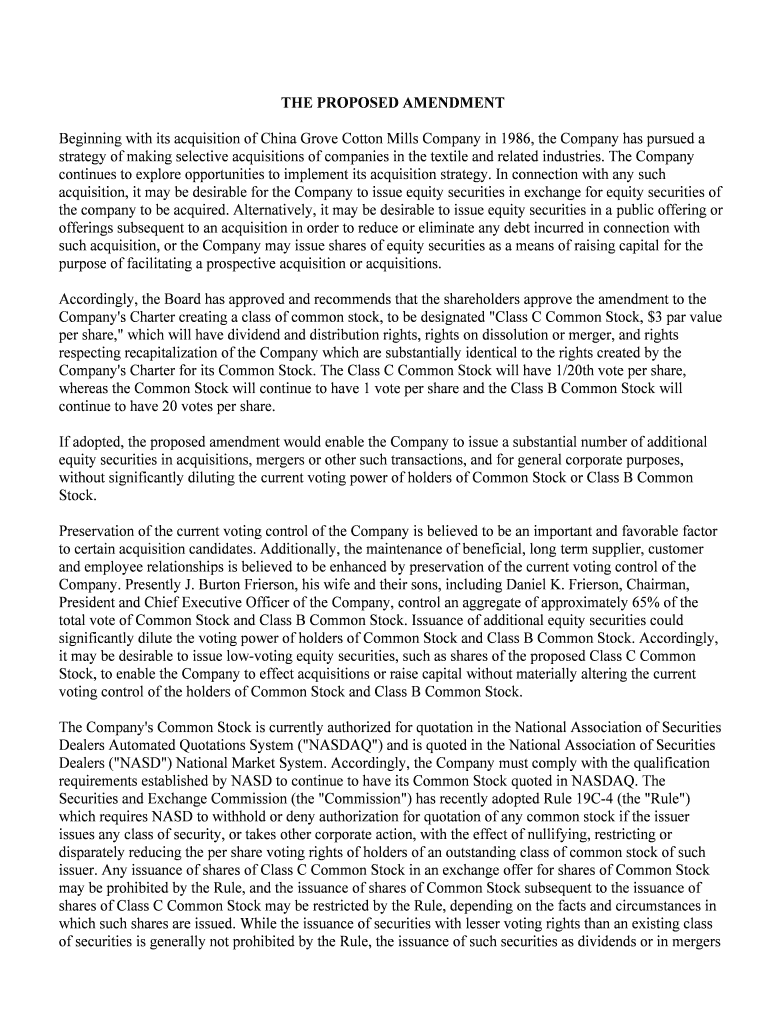
Fill and Sign the 1 Proposed Acquisitions by the Company Constituting a Very Form

How it works

Open the document and fill out all its fields.
Apply your legally-binding eSignature.
Save and invite other recipients to sign it.

Rate template

4.6
42 votes
THE PROPOSED AMENDMENT Beginning with its acquisition of China Grove Cotton Mills Company in 1986, the Company has pursued a strategy of making selective acquisitions of companies in the textile and related industries. The Compa ny continues to explore opportunities to implement its acquisition strategy. In connection with any such acquisition, it may be desirable for the Company to issue equity securities in exchange for equity securitie s of the company to be acquired. Alternatively, it may be desirable to issue equity securities in a public offering or offerings subsequent to an acquisition in order to reduce or eliminate any debt incurred in connection with such acquisition, or the Company may issue shares of equity securities as a means of raising capital for the purpose of facilitating a prospective acquisition or acquisitions. Accordingly, the Board has approved and recommends that the shareholders approve the amendment to the Company's Charter creating a class of common stock, to be designated "Class C Common Stock, $3 par value per share," which will have dividend and distribution rights, rights on dissolution or merger, and rights respecting recapitalization of the Company which are substantially identical to the rights creat ed by the Company's Charter for its Common Stock. The Class C Common Stock will have 1/20th vote per share, whereas the Common Stock will continue to have 1 vote per share and the Class B Common Stock will continue to have 20 votes per share. If adopted, the proposed amendment would enable the Company to issue a substantial number of additional equity securities in acquisitions, mergers or other such transactions, and for general corporate purposes, without significantly diluting the current voting power of holders of Common Stock or Class B Common Stock. Preservation of the current voting control of the Company is believed to be an important and favorable factor to certain acquisition candidates. Additionally, the maintenance of beneficial, long term supplier, cust omer and employee relationships is believed to be enhanced by preservation of the current voting control of the Company. Presently J. Burton Frierson, his wife and their sons, including Daniel K. Frierson, Chairman, President and Chief Executive Officer of the Company, control an aggregate of approximately 65% of the total vote of Common Stock and Class B Common Stock. Issuance of additional equity securities could significantly dilute the voting power of holders of Common Stock and Class B Common Stock. Accordingly, it may be desirable to issue low-voting equity securities, such as shares of the proposed Class C Common Stock, to enable the Company to effect acquisitions or raise capital without materially altering the current voting control of the holders of Common Stock and Class B Common Stock. The Company's Common Stock is currently authorized for quotation in the National Association of Securities Dealers Automated Quotations System ("NASDAQ") and is quoted in the National Association of Securities Dealers ("NASD") National Market System. Accordingly, the Company must comply with the qualification requirements established by NASD to continue to have its Common Stock quoted in NASDAQ. The Securities and Exchange Commission (the "Commission") has recently adopted Rule 19C-4 (the "Rule") which requires NASD to withhold or deny authorization for quotation of any common stock if the issuer issues any class of security, or takes other corporate action, with the effect of nullifying, restricting or disparately reducing the per share voting rights of holders of an outstanding class of common stock of such issuer. Any issuance of shares of Class C Common Stock in an exchange offer for shares of Common Stock may be prohibited by the Rule, and the issuance of shares of Common Stock subsequent to the issuance of shares of Class C Common Stock may be restricted by the Rule, depending on the facts and circumstances in which such shares are issued. While the issuance of securities with lesser voting rights than an existing class of securities is generally not prohibited by the Rule, the issuance of such securities as dividends or in mergers or acquisitions may, depending on the facts and circumstances, involve application of the Rule. Accordingly, the Company may seek advice from NASD to clarify application of the Rule to any proposed transaction.The Company is seeking approval of the proposed amendment for strategic purposes and has no present plan or intention to issue any shares of Class C Common Stock. If the proposed amendment is approved, authorized shares of Class C Common Stock may be issued without further approval of the Company's shareholders unless such approval is required for a particular transaction by applicable law or regulations. Current rules of NASD may require shareholder approval for the issuance of the Company's securities, including shares of Class C Common Stock, in certain circumstances, including acquisitions, in which such issuance would result in an increase in outstanding common shares of 25% or more. Shares of Class C Common Stock may be issued for such consideration as is determined by the Board of Directors, including, as provided by law, any tangible or intangible property or benefit to the Company. Additionally, shares may be issued as dividends subject to limitations imposed by the Charter. Shareholders of the Company do not have any preemptive rights to subscribe for any shares of Class C Common Stock that may be issued. A description of the relative rights, privileges, preferences and powers of the proposed Class C Common Stock is set forth below. DESCRIPTION OF THE PROPOSED CLASS C COMMON STOCK General The Company's Charter currently authorizes two classes of common stock designated "Common Stock, $3 par value per share" and "Class B Common Stock, $3 par value per share." The Charter currently authorizes 80,000,000 shares of Common Stock and 16,000,000* shares of Class B Common Stock.- At last year's Annual Meeting a class of preferred stock was authorized, consisting of 16,000,000 shares. The proposed amendment would create a class of common stock consisting of 200,000,000 authorized shares ("Class C Common Stock"). See Appendix I for the text of the proposed amendment. Voting Rights Holders of Class C Common Stock would be entitled to 1/20th vote per share on each matter that is submitted to shareholders for approval, whereas holders of Common Stock are entitled to one vote per share and holders of Class B Common Stock are entitled to 20 votes per share on each such matter. No class of shares would have cumulative voting rights. Dividends If the proposed amendment is adopted and the Class C Common Stock is authorized, the Company's Charter will provide that any dividends declared and paid on Common Stock and Class C Common Stock must be equal in amount or value and may exceed but may not be less than any such dividends declared and paid to holders of Class B Common Stock. Dividends of shares of Common Stock may be paid to holders of Common Stock and Class C Common Stock only or to holders of all classes of common stock if the number of shares paid per share to such holders is the same. Similarly, dividends of shares of Class B Common Stock may be paid to holders of Common Stock and Class C Common Stock only or to holders of all classes of common stock if the number of shares paid per share to such holders is the same. Dividends of shares of Class C Common Stock may be paid to holders of Common Stock and Class C Common Stock only or to holders of all classes of common stock if the number of shares paid per share to such holders is the same. A dividend of shares of Common Stock may be declared and paid to holders of Common Stock, and a dividend of shares of Class B Common Stock may be declared and paid to holders of Class B Common Stock, and a dividend of shares of Class C Common Stock may be declared and paid to holders of Class C Common Stock if the number of shares paid per share to such holders is the same.If only shares of Class B Common Stock and Class C Common Stock are outstanding, then a dividend of shares of Class C Common Stock, Class B Common Stock or Common Stock may be declared and paid to holders of Class C Common Stock only or to holders of Class B Common Stock and Class C Common Stock if the number of shares paid per share to such holders is the same; provided that a dividend of shares of Class B Common Stock may be paid to holders of Class B Common Stock and a dividend of shares of Common Stock or Class C Common Stock may be paid to holders of Class C Common Stock if the number of shares paid to such holders is the same. Transferability The Company's Charter contains no restrictions on the transferability of shares of Common Stock; if the proposed amendment is adopted, the Charter also would contain no restriction on the transferability of shares of Class C Common Stock. Conversion Rights Shares of Common Stock do not possess any rights of conversion. If the proposed amendment is adopted, neither shares of Common Stock nor shares of Class C Common Stock would possess any rights of conversion. From and after May 1, 1989, shares of Class B Common Stock are convertible, at the option of and without cost to the holder thereof, into shares of Common Stock on a one share for one share basis. Shares of Class B Common Stock would not be convertible into shares of Class C Common Stock. Other Terms Shares of Class C Common Stock would have no preemptive or other rights to subscribe for additional shares of voting securities of the Company. Upon liquidation, dissolution or winding up of the affairs of the Company, the assets legally available for distribution to shareholders would be distributable pro rata among the holders of the shares of Common Stock and Class B Common Stock and, if the proposed amendment is adopted, among the holders of the Class C Common Stock, at the time outstanding. Holders of Common Stock and Class B Common Stock and, if the proposed amendment is adopted, holders of Class C Common Stock, would be entitled to share pro rata in the proceeds of any merger, liquidation or other such transaction approved by the Board. Accordingly, control of the Company cannot be transferred by sale of Class B Common Stock at a price not shared pro rata by other shareholders of the Company. Common Stock, Class B Common Stock and Class C Common Stock, if the proposed amendment is adopted, will not be subject to call or redemption. APPENDIX I Article 4 thereof shall be amended in the following respects: 1. Subparagraphs (b) and (c) shall not be amended in any respect; the first sentence of Article 4 and subparagraph (a) thereof shall be amended to read as follows: 4. The total amount of the capital stock of this corporation is 296,000,000 shares of common stock and 16,000,000 shares of Preferred Stock. (a)(i) The common stock which the corporation shall have authority to issue shall consist of: (1) 80,000,000 shares of Common Stock having $3 par value per share; (2) 16,000,000 shares of Class B Common Stock having $3 par value per share; and (3) 200,000,000 shares of Class C Common Stock having $3 par value per share. 2. Subparagraphs (d) and (e) shall be added to Article 4 to read as follows: (d) The holders of Class C Common Stock shall have the same rights and privileges as holders of Common Stock, and Class B Common Stock except that: (i) The holders of Class C Common Stock shall have the right to vote, but not as a separate class except to the extent required by law, upon all matters submitted to the stockholders of the corporation for consideration at any meeting of stockholders; provided, however, that the holders of Class C Common Stock shall be entitled to 1/20th vote per share with respect to each matter to be voted upon; (ii) If any cash dividend or dividend of property or stock, other than stock of the corporation as provided for in subsection (d)(iii) below, shall be declared and paid, per share, on the Common Stock, then a dividend of an equal amount of cash or value of property or stock shall be declared and paid, per share, on the Class C Common Stock; and no cash dividend or dividend of property or stock, other than as provided for in subsection (d)(iii) below, may be declared and paid, per share, on the Class C Common Stock unless a dividend of an equal amount of cash or value of property or stock has been declared and paid, per share, on the Common Stock; and provided that if any cash dividend or dividend of property or stock, other than as provided for in subsection (d)(iii) below, shall be declared and paid, per share, on the Class B Common Stock, then a dividend of an equal or greater amount of cash or value of property or stock shall be declared and paid, per, share, on the Class C Common Stock; (iii) If any dividend of shares of any class of common stock is paid to holders of Common Stock, or to holders of Class B Common Stock in the event that there is no Common Stock outstanding, then an equal dividend of shares of such common stock shall be paid to holders of Class C Common Stock; provided, however, that if any dividend of shares of Common Stock is declared and paid to holders of Common Stock and in Class B Common Stock to holders of Class B Common Stock, then an equal dividend of shares of Class C Common Stock shall be paid to holders of Class C Common Stock and if any dividend of shares of Class C Common Stock is declared and paid to holders of Class B Common Stock then an equal dividend of shares of Class C Common Stock shall be declared and paid to holders of Common Stock and Class C Common Stock; and provided further that if only shares of Class B Common Stock and Class C Common Stock are outstanding and a dividend of shares of Class B Common Stock is paid to holders of Class B Common Stock, then an equal dividend of shares of Class C Common Stock or Common Stock may be paid to holders of Class C Common Stock;(iv) Except as provided in subsection (d)(iii) above, if shares of Common Stock and Class B Common Stock outstanding at any time are split or subdivided, whether by stock distribution, reclassification, recapitalization, or otherwise, so as to increase the number of shares thereof issued and outstanding, then the shares of Class C Common Stock shall be split or subdivided, whether by stock distribution, reclassification, recapitalization, or otherwise, so that the number of shares thereof outstanding shall be proportionately increased in order to maintain the same proportionate equity ownership (i.e., the same proportion of shares held by each class) among the holders of Common Stock, Class B Common Stock and Class C Common Stock as existed on the date hereof; similarly, if shares of Class C Common Stock shall be split or subdivided in any manner, then all other outstanding classes of common stock shall be proportionately split or subdivided; (v) If shares of Common Stock and Class B Common Stock outstanding at any time are reverse split or combined, whether by reclassification, recapitalization or otherwise, so as to decrease the number of shares thereof issued and outstanding, then the shares of all other classes of common stock shall be reverse split or combined so that the number of shares thereof outstanding shall be proportionately decreased in order to maintain the same proportionate ownership (i.e., the same proportion of shares held by each class) between the holders of Common Stock, Class B Common Stock and Class C Common Stock as existed on the date hereof; similarly, if shares of Class C Common Stock are reverse split or combined in any manner, all other outstanding classes of common stock shall be proportionately reverse split or combined; (vi) In the event of a liquidation or dissolution of the corporation, or a winding up of its affairs, whether voluntary or involuntary, or a merger or consolidation of the corporation, after payment or provision for payment of the debts or liabilities of the corporation, holders of Class C Common Stock shall be entitled to share pro rata in the remaining assets of the corporation with the holders of all other outstanding classes of common stock. (e) The Class C Common Stock shall not be subject to redemption or call by the corporation nor shall the holders of such shares be entitled to preemptive rights with respect to the issuance of additional shares of Common Stock, Class B Common Stock, or Class C Common Stock. Dixie Yarns, Inc. 3/28/89

Practical advice on finishing your ‘1 Proposed Acquisitions By The Company Constituting A Very’ online

Are you fatigued by the inconvenience of managing documentation? Look no further than airSlate SignNow, the premier electronic signature solution for individuals and businesses. Bid farewell to the tedious task of printing and scanning documents. With airSlate SignNow, you can seamlessly complete and endorse documentation online. Utilize the extensive features integrated into this straightforward and budget-friendly platform to transform your method of document management. Whether you need to approve forms or collect signatures, airSlate SignNow manages it effortlessly, with merely a few clicks.

Adhere to these comprehensive instructions:

  1. Sign in to your account or initiate a free trial with our service.
  2. Click +Create to upload a file from your device, cloud storage, or our template collection.
  3. Access your ‘1 Proposed Acquisitions By The Company Constituting A Very’ in the editor.
  4. Click Me (Fill Out Now) to set up the form on your end.
  5. Add and designate fillable fields for additional parties (if required).
  6. Continue with the Send Invite options to solicit eSignatures from others.
  7. Download, print your version, or convert it into a multi-usable template.

No need to worry if you need to cooperate with others on your 1 Proposed Acquisitions By The Company Constituting A Very or send it for notarization—our platform offers everything necessary to accomplish such tasks. Register for an account with airSlate SignNow today and enhance your document management to a new standard!

Here is a list of the most common customer questions. If you can’t find an answer to your question, please don’t hesitate to reach out to us.

Need help? Contact Support

The best way to complete and sign your 1 proposed acquisitions by the company constituting a very form
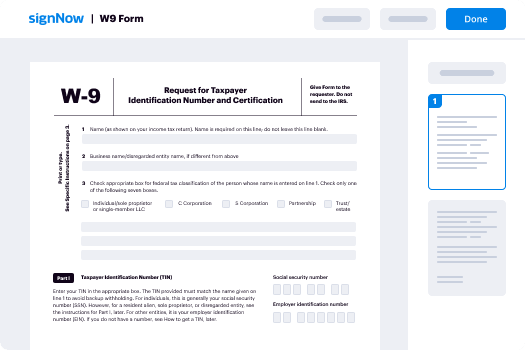
Save time on document management with airSlate SignNow and get your 1 proposed acquisitions by the company constituting a very form eSigned quickly from anywhere with our fully compliant eSignature tool.

How to Sign a PDF Online How to Sign a PDF Online

How to complete and sign paperwork online

Previously, working with paperwork required lots of time and effort. But with airSlate SignNow, document management is quick and easy. Our robust and user-friendly eSignature solution lets you effortlessly complete and electronically sign your 1 proposed acquisitions by the company constituting a very form online from any internet-connected device.

Follow the step-by-step guidelines to eSign your 1 proposed acquisitions by the company constituting a very form template online:

  • 1.Register for a free trial with airSlate SignNow or log in to your account with password credentials or SSO authorization option.
  • 2.Click Upload or Create and import a form for eSigning from your device, the cloud, or our form catalogue.
  • 3.Click on the document name to open it in the editor and use the left-side toolbar to fill out all the empty fields properly.
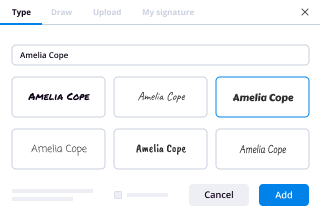
  • 4.Put the My Signature field where you need to eSign your form. Type your name, draw, or import an image of your regular signature.
  • 5.Click Save and Close to finish modifying your completed document.

Once your 1 proposed acquisitions by the company constituting a very form template is ready, download it to your device, export it to the cloud, or invite other people to electronically sign it. With airSlate SignNow, the eSigning process only takes several clicks. Use our robust eSignature tool wherever you are to manage your paperwork efficiently!

How to Sign a PDF Using Google Chrome How to Sign a PDF Using Google Chrome

How to complete and sign documents in Google Chrome

Completing and signing paperwork is simple with the airSlate SignNow extension for Google Chrome. Installing it to your browser is a quick and productive way to deal with your forms online. Sign your 1 proposed acquisitions by the company constituting a very form sample with a legally-binding electronic signature in a couple of clicks without switching between programs and tabs.

Follow the step-by-step guide to eSign your 1 proposed acquisitions by the company constituting a very form template in Google Chrome:

  • 1.Go to the Chrome Web Store, find the airSlate SignNow extension for Chrome, and add it to your browser.
  • 2.Right-click on the link to a form you need to sign and choose Open in airSlate SignNow.
  • 3.Log in to your account with your credentials or Google/Facebook sign-in option. If you don’t have one, you can start a free trial.
  • 4.Utilize the Edit & Sign toolbar on the left to complete your sample, then drag and drop the My Signature option.
  • 5.Insert a picture of your handwritten signature, draw it, or simply type in your full name to eSign.
  • 6.Verify all information is correct and click Save and Close to finish modifying your form.

Now, you can save your 1 proposed acquisitions by the company constituting a very form sample to your device or cloud storage, send the copy to other individuals, or invite them to eSign your form via an email request or a protected Signing Link. The airSlate SignNow extension for Google Chrome improves your document processes with minimum effort and time. Start using airSlate SignNow today!


How to Sign a PDF in Gmail How to Sign a PDF in Gmail How to Sign a PDF in Gmail

How to complete and sign paperwork in Gmail

Every time you receive an email with the 1 proposed acquisitions by the company constituting a very form for signing, there’s no need to print and scan a document or save and re-upload it to another tool. There’s a much better solution if you use Gmail. Try the airSlate SignNow add-on to rapidly eSign any documents right from your inbox.

Follow the step-by-step guidelines to eSign your 1 proposed acquisitions by the company constituting a very form in Gmail:

  • 1.Go to the Google Workplace Marketplace and look for a airSlate SignNow add-on for Gmail.
  • 2.Install the program with a corresponding button and grant the tool access to your Google account.
  • 3.Open an email containing an attachment that needs approval and use the S sign on the right sidebar to launch the add-on.
  • 4.Log in to your airSlate SignNow account. Select Send to Sign to forward the document to other parties for approval or click Upload to open it in the editor.
  • 5.Drop the My Signature option where you need to eSign: type, draw, or upload your signature.

This eSigning process saves time and only takes a few clicks. Utilize the airSlate SignNow add-on for Gmail to adjust your 1 proposed acquisitions by the company constituting a very form with fillable fields, sign paperwork legally, and invite other individuals to eSign them al without leaving your mailbox. Boost your signature workflows now!

How to Sign a PDF on a Mobile Device How to Sign a PDF on a Mobile Device How to Sign a PDF on a Mobile Device

How to complete and sign documents in a mobile browser

Need to rapidly complete and sign your 1 proposed acquisitions by the company constituting a very form on a mobile phone while working on the go? airSlate SignNow can help without needing to set up extra software programs. Open our airSlate SignNow solution from any browser on your mobile device and add legally-binding electronic signatures on the go, 24/7.

Follow the step-by-step guide to eSign your 1 proposed acquisitions by the company constituting a very form in a browser:

  • 1.Open any browser on your device and go to the www.signnow.com
  • 2.Sign up for an account with a free trial or log in with your password credentials or SSO option.
  • 3.Click Upload or Create and pick a file that needs to be completed from a cloud, your device, or our form catalogue with ready-to go templates.
  • 4.Open the form and complete the blank fields with tools from Edit & Sign menu on the left.
  • 5.Put the My Signature area to the form, then type in your name, draw, or add your signature.

In a few easy clicks, your 1 proposed acquisitions by the company constituting a very form is completed from wherever you are. When you're done with editing, you can save the document on your device, build a reusable template for it, email it to other people, or invite them eSign it. Make your paperwork on the go speedy and effective with airSlate SignNow!


How to Sign a PDF on iPhone How to Sign a PDF on iPhone

How to complete and sign forms on iOS

In today’s corporate environment, tasks must be done rapidly even when you’re away from your computer. With the airSlate SignNow application, you can organize your paperwork and approve your 1 proposed acquisitions by the company constituting a very form with a legally-binding eSignature right on your iPhone or iPad. Set it up on your device to close deals and manage forms from anywhere 24/7.

Follow the step-by-step guidelines to eSign your 1 proposed acquisitions by the company constituting a very form on iOS devices:

  • 1.Open the App Store, search for the airSlate SignNow app by airSlate, and install it on your device.
  • 2.Open the application, tap Create to upload a form, and choose Myself.
  • 3.Select Signature at the bottom toolbar and simply draw your signature with a finger or stylus to eSign the form.
  • 4.Tap Done -> Save right after signing the sample.
  • 5.Tap Save or use the Make Template option to re-use this paperwork in the future.

This method is so simple your 1 proposed acquisitions by the company constituting a very form is completed and signed in just a couple of taps. The airSlate SignNow application works in the cloud so all the forms on your mobile device remain in your account and are available any time you need them. Use airSlate SignNow for iOS to boost your document management and eSignature workflows!

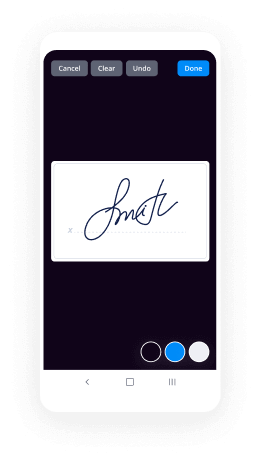
How to Sign a PDF on Android How to Sign a PDF on Android

How to fill out and sign paperwork on Android

With airSlate SignNow, it’s easy to sign your 1 proposed acquisitions by the company constituting a very form on the go. Set up its mobile app for Android OS on your device and start improving eSignature workflows right on your smartphone or tablet.

Follow the step-by-step guide to eSign your 1 proposed acquisitions by the company constituting a very form on Android:

  • 1.Go to Google Play, search for the airSlate SignNow app from airSlate, and install it on your device.
  • 2.Log in to your account or register it with a free trial, then upload a file with a ➕ key on the bottom of you screen.
  • 3.Tap on the uploaded file and select Open in Editor from the dropdown menu.
  • 4.Tap on Tools tab -> Signature, then draw or type your name to eSign the template. Complete blank fields with other tools on the bottom if required.
  • 5.Use the ✔ key, then tap on the Save option to end up with editing.

With a user-friendly interface and full compliance with major eSignature requirements, the airSlate SignNow app is the best tool for signing your 1 proposed acquisitions by the company constituting a very form. It even operates without internet and updates all document modifications once your internet connection is restored and the tool is synced. Complete and eSign forms, send them for eSigning, and make multi-usable templates anytime and from anywhere with airSlate SignNow.

Sign up and try 1 proposed acquisitions by the company constituting a very form
  • Close deals faster
  • Improve productivity
  • Delight customers
  • Increase revenue
  • Save time & money
  • Reduce payment cycles