Establishing secure connection…Loading editor…Preparing document…

Letter Acknowledging Receipt of Correspondence

This template is fully customizable. Edit the text, fill out the fields, and send it for signature. Give it a try!
Letter Acknowledging Receipt of Correspondence

What a Letter Acknowledging Receipt of Correspondence Is

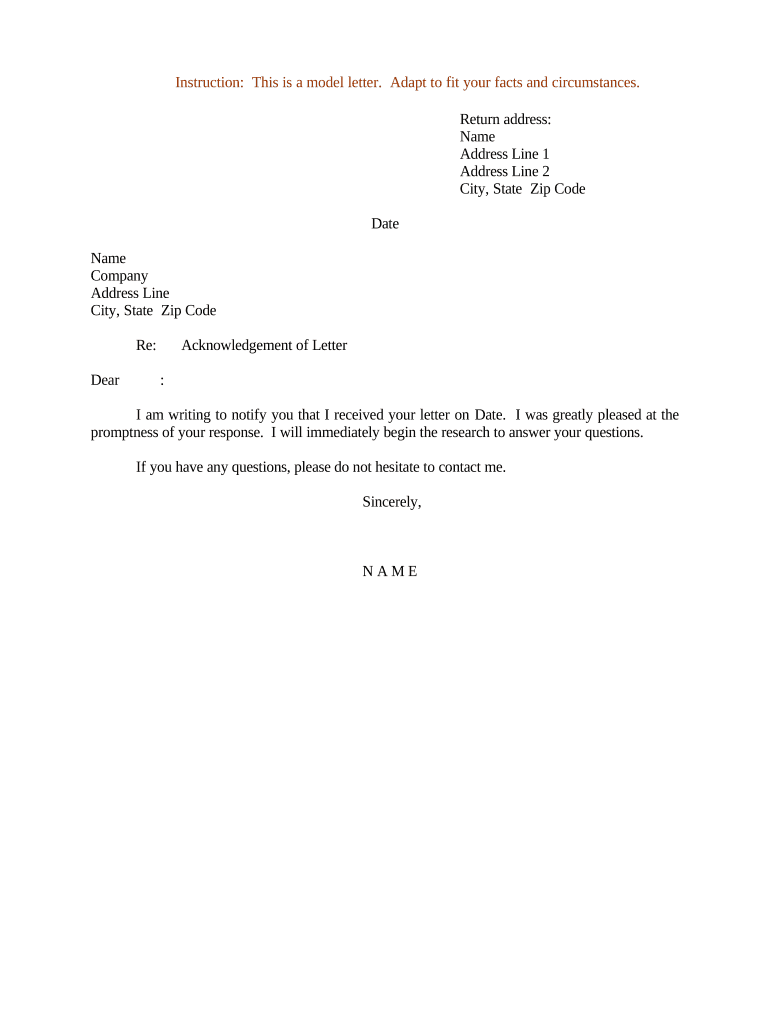
A Letter Acknowledging Receipt of Correspondence is a concise written notice confirming that an organization or individual has received a specific communication, such as a request, legal filing, invoice, or customer inquiry. The letter records the receipt date, identifies sender and recipient, notes the item received, and may reference attachments or file numbers. It creates an auditable record that supports internal tracking, response timelines, and evidentiary needs in disputes or regulatory reviews. The letter can be issued on paper or electronically and should be retained per applicable retention rules.

Why Issuing an Acknowledgement Letter Matters

A clear acknowledgement establishes a dated, auditable record that reduces disputes, clarifies next steps, and documents when response windows begin. It supports compliance, customer service consistency, and internal routing by creating a single reference for subsequent actions.

Why Issuing an Acknowledgement Letter Matters

Who Typically Prepares and Sends These Letters

Common users include legal teams, records administrators, and customer-service or HR groups that handle incoming documents and escalate responses.

  • Legal departments tracking court filings, notices, and discovery materials for litigation and regulatory matters
  • Human resources and benefits teams acknowledging employee forms, certifications, and benefit elections
  • Customer service, billing, and vendor management teams confirming invoices, claims, and contractual communications

Step-by-Step: Create and Send an Acknowledgement Letter

Follow these sequential steps to complete, document, and distribute an acknowledgement letter accurately and electronically when appropriate.

  • 01
    Prepare header: Enter recipient, sender, date, and reference number.
  • 02
    Describe item: Summarize the correspondence type and attach received file names.
  • 03
    State receipt: Confirm receipt date and method (mail, email, portal).
  • 04
    Next steps: Note any expected response timeframe or routing instructions.

Core Components of a Professional Acknowledgement Letter

A well-structured acknowledgement letter includes specific elements that support clarity, auditability, and legal sufficiency for downstream processes.

Header

Sender and recipient names, addresses, and a clear reference line linking the acknowledgement to the original correspondence or internal file identifier.
Receipt Details

Exact receipt date and time when available, delivery method, tracking identifiers, and the name of the person who accepted the delivery to support audit trails.

Item Description

Concise description of the document received, including subject, attachment list, page counts, and file names to prevent ambiguity.

Acknowledgement Statement

A short confirmation sentence stating receipt and date, for example 'We acknowledge receipt on [date].' Avoid admissions about content beyond receipt.

Next Steps

Describe expected processing timelines, responsible department, or the date by which a reply or action will occur to set clear expectations.

Signature

Printed name, title, signature, and date; indicate if electronically signed and reference any audit-trail or document ID for verification.

Required Information and Minimal Metadata

Recipient Name: Full legal name of recipient exactly as on records.
Sender Name: Full name and organization of the sender.
Receipt Date: Use MM/DD/YYYY format for the receipt date.
Delivery Method: Specify delivery method and include tracking details.
Reference Number: Enter internal case or file number for tracking.
Signature Details: Include signer name, title, signature, and date.

Where to File or Send the Acknowledgement

Choose a distribution route that creates a verifiable record; options vary by organizational policy and the channel used to receive the original correspondence.

  • Return to Sender: Return a copy to the original sender confirming receipt and next steps.
  • Internal Records: File in the case management system or document repository with searchable metadata.
  • Regulatory Filing: Send to a regulator or contract counterparty when statutes or contract terms require formal notice.
  • Legal Counsel: Provide copies to counsel for matters with litigation or regulatory risk.

Technical Considerations for Electronic Acknowledgements

Use a platform that creates tamper-evident PDF records, captures an audit trail, and stores documents securely to meet legal and policy requirements.

  • Formats Supported: PDF, DOCX, and HTML accepted.
  • Integrations: Salesforce, Microsoft 365, NetSuite, Google Workspace.
  • Authentication: Email links, SMS codes, KBA, or SSO.

Online Workflow Settings to Automate Acknowledgements

Configure these settings when using an electronic platform to automate acknowledgement creation and preserve an audit trail.

Field Configuration
Auto-fill fields Enable Magic fields to populate sender and recipient.
Signature Type Accept typed, drawn, or PKI signatures.
Authentication Use email link with optional SMS or KBA.
Retention Policy Set automatic archival and retention tags.

eSignature Pricing and Capability Snapshot

High-level pricing and capability comparison for common eSignature needs, with signNow listed first to align platform references.

signNow DocuSign Adobe Sign PandaDoc HelloSign
Starting Price $8/user/mo $15/user/mo $14/user/mo $19/user/mo $15/user/mo
Free Trial 7-day trial Varies by plan Varies by plan Varies by plan Varies by plan
Bulk Send Yes Yes Yes Yes No
Audit Trail Yes Yes Yes Yes Yes
HIPAA Compliant Yes Yes Yes No No
Envelope Cap No cap 100 envelopes/user/year Varies by plan Varies by plan Varies by plan

Common Mistakes to Avoid When Preparing an Acknowledgement

  • Using inconsistent reference numbers across documents, which prevents effective cross-referencing and complicates searches during audits or disputes.
  • Failing to record delivery metadata such as tracking numbers, timestamps, sender IDs, or IP addresses, which weakens evidentiary value.
  • Entering an incomplete or informal recipient name that does not match official records, creating uncertainty about who received the notice.
  • Omitting the expected next steps or response timelines, which leads to misunderstandings and missed service-level commitments.

Risks of Inadequate or Incorrect Acknowledgements

Missed Deadlines: Loss of response-window proof
Evidentiary Loss: Weakens legal position
Regulatory Exposure: Possible agency penalties
HIPAA Violation: Potential civil penalties
Contract Risk: Dispute over notice delivery
Increased Costs: Higher legal or remediation expenses

Practical Tips for Efficient and Accurate Completion

Follow these best practices to increase accuracy, speed processing, and reduce downstream disputes when issuing acknowledgement letters.

Use a standardized template
Adopt a single, organization-approved template that includes header, receipt statement, item list, next steps, and signature block. Templates reduce variation, improve legal clarity, and ensure required metadata is captured consistently across teams.
Capture delivery metadata
Record tracking numbers, timestamps, IP addresses, and handler names in the metadata or case file. This information supports audits, proves receipt timing, and can be critical evidence in disputes or regulatory reviews.
Confirm e-sign compliance
When using electronic signatures, ensure the vendor supports ESIGN and UETA principles, provides an immutable audit trail, and offers a Business Associate Agreement (BAA) where PHI is involved to meet HIPAA obligations.
Automate retention and classification
Apply retention tags and automatic archival at creation. Establish legal-hold procedures so documents subject to litigation or regulatory review are preserved without manual intervention.

Real-World Examples of Acknowledgement Letters in Use

Two brief examples illustrate practical benefits and how organisations integrate acknowledgements into workflows.

Martin Properties — Tim Martin

Martin Properties used online acknowledgement letters to confirm receipt of tenant documents and speed leasing workflows.

  • Reduced in-person follow-ups by half.
  • By linking each acknowledgement to tenant files and preserving timestamps for dispute protection, the team shortened document turnaround and freed staff for higher-value leasing tasks.

Fertility Centers of Illinois — John Butler

Fertility Centers of Illinois implemented acknowledgement letters to document receipt of patient forms and consent packages securely.

  • Maintained HIPAA-compliant patient records and audit trails.
  • This ensured a defensible chain of custody for sensitive documents, streamlined administrative intake, and supported regulatory audits by retaining signed acknowledgements and metadata.

Frequently Asked Questions About Acknowledgement Letters

Answers to common questions about legal effect, electronic signatures, notarization, retention, disputes, and automation for acknowledgement letters.


Need help? Contact support

be ready to get more
Join over 28 million airSlate SignNow users