Declarant
Provide full legal name, contact information, and capacity (owner, tenant, attorney). Accuracy affects identity verification and may impact notary or authentication steps during filing and recording.
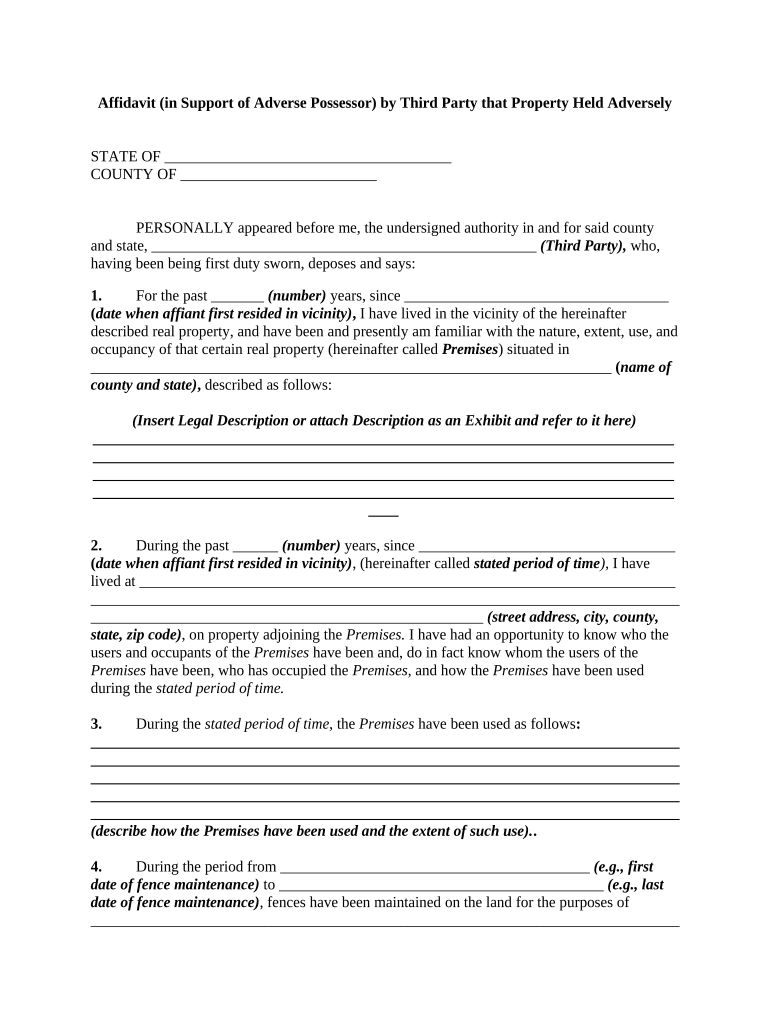
An Affidavit Adverse clarifies contested facts, creates a sworn record, preserves statutory deadlines, and supports filings such as quiet-title actions or corrective deeds. It helps establish notice to third parties and can prompt administrative or judicial review where factual disputes exist.

Common users include attorneys, title officers, property owners, and court litigants who need a sworn adverse statement on record.
Provide full legal name, contact information, and capacity (owner, tenant, attorney). Accuracy affects identity verification and may impact notary or authentication steps during filing and recording.
Narrative of adverse facts with dates, locations, and specific incidents. Use clear, chronological language and avoid conclusory legal opinions without supporting evidence unless properly cited.
Attach documentary evidence such as deeds, correspondence, maps, or photographs and label exhibits sequentially; reference each exhibit where relevant in the narrative for clarity and verification.
Include a notarization block with official language, notary signature, seal, jurisdiction, and date; some filings require remote online notarization with audio-video record and retention rules.
Specify filing destination (county recorder, court clerk, or registry), required copies, fees, and any special indexing instructions to ensure accurate recording and retrieval by parcel or case number.
Provide dated signature block for the declarant and space for witness initials if required; include printed name, title or capacity, and contact details for follow-up.
Use platforms that support PDF, Word, remote notarization, and secure storage to streamline affidavit preparation and eSubmission.
Deliver to affected parties promptly, per procedural rules.
County recorders often process daily or weekly batches.
Dates in affidavit can affect legal deadline tolling.
Audio-video and journal records retained per state rules.
Court deadlines vary; check local rules for service.
A landowner discovered an encroaching structure and prepared an Affidavit Adverse to record the facts with the county recorder.
An heir filed an Affidavit Adverse detailing discrepancies in a decedent’s will and asserting facts that challenged an executor’s accountings.
| signNow | DocuSign | Adobe Sign | PandaDoc | HelloSign | |
|---|---|---|---|---|---|
| Starting Price | $8/user/mo | $15/user/mo | $14/user/mo | $19/user/mo | $15/user/mo |
| Free Trial | 7-day free trial | No | No | Yes, limited | Yes, limited |
| Bulk Send | Yes | Yes | Yes | Yes | No |
| Audit Trail | Yes | Yes | Yes | Yes | Yes |
| HIPAA Compliant | Yes | Yes | Yes | No | No |