Establishing secure connection…Loading editor…Preparing document…

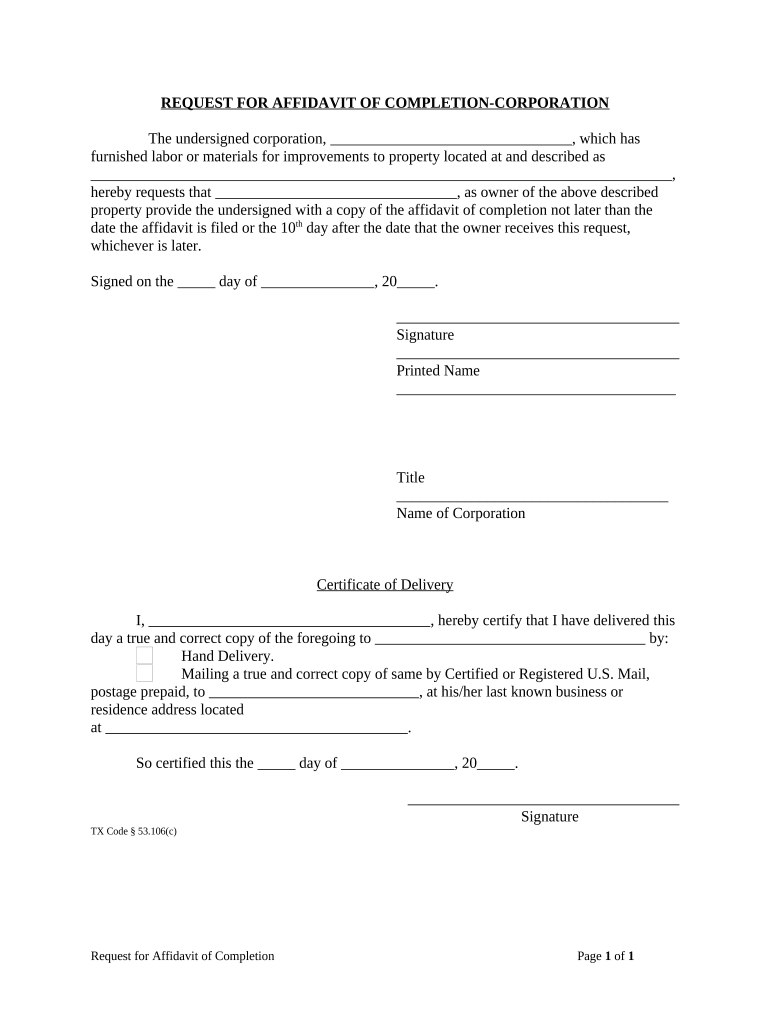
Request for Affidavit of Completion

This template is fully customizable. Edit the text, fill out the fields, and send it for signature. Give it a try!
Request for Affidavit of Completion

What a Request for Affidavit of Completion Is and When It’s Used

A Request for Affidavit of Completion is a written demand asking a contracting party—often a subcontractor, supplier, or contractor—to provide a sworn affidavit confirming that specified work, services, or deliveries have been completed in accordance with contract terms. The affidavit itself is a signed, notarized declaration that documents completion and can support final payment, lien releases, project closeout, or contractual acceptance. This guide explains what to include, how to fill the request, common legal considerations in the United States, and options for electronic completion and notarization.

Why Sending a Clear Request Matters

A well‑structured request reduces ambiguity, speeds verification, and provides a documented paper trail for payments, lien waivers, and dispute prevention.

Why Sending a Clear Request Matters

Typical Users and Stakeholders

Parties who commonly prepare or respond to these requests include general contractors, subcontractors, owners, construction managers, and contract administrators.

  • General contractors — issue requests to subcontractors to verify completion before final disbursement or lien waiver acceptance.
  • Subcontractors / Suppliers — complete affidavits to confirm scope performed and permit release of retention or final payment.
  • Owners / Lenders — rely on affidavits to confirm project milestones before releasing holdbacks or approving closeout.

Properly targeted requests keep closeout efficient and create admissible evidence of completion when supported by notarization and supporting documents.

Essential Sections to Include in a Professional Request

A professional request should clearly identify the project, reference the original contract, state the specific work or deliverable, request the sworn affidavit with any supporting documents, and provide instructions for execution and return, including acceptable notarization or electronic notarization methods.

Project ID

Include project name, job number, and property address to ensure the affidavit ties to the correct contract and records.
Contract Reference

Cite the contract or purchase order number, relevant clause(s), and date to connect the affidavit to contractual obligations.

Scope Statement

Describe the specific tasks or deliverables being certified as complete, including dates of completion and any milestone references.

Requested Documents

List supporting items required with the affidavit, such as lien waivers, inspection reports, change orders, or final invoices.

Execution Instructions

State whether notarization is required, whether remote online notarization (RON) is acceptable, and acceptable return methods.

Return Routing

Provide the recipient name, mailing address, email, or secure eSubmission instructions and any deadline for return.

Required Data Elements to Verify Identity and Authenticity

Affiant Name: Full legal name
Title or Capacity: Signer role (e.g., President, Authorized Agent)
Company Name: Registered business name
Signature Date: MM/DD/YYYY
Notary Details: Notary name, commission number, and seal
Supporting Docs: Invoices, inspection reports, lien waivers

Step-by-Step: How to Prepare and Send a Request

Follow these sequential steps to create, deliver, and track a request for an affidavit of completion, whether using paper, email, or a secure eSignature platform.

  • 01
    Draft Request: Describe project, contract reference, scope to be certified
  • 02
    Attach Requirements: List supporting documents the affiant must provide
  • 03
    Specify Authentication: Indicate notarization or RON acceptance and signer ID requirements
  • 04
    Send & Track: Deliver via recorded method and log receipt and deadlines

Where to File, Send, or Submit the Completed Affidavit

Choose the recipient and delivery method based on contractual requirements and recordkeeping needs; preserve proof of delivery and timestamps.

  • Contracting Party: Return to the requester named in the contract by email or certified mail
  • Owner or Lender: Submit copies required for release of funds or mortgage/lien release processing
  • County Recorder: File only when recording is contractually or legally required; recording rules vary by county
  • Secure eSubmission: Use a secure eSignature platform or file portal when electronic notarization or digital records are permitted

How to Configure an Online Request Workflow

Set up a consistent online workflow to reduce errors: define fields, required attachments, signer authentication, and notification rules.

Field Configuration
Required Attachments Inspection reports | invoices
Signer Authentication Email + SMS code | KBA optional
Notary Option Allow RON | In-person only
Notifications Reminders at 3 and 7 days

Digital Signing and eSubmission: Platform Considerations

When accepting electronic affidavits, choose platforms that support audit trails, secure storage, and the notarization option required by the contract or jurisdiction.

  • File Formats: PDF | DOCX supported for upload and archiving
  • Integrations: Connect to cloud storage and project systems
  • Authentication: Support for email, SMS, KBA, and advanced signer verification

Use platforms that preserve tamper-evident audit trails and that meet legal standards for electronic signatures and, where applicable, remote notarization.

Typical Timelines and Deadlines to Expect

Deadlines depend on contract terms, retention periods, and whether notarization or additional approvals are required; set internal targets to avoid late payments or statutory exposure.

Response Deadline:

7–30 days from request, as contract specifies

Notarization Window:

Sign and notarize within contract deadline

Payment Release:

Often tied to affidavit receipt and verification

Record Retention:

Retain signed affidavit per retention rules

Dispute Period:

Follow contract notice periods for claims

Common Preparation Errors to Avoid

  • Vague scope descriptions that fail to identify the precise work claimed as complete and invite disputes.
  • Mismatched names between the affidavit and contract documents, which can invalidate the attestation or delay processing.
  • Missing supporting documents such as final invoices, inspection reports, or lien waivers required by the requester.
  • Not specifying acceptable notarization methods or failing to allow RON when permitted by contract and state law.

Risks and Consequences of Incorrect or Missing Affidavits

Payment Delay: Final payment or release of retention may be withheld
Lien Exposure: Failure to obtain proper affidavits can complicate lien releases and cause filing disputes
Contract Claims: Inaccurate affidavits risk breach of contract claims or indemnity obligations
Notarization Invalidity: Incorrect notarization methods can render affidavit unacceptable
Recordkeeping Penalty: Noncompliance with retention rules may affect audits or regulatory reviews
Fraud Allegations: False sworn statements expose affiants to perjury or civil liability

Differences Between an Affidavit of Completion and Similar Documents

Compare closely related document types to pick the right form and avoid mixing functions that can create legal ambiguity.

Document Type Purpose Typical Authentication
Affidavit of Completion sworn confirmation of finished work notary or ron
Certificate of Completion owner or inspector attests project stage signature, not always notarized
Conditional Lien Waiver waives lien upon payment signed, often notarized
Final Lien Waiver waives lien after final payment signed and usually notarized

eSignature Vendor Pricing and Feature Snapshot for Affidavit Workflows

A compact pricing and capability comparison can help select an eSignature provider that supports notarization options, audit trails, and integration with document systems; signNow is shown first per vendor convention.

signNow DocuSign Adobe Sign PandaDoc HelloSign
Starting Price $8/user/mo $15/user/mo $14/user/mo $19/user/mo $15/user/mo
Free Trial 7-day free trial Varies by plan Varies by plan Varies by plan Varies by plan
Bulk Send Yes Yes Yes Yes No
Audit Trail Yes Yes Yes Yes Yes
HIPAA Compliant Yes Yes Yes No No
Envelope Cap No cap 100 envelopes/user/year Varies Varies Varies

Practical Examples of How Requests Are Used

These short case arcs show how a clear request and affidavit support payment and closeout in real scenarios.

Commercial Construction Closeout

A general contractor requests an affidavit for final mechanical work completed on 09/01/2025.

  • The subcontractor provides a notarized affidavit plus final invoice and lien waiver.
  • The owner releases retainage after verifying the affidavit and associated inspection report, simplifying final accounting and reducing dispute risk.

Residential Renovation Payment

A lender conditions final draw on a sworn completion affidavit from the contractor.

  • The contractor signs via permitted RON and uploads inspection photos.
  • The lender receives the signed affidavit, confirms completion, and authorizes the final disbursement to close the file.

FAQs and Troubleshooting for Requesting an Affidavit of Completion

Answers to common procedural and legal questions about preparing, signing, notarizing, and storing affidavits for completion.


Need help? Contact support

be ready to get more
Join over 28 million airSlate SignNow users