Establishing secure connection…Loading editor…Preparing document…

Music Agreement Contract

This template is fully customizable. Edit the text, fill out the fields, and send it for signature. Give it a try!
Music Agreement Contract

What a Music Agreement Contract Is and When it Applies

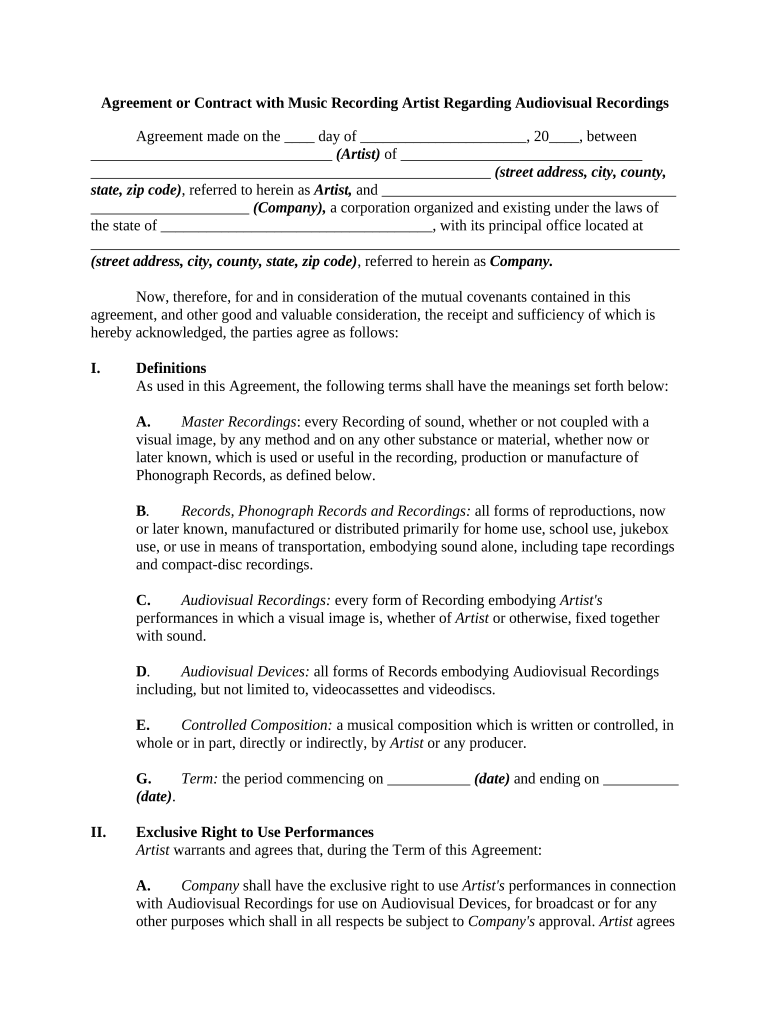
A Music Agreement Contract is a written contract that records the rights, obligations, and commercial terms between parties involved in a musical work or performance. Typical uses include recording agreements, publishing and royalty splits, work-for-hire assignments, licensing for sync or performance, and producer or session musician engagements. The contract defines who owns copyright, how revenue is split, the scope and duration of the license, delivery and approval milestones, and termination conditions. Well-drafted music agreements reduce disputes and clarify payment and ownership for creators, labels, licensors, and service providers.

Why a Clear Music Agreement Matters

A precise contract protects intellectual property, clarifies payment and credit, and limits liability between artists, producers, and licensees. Clear written terms reduce litigation risk and make royalty accounting and licensing straightforward.

Why a Clear Music Agreement Matters

Who Typically Uses a Music Agreement Contract

Choose the contract variant that matches the relationship: license, assignment, co-writing split, or producer agreement, and ensure all signatories have authority to bind their entities.

  • Independent artists and bands — negotiate recording splits, licensing, and distribution terms with labels or platforms.
  • Producers and session musicians — record assignment or work-for-hire terms to secure payment and credits.
  • Publishers and licensors — document mechanical, synchronization, and public performance licenses for third-party use.

Step-by-Step: How to Complete the Contract

Follow these steps in order to assemble a valid Music Agreement Contract and prepare it for signature and recordkeeping.

  • 01
    Draft core terms: Define parties, scope, payment, and ownership clearly.
  • 02
    Attach exhibits: Add schedules for splits, deliverables, or song lists.
  • 03
    Review legal clauses: Check warranties, indemnities, and termination rights.
  • 04
    Gather signatures: Obtain signatures with proper authority and dates.

Typical Workflow for Creating and Executing a Music Agreement

This common sequence shows how a music agreement moves from draft to executed record.

  • Prepare draft: Sender uploads or drafts the agreement and adds fields.
  • Set signers: Assign roles, signing order, and authentication method.
  • Send for signature: Deliver via email or a secure link to each signer.
  • Capture execution: System logs signatures, timestamps, and audit trail.

Configuring an Online Signing Workflow for a Music Agreement

Recommended platform settings speed execution and reduce errors when using electronic signatures.

Field Configuration
Signature Block Require printed name, title, and date fields near signature
Signer Order Sequential signing for negotiation-sensitive contracts
Authentication Use email + SMS code for higher assurance
Audit Settings Enable full audit trail with IP and timestamp

Delivery Options and Technical Requirements for eSigning

For sensitive contracts involving royalties or exclusive rights, increase signer authentication and preserve a tamper-evident audit trail.

  • Email link: Common and simple; suitable for most transactions
  • Shared signing link: Useful for mass releases but less control over signer identity
  • In-person / kiosk: Use when you need immediate ID verification

Essential Clauses to Include in a Professional Music Agreement

A robust contract addresses ownership, compensation, credits, delivery, licensing, and dispute resolution to minimize ambiguity.

Ownership

Specify whether the master and composition copyrights are assigned or licensed and any reversion terms.
Compensation

Detail advances, royalty splits, payment schedule, accounting frequency, and audit rights.

Credits

State how artist and contributor credits appear on releases and metadata.

Deliverables

List masters, stems, lyric sheets, and delivery format deadlines.

Warranties

Include original authorship warranties and clearances for samples or third-party material.

Termination

Define breach remedies, cure periods, and post-termination rights for exploitation.

Key Data Elements to Protect in a Music Agreement

Personal data: Names, addresses, and payment details
Financial terms: Advances, royalty percentages, and account numbers
Copyright data: ISRCs, ownership percentages, and registration details
Contact info: Manager, attorney, and label contacts
Delivery files: Master audio files and stems
Audit trail: Timestamps, signer IPs, and authentication logs

Common Legal Risks if the Contract is Incorrect or Incomplete

Ownership disputes: Unclear assignment language
Royalty errors: Vague split or accounting terms
Credit disputes: Missing credit obligations
Unauthorized samples: Uncleared third-party content
Invalid signatures: Improper authority or missing dates
Tax exposure: Incorrect reporting or missing W-9

Frequent Preparation Errors to Avoid

  • Leaving monetary terms vague or stated as 'to be agreed' after signing
  • Using initials instead of full signatures when the document requires a signing block
  • Failing to attach exhibits that define the works or deliverables
  • Not verifying the signatory's authority when contracting for businesses

Time-Sensitive Steps and Common Deadlines

Certain filing and tax-related actions tied to music income have fixed deadlines; monitor accounting and reporting timelines.

Provide W-9 on request:

No fixed IRS deadline; provide when requested to avoid backup withholding

1099-NEC reporting:

Recipient and IRS due by Jan 31 when required

Payment schedules:

Follow contract payment dates to prevent breach

Royalty accounting:

Observe accounting periods stated in the contract

Contract renewals:

Note renewal or notice windows stated in agreement

Execution Milestones from Negotiation to Recordkeeping

Track these stages from initial offer through long-term retention to ensure compliance and continuity.

01

Negotiation Complete

Terms agreed and final draft prepared for signature

02

Signatures Executed

All parties sign and date the agreement

03

Delivery of Masters

Artist or producer provides final deliverables per schedule

04

Accounting & Royalty Runs

Periodic royalty statements and payments commence

Comparing eSignature Options for Executing Music Agreements

Basic vendor differences are shown below to help evaluate cost, compliance, and high-volume capabilities for contract execution.

signNow DocuSign Adobe Sign PandaDoc HelloSign
Starting Price $8/user/mo $15/user/mo $14/user/mo $19/user/mo $15/user/mo
Free Trial 7-day free trial Varies by plan Varies by plan Varies by plan Varies by plan
Bulk Send Yes Yes Yes Yes No
Audit Trail Yes Yes Yes Yes Yes
HIPAA Compliant Yes Yes Yes No No
Envelope Cap No cap 100 envelopes/user/year Varies by plan Varies by plan Varies by plan

Frequently Asked Questions About the Music Agreement Contract

Answers to common questions about signing, enforceability, witnesses, and recordkeeping for music agreements.


Need help? Contact support

be ready to get more
Join over 28 million airSlate SignNow users