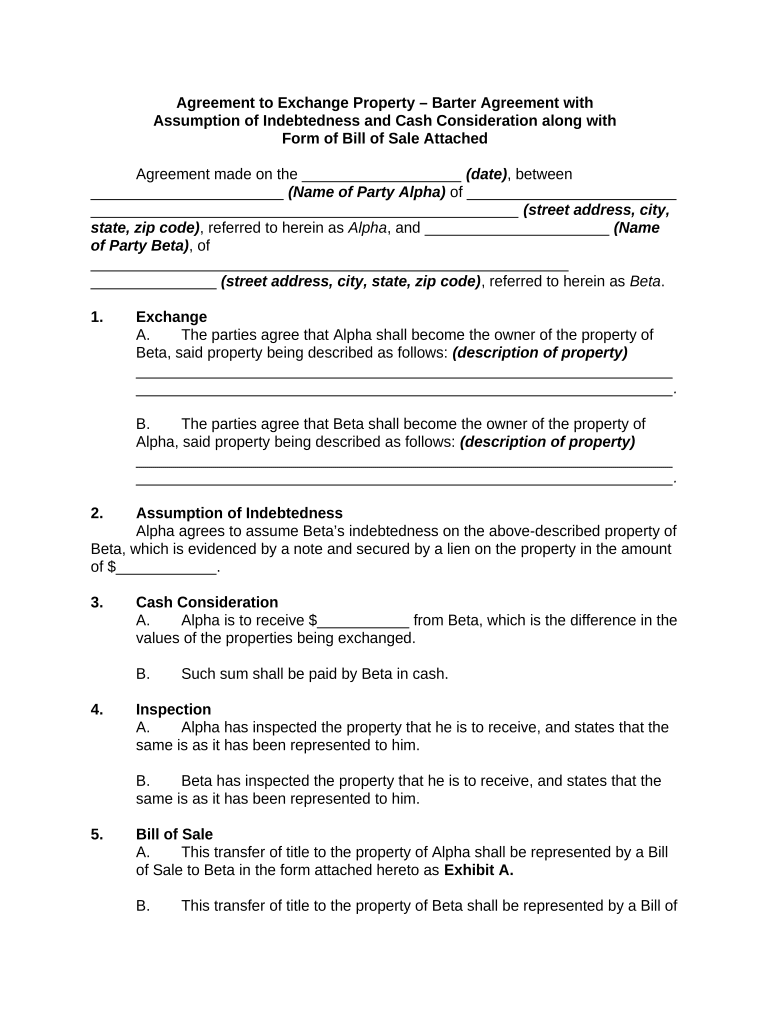
Agreement to Exchange Property
What an Agreement to Exchange Property Is and when it’s used
Why a clear Agreement to Exchange Property matters
A precise agreement clarifies each party’s obligations, protects title interests, allocates risk, and creates enforceable obligations under contract law and electronic signature statutes such as the ESIGN Act (15 U.S.C. ch. 96) and state UETA frameworks. It reduces disputes at closing and supports timely recording and tax compliance.
Who typically prepares and signs this agreement
Real estate attorneys, brokers, property investors, title companies, and corporate representatives commonly prepare or review Agreements to Exchange Property to ensure legal and tax implications are addressed.
- Individual owners and investors — used for direct swaps, like-kind exchanges, or mutual property transfers; requires clear legal names and title checks.
- Title and escrow companies — verify encumbrances, prepare deeds, and manage county recording and settlement funds for the transfer.
- Attorneys and tax advisors — draft protective representations, update escrow instructions, and advise on tax-deferral strategies such as IRC §1031 exchanges.
In many transactions multiple parties (seller, buyer, exchange accommodator) and their agents sign; confirm authority to sign before executing to avoid later invalidation.
Step-by-step: completing an Agreement to Exchange Property
-
01Drafting: Describe parties, properties, consideration, and contingencies.
-
02Title review: Obtain title report and resolve liens or encumbrances.
-
03Signatures: Secure authorized signatures, notarizations, or witness attestations.
-
04Recording: File deed or instrument with county recorder and update title records.
How the exchange workflow typically flows
-
Agreement execution: Parties sign and date the contract; preserve originals for recording.
-
Escrow setup: Title company holds funds, clears title, and prepares deeds.
-
Deed preparation: Attorney or title prepares conveyance documents for recording.
-
Recording and delivery: Recorder files deed; certified copy delivered to parties.
Common digital workflow settings for online completion
| Field | Configuration |
|---|---|
| Signature Type | Electronic signature with timestamp and audit trail |
| Authentication | Email + optional SMS or Knowledge-Based Authentication |
| Document Versioning | Enable version history and PDF export |
| Notifications | Automatic reminders and completion alerts |
Technical considerations for eSigning and eSubmission
Use a platform that supports tamper-evident PDFs, detailed audit trails, and secure signer authentication to ensure enforceability.
- Document formats: PDF/A, DOCX supported
- Integrations: Title and escrow systems via API
- Security: TLS and AES-256 encryption
Ensure the provider complies with ESIGN and UETA, offers notarization or RON integrations when required, and retains records in a searchable, exportable format for audit and recording purposes.
Key dates and deadlines to confirm in the agreement
Effective Date:
When the agreement becomes binding and triggers performance obligations.
Inspection Period:
Number of days for inspections and notice of defects.
Closing Date:
Date for transfer of title and exchange of consideration.
Recording Deadline:
Target date to record deed with county recorder to preserve priority.
Tax Identification:
Timing for providing tax IDs or 1031 identification if applicable.
Milestones from agreement to recorded conveyance
Agreement Signed
Contract executed and effective date established.
Title Clearance
Resolve liens, encumbrances, and title objections.
Closing Settlement
Funds exchanged and deeds delivered to escrow.
County Recording
Recorder files deed; certified copy returned to parties.
Common mistakes to avoid when preparing the agreement
- Using informal property descriptions or street addresses instead of the legal description causes recorder rejections and delays.
- Failing to verify signer authority for entities (minutes or resolution) can result in voidable conveyances.
- Omitting contingencies for title defects or environmental issues exposes parties to unexpected liabilities.
- Not aligning the agreement with tax guidance for exchanges (e.g., 1031 identification rules) can trigger immediate tax consequences.
Legal and financial risks of incorrect or incomplete agreements
Comparing eSignature vendors for signing and managing exchange agreements
| signNow | DocuSign | Adobe Sign | PandaDoc | HelloSign | |
|---|---|---|---|---|---|
| Starting Price | $8/user/mo | $15/user/mo | $14/user/mo | $19/user/mo | $15/user/mo |
| Free Trial | 7-day free trial | Varies by plan | Varies by plan | Varies by plan | Varies by plan |
| Bulk Send | Yes (Premium) | Yes | Yes | Yes | No |
| Audit Trail | Yes | Yes | Yes | Yes | Yes |
| HIPAA Compliant | Yes | Yes | Yes | No | No |
| Envelope Cap | No cap | 100 envelopes/user/year | Varies | Varies | Varies |
Frequently asked questions about executing and validating the agreement
-
Are electronic signatures legally enforceable?
Yes. Electronic signatures are generally enforceable under the ESIGN Act (15 U.S.C. ch. 96) and state UETA laws when intent, consent, attribution, and record retention requirements are met.
-
When is notarization required?
Notarization is required for deed acknowledgements in virtually all states. Remote Online Notarization (RON) rules vary by state; verify with the state notary commission before using RON.
-
How do I ensure the deed will record?
Use the exact legal description, obtain proper notarization and witnessing where required, and pay applicable county recording fees; confirm format and margins per county recorder guidance.
-
Can I fix errors after signing?
Minor clerical errors may be corrected by a corrective deed or affidavit; substantive changes typically require re-execution. Consult title counsel before submitting corrections to avoid clouding title.
-
Who must sign for an entity?
An authorized officer or agent must sign and include title; attach a corporate resolution or LLC authorization if requested by title or escrow agents.
-
What if parties want to cancel the agreement?
Cancellation depends on contract terms for termination, contingencies, and any escrow instructions. Follow the written termination procedure in the agreement to avoid breach claims.