Establishing secure connection…Loading editor…Preparing document…

Stock Sale Agreement

This template is fully customizable. Edit the text, fill out the fields, and send it for signature. Give it a try!
Stock Sale Agreement

What a Stock Sale Agreement Is and when it’s used

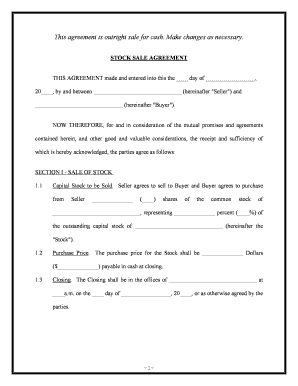
A Stock Sale Agreement is a legally binding contract documenting the transfer of equity in a corporation or other entity from a seller to a buyer. It sets the purchase price, number and class of shares, closing conditions, representations and warranties, indemnities, and any escrow or holdback mechanics. The agreement defines the rights transferred, allocates risks between parties during due diligence and closing, and specifies governing law and dispute resolution. Parties commonly use this document for private company transactions, secondary sales, or stock purchases tied to employment or investor exits.

Why a clear Stock Sale Agreement matters

A clear agreement reduces ambiguity about what is being sold, when payment transfers, and which pre-closing conditions must be satisfied. It limits post-closing disputes by documenting representations, indemnities, and remedies, and it supports compliance with tax, securities, and corporate law obligations.

Why a clear Stock Sale Agreement matters

Typical parties and advisors involved

Stock Sale Agreements involve defined roles across deal teams and external advisors.

  • Buyer teams and investors who review purchase price allocation, closing mechanics, and post-close covenants.
  • Sellers, founders, or equity holders who provide representations, deliverables, and transition commitments.
  • Legal counsel, accountants, and escrow agents who prepare schedules, tax adjustments, and closing escrow instructions.

Transactions vary by size and complexity; parties tailor schedules, disclosure schedules, and escrow terms accordingly.

Who typically signs a Stock Sale Agreement

Seller — CEO

The seller or its authorized representative (CEO, board designee, or corporate officer) signs on behalf of the selling entity. Authority must be evidenced by board resolutions or corporate minutes to avoid post-closing challenges and to enable transfer of share certificates or book-entry records.

Buyer — Investor

The buyer or designated representative (investor, acquisition vehicle, or trustee) must sign and, when required, deliver payment at closing. Signing authority typically requires proof of entity formation and signature authority for institutional buyers.

Key compliance and security considerations

Encryption: TLS 1.2/1.3 in transit
Data at rest: AES-256 encryption
Audit trail: Timestamps and logs
HIPAA: BAA available if required
ESIGN / UETA: Legal compliance
21 CFR Part 11: Compliant options exist

Common legal risks and penalties

Tax misreporting: IRS penalties apply
Unclear authority: Transaction may be voidable
Incomplete disclosures: Indemnity claims increase
Unsigned exhibits: Closing delays occur
Securities violations: Enforcement risk exists
I-9/Employment: Paperwork fines possible

Frequent drafting and execution pitfalls

  • Ambiguous share descriptions that fail to specify class, par value, or certificate numbers create transfer disputes and valuation mismatches.
  • Missing or incomplete disclosure schedules omit exceptions to reps and warranties, leading to unexpected indemnity claims after closing.
  • Overly broad indemnities without caps or baskets expose sellers to unlimited post-close liability and increase buyer resistance.
  • Failure to confirm signing authority or attach corporate resolutions delays closing and can invalidate the transfer of equity.

Step-by-step: completing a Stock Sale Agreement

Follow these core steps to prepare, review, and execute the agreement in an orderly closing process.

  • 01
    Draft terms: Define parties, shares, price, and key conditions
  • 02
    Prepare schedules: Assemble disclosure schedules and financial exhibits
  • 03
    Negotiate clauses: Agree on reps, indemnities, escrow, and closing mechanics
  • 04
    Sign and close: Execute, wire funds, and transfer certificates or book entries

How electronic completion typically flows

Digital workflows mirror in-person steps: prepare document, assign fields, authenticate signers, capture signatures, and archive records.

  • Prepare document: Upload final agreement and attach exhibits
  • Add fields: Place signature, initial, and date fields
  • Authenticate signers: Use email, SMS code, or advanced authentication
  • Archive evidence: Store executed copy and audit trail

Core elements to include in a professional Stock Sale Agreement

A well-structured agreement protects both parties and facilitates closing. Include clear definitions, conditions precedent, and post-closing mechanics so obligations are enforceable and expectations align.

Purchase Price

Specify total consideration, payment method, adjustments for working capital, and escrow or holdback arrangements that determine net proceeds at closing.
Shares and Transfer

Identify number, class, certificate numbers or book‑entry method, and procedures for physical transfer or corporate record updates.

Representations

Detail seller and buyer reps about authority, capitalization, tax status, contracts, and litigation to allocate pre‑closing risk.

Conditions Precedent

List permits, consents, approvals, and third‑party waivers required before the parties are obligated to close the transaction.

Indemnities

Define the scope, survival periods, caps, baskets, and procedural steps for presenting and resolving claims after closing.

Closing Mechanics

Cover escrow instructions, wire transfer details, delivery of stock certificates, resignations, and board approvals required at closing.

Configuring an online signing workflow for a Stock Sale Agreement

Set up an eSigning workflow that enforces signing order, secures authentication, and preserves evidentiary audit trails.

Field Configuration
Signing order Specify role sequence to reflect buyer/seller priorities
Authentication Use email + SMS or ID verification for high-value deals
Conditional fields Show escrow instructions only after price is entered
Certificate storage Attach signed exhibits and ledger proof to record

Technology considerations for secure eSigning

Choose a platform that supports strong encryption, audit trails, and flexible authentication suitable for high-value equity transfers.

  • Authentication options: Email, SMS, KBA, or ID checks
  • Audit evidence: Detailed logs and timestamps
  • Integration: Connects to CRM and document storage

Ensure your provider can supply retention, BAA or 21 CFR Part 11 attestations when required and can export signed PDFs with embedded audit metadata.

Typical dates and timing to track

Track signature deadlines, closing date, tax reporting dates, and any post-closing survival periods to avoid penalties and disputes.

Signing deadline:

Set a date for execution to lock valuation and obligations

Closing date:

Date funds transfer and shares change hands

Tax reporting:

Report gains per IRS timing and applicable filings

Indemnity survival:

Specified survival period for reps and covenants

Escrow release:

Date or milestone triggering escrow distribution

Deal milestones from proposal to closing

A sequential milestone view helps coordinate diligence, approvals, and funding ahead of the closing date.

01

Letter of Intent

Nonbinding terms and exclusivity period negotiated

02

Due Diligence

Buyer reviews contracts, financials, and cap table

03

Definitive Agreement

Execute the Stock Sale Agreement and schedules

04

Closing

Funds wired, shares transferred, and post-close notices issued

eSignature vendor comparison for Stock Sale Agreement workflows

Cost and capability vary across major eSignature vendors; summary below highlights starting price, free trial availability, bulk send, audit trail, HIPAA support, and envelope caps.

signNow DocuSign Adobe Sign PandaDoc HelloSign
Starting Price $8/user/mo $15/user/mo $14/user/mo $19/user/mo $15/user/mo
Free Trial 7-day free trial (no card) Varies by plan Varies by plan Varies by plan Varies by plan
Bulk Send Yes Yes Yes Yes No
Audit Trail Yes Yes Yes Yes Yes
HIPAA Compliant Yes Yes Yes No No

FAQs and troubleshooting for Stock Sale Agreements

Answers to frequent legal and technical questions about drafting, signing, and preserving Stock Sale Agreements.


Need help? Contact support

be ready to get more
Join over 28 million airSlate SignNow users