Establishing secure connection…Loading editor…Preparing document…

Amendment to Living Trust

This template is fully customizable. Edit the text, fill out the fields, and send it for signature. Give it a try!
Amendment to Living Trust

What an Amendment to a Living Trust Is and When It Applies

An Amendment to Living Trust is a written instrument used to alter, add to, or remove provisions of an existing revocable living trust without creating a new trust. It typically cites the original trust by name and date, identifies the trustee(s) and settlor(s), specifies the exact changes (for example adding or removing beneficiaries, updating distribution language, or changing successor trustee appointments), and is executed with the same formalities required by the original trust instrument or state law. Amendments preserve continuity of the trust while documenting the grantor's changed wishes.

Why an Amendment Matters for Estate Planning

Amendments let a grantor update beneficiaries, correct errors, add assets, or change trustee designations without revoking the entire trust. They preserve estate planning continuity and can avoid probate delays by keeping the original trust intact while reflecting current intentions.

Why an Amendment Matters for Estate Planning

Who Typically Prepares or Signs Trust Amendments

Parties should confirm whether the original trust requires notarization, witnesses, or additional formalities before executing an amendment.

  • Grantors updating beneficiaries after life events such as birth, death, divorce, or remarriage.
  • Current trustees implementing administrative changes or clarifying distribution language.
  • Estate attorneys or paralegals drafting precise amendment language to avoid ambiguity.

Essential Parts of a Professional Trust Amendment

A clear, well-structured amendment cites the trust, identifies parties, states the effective date, describes specific changes, and includes execution details to match original formalities.

Title

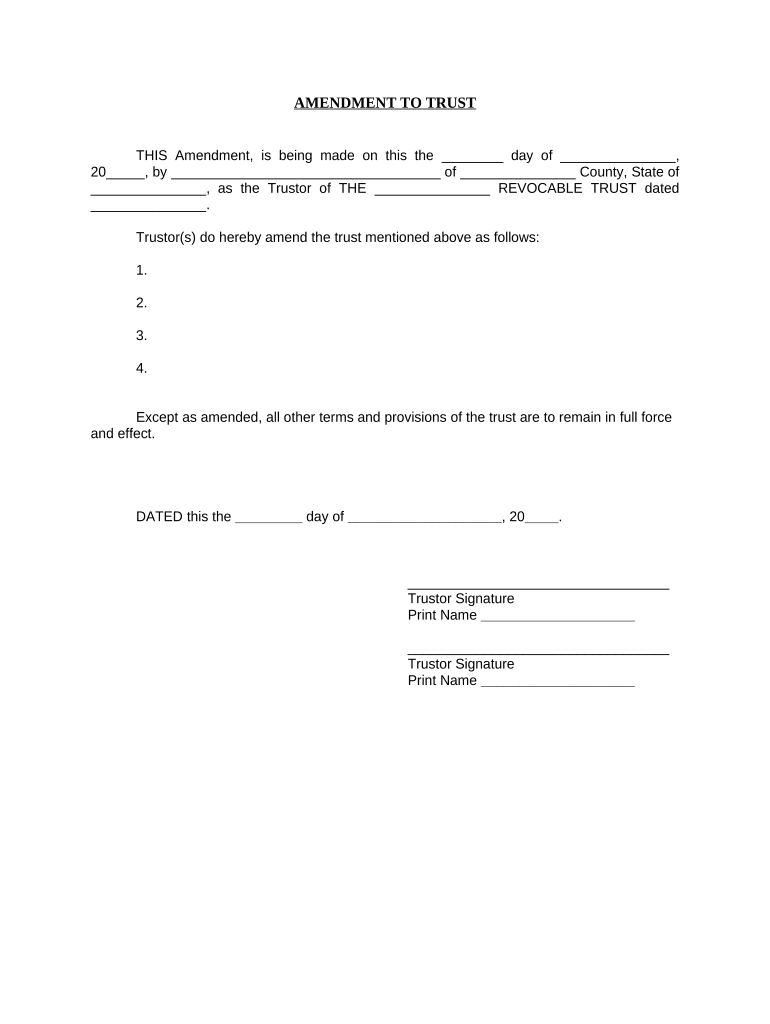
Heading that identifies the document as an Amendment to Living Trust and references the original trust name and date for clarity and chain of title.
Recitals

Short background statements identifying the grantor, trustee, trust date, and reason for the amendment to provide context and avoid ambiguity.

Amendment Text

Precise replacement or insertion language using exact paragraph references from the original trust or unambiguous new provisions to be added or modified.

Effective Date

A clear effective date clause stating when the amendment takes effect, which can affect tax and creditor timelines.

Execution Clause

Signature blocks that mirror the original trust's required formalities, including notarization or witness lines if required by the trust or state law.

Attachment List

Schedule of attached exhibits, pour-over deed references, or asset lists to ensure the amendment ties to specific property and avoids later disputes.

Information Typically Required in the Amendment

Grantor Name: Full legal name
Trust Name: Exact trust title
Original Date: Original trust date
Change Summary: Concise amendment text
Effective Date: MM/DD/YYYY
Signatures: Signature and date

Step-by-Step: How to Complete an Amendment

Follow these sequential steps to prepare, execute, and distribute a valid amendment to a living trust.

  • 01
    Locate the Trust: Identify the original trust name and date for accurate reference.
  • 02
    Draft Specific Changes: Write explicit language that replaces or adds numbered paragraphs.
  • 03
    Match Formalities: Use the same signing, witness, and notarization requirements as the original trust.
  • 04
    Record and Distribute: Provide copies to trustees, successor trustees, and custodians of record.

Customizing and Completing the Amendment Online

When preparing an amendment online, set up fields and authentication to match legal requirements and the trust's original formalities.

Field Configuration
Grantor Name Field Required text; full legal name
Amendment Text Field Multi-line; preserve formatting and paragraph references
Effective Date Field Date picker; MM/DD/YYYY
Signature Block Signer, date, and notary/witness lines as needed

Where to File, Send, and Store the Executed Amendment

After execution, route copies to stakeholders and retain the original with trust records; record only when the amendment transfers real property interests.

  • Trust Records: Place the original amendment with the trust document binder held by the trustee.
  • Trustee Copies: Provide signed copies to current and successor trustees for administration.
  • Beneficiary Notice: Share copies with named beneficiaries when appropriate for transparency.
  • County Recorder: Record only if the amendment conveys or affects real property; otherwise recording is unnecessary.

Digital Signing: Technical and Authentication Considerations

Choose a platform that supports notarization integration or facilitates in-person notarization workflows when state law or the original trust requires it.

  • Signer Authentication: Email + SMS or stronger KBA for identity assurance
  • Audit Trail: Capture timestamp, IP, and signer actions
  • Document Integrity: Tamper-evident PDF output and hash-based audit

Timing and Processing Expectations

Typical timing depends on whether notarization, witnesses, or recording are required; plan for lead times for notarization and county recording if applicable.

Execution Lead Time:

Same day if parties available; schedule notarization as needed

Notarization Scheduling:

Allow 1–7 business days for remote or mobile notary appointments

Recording Delay:

County recorder processing: 3–30 business days depending on jurisdiction

Attorney Review:

Allow 3–7 business days for counsel review and edits

Distribution:

Provide copies immediately after execution; digital copies near-instant

Common Mistakes to Avoid When Preparing an Amendment

  • Referencing the wrong trust date or name, which can create ambiguity and delay probate or trustee acceptance.
  • Using vague language like 'all my assets' instead of listing specific paragraphs or schedule references to avoid interpretation disputes.
  • Failing to follow the original trust's execution formalities (notarization or witnesses), which can jeopardize enforceability.
  • Recording an amendment unnecessarily or failing to record when property ownership changes, producing gaps in public title records.

Risks and Legal Consequences of an Incorrect Amendment

Invalid Amendment: Amendment may be held unenforceable
Probate Exposure: Assets could enter probate if trust clarity is lost
Title Issues: Unrecorded property changes risk clouded title
Beneficiary Disputes: Ambiguities increase litigation risk
Tax Consequences: Changes may affect estate or gift tax positions
Fiduciary Liability: Trustees risk breach claims for improper amendments

Realistic Use Cases for an Amendment to a Living Trust

Two common scenarios illustrate practical amendment use and administrative follow-up for trustees and beneficiaries.

Family Update

The grantor adds a newborn as a beneficiary and updates distribution percentages to reflect the expanded family

  • Amendment references paragraph 4 and replaces split percentages
  • After notarization, the trustee receives a certified copy and updates custodial beneficiary designations on investment accounts to match the amendment.

Trustee Change

A grantor names a successor trustee after a move to another state and clarifies successor powers

  • New trustee acceptance language is inserted and an effective date given
  • The outgoing trustee delivers the signed amendment to successor trustees and files any deed affidavits with the county recorder if property powers changed.

eSignature Vendors: Price and Feature Snapshot for Trust Amendments

Comparing basic pricing and key features helps choose an eSignature provider that supports notarization, audit trails, and compliance for legal documents.

signNow DocuSign Adobe Sign PandaDoc HelloSign
Starting Price $8/user/mo $15/user/mo $14/user/mo $19/user/mo $15/user/mo
Free Trial Yes, 7-day trial Varies Varies Varies Varies
Bulk Send Yes Yes Yes Yes No
Audit Trail Yes Yes Yes Yes Yes
HIPAA Compliant Yes Yes Yes No No

Frequently Asked Questions About Trust Amendments

Answers to common questions on validity, notarization, recording, and digital signatures for amendments to living trusts.


Need help? Contact support

be ready to get more
Join over 28 million airSlate SignNow users