Establishing secure connection…Loading editor…Preparing document…

Answers to Original First Amended and Supplemental Petition and Reconventional Demand for Divorce

This template is fully customizable. Edit the text, fill out the fields, and send it for signature. Give it a try!
Answers to Original First Amended and Supplemental Petition and Reconventional Demand for Divorce

What this Answers form is and when it’s used

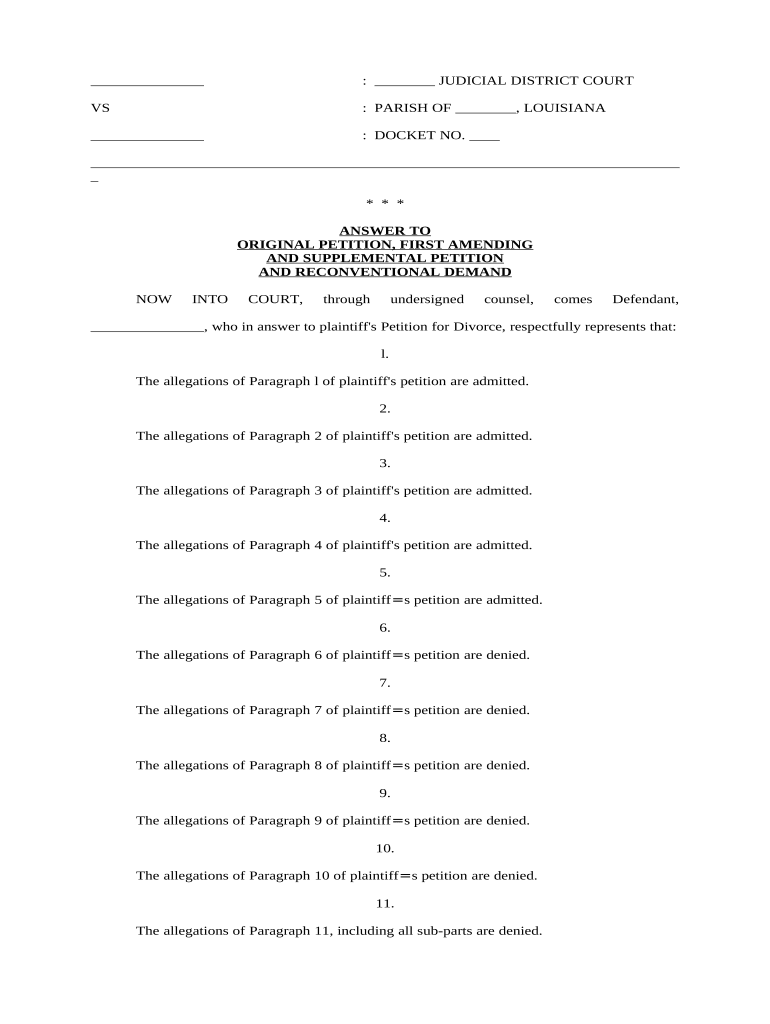
The Answers to Original First Amended and Supplemental Petition and Reconventional Demand for Divorce is a formal written response filed by a respondent to address allegations, assert defenses, and present any counterclaims in a divorce case. It responds to an amended petition and any supplemental allegations, and it may include admissions, denials, affirmative defenses, and a reconventional demand (a counterclaim) seeking affirmative relief. The filing both preserves procedural rights and frames issues for discovery, temporary orders, settlement negotiations, and final hearing.

Why completing accurate Answers matters

A complete, timely Answer preserves defenses, prevents default judgment, and establishes the respondent’s factual and legal positions for discovery and hearings. It also permits a reconventional demand to seek relief in the same case, reducing duplicative litigation.

Why completing accurate Answers matters

Who prepares and files these Answers

Ensure the chosen preparer understands local family-court filing rules, service requirements, and any statute-of-limitations or temporary-order timing that affects relief.

  • Respondent or self-represented litigant preparing a formal answer and defenses to an amended petition.
  • Family law attorneys drafting responsive pleadings and reconventional demands on behalf of clients.
  • Court clerks receiving e-filed or paper answers and notifying opposing counsel of service and deadlines.

Key components to include in a professional Answer

A well-structured answer organizes responses to each numbered allegation, asserts affirmative defenses, requests relief, and preserves counterclaims in a reconventional demand.

Caption

Court name, parties, case number, and title to ensure the response is associated with the correct filing.
Admissions/Denials

A paragraph-by-paragraph response admitting, denying, or stating lack of knowledge for each allegation in the amended petition.

Affirmative Defenses

Specific defenses asserted (statute of limitations, laches, equitable defenses) with facts supporting each defense.

Reconventional Demand

A counterclaim section stating the legal basis, factual allegations, and specific relief sought from the court.

Prayer for Relief

Clear statement of requested outcomes (custody, support, property division, attorney’s fees) tied to factual allegations.

Signature Block

Signed and dated by respondent or counsel, with contact information and certificate of service.

Required information to include on the Answers form

Case Caption: Court and case number
Party Names: Full legal names
Responses: Admit/deny per paragraph
Counterclaims: Facts and relief requested
Signatures: Respondent or attorney signature
Service Statement: How and when served

Step-by-step: preparing and filing your Answer

Follow these sequential steps to prepare a compliant Answer and reconventional demand for filing and service.

  • 01
    Review Petition: Read every allegation and note numbered paragraphs to respond.
  • 02
    Draft Responses: Respond paragraph by paragraph with admissions, denials, or lack of information.
  • 03
    Add Defenses: List affirmative defenses and supporting facts.
  • 04
    File & Serve: File with the court clerk and serve opposing counsel per local rules.

Where these Answers are filed and how the process flows

The filing and service pathway depends on local court procedures; follow county family-court e-filing or paper filing rules closely.

  • File with Clerk: Submit to family court via e-file portal or paper at clerk’s office.
  • Obtain Filing Stamp: Receive date-stamped copy to confirm filing date.
  • Serve Opposing Party: Deliver per local service rules: personal, mail, or electronic if authorized.
  • Proof of Service: File certificate of service with the court.

Digital filing and eSignature considerations

Confirm with the county family court whether the Answer may be e-filed and whether an electronic signature or a wet signature plus notarization is required for any attachments or affidavits.

  • File Format: Typically PDF
  • Authentication: Court may require user ID or verified e-filing account
  • Notarization: Some documents still require notarization

Common timelines and response deadlines to watch

Timelines vary by state and local rule; check the summons and local court rules to confirm the exact deadline to answer.

Standard Response Window:

Often 20–30 days from service

Default Judgment Risk:

Failure to answer may lead to default and loss of rights

Temporary Orders:

Hearings for temporary relief may occur within weeks

Amendment Timing:

Amendments may require leave of court or stipulation

Service Deadline:

Proof of service must be filed promptly after service

Common mistakes to avoid when preparing Answers

  • Responding with general denials instead of paragraph-specific admissions or denials, which can create ambiguity and procedural objections.
  • Missing the deadline to file and serve the Answer, which risks default judgment or waiver of defenses.
  • Failing to include a certificate of service or proper contact information, causing the court to reject the filing or delay proceedings.
  • Including unsupported counterclaims without factual detail, which can lead to motions to strike or dismissal for insufficient pleading.

Consequences of incorrect or late Answers

Default Judgment: Loss of defenses
Dismissal: Counterclaim may be dismissed
Sanctions: Possible court sanctions
Delay: Proceedings and hearings postponed
Fee Exposure: Potential attorney fee awards
Appeal Limits: Restricted appellate remedies

Real-world examples of digital signing in legal workflows

Practice examples show how eSignature platforms support responsive pleadings and reduce turnaround between service and filing.

Optica Ventures (Brian Fitzgibbons)

Their team found the interface simple and client-friendly

  • Rapid remote signing reduced in-person coordination
  • For family-law practices, the same ease of use helps collect executed financial affidavits and client acknowledgements without delaying filings.

Fertility Centers of Illinois (John Butler)

The company praised API flexibility and compliance focus

  • Integration automated signature collection across forms
  • Law firms can similarly integrate eSign into intake and document-assembly workflows to accelerate responsive pleadings and proofs of service.

Comparing eSignature vendor pricing and key capabilities

Basic pricing and feature availability for commonly used eSignature vendors — signNow is listed first per vendor-comparison convention.

signNow DocuSign Adobe Sign PandaDoc HelloSign
Starting Price $8/user/mo $15/user/mo $14/user/mo $19/user/mo $15/user/mo
Free Trial 7-day trial Varies by plan Varies by plan Varies by plan Varies by plan
Bulk Send Yes Yes Yes Yes No
Audit Trail Yes Yes Yes Yes Yes
HIPAA Compliant Yes Yes Yes No No

Frequently asked questions about Answers and electronic filing

Answers to common procedural and technical questions about preparing, signing, and filing responsive pleadings in divorce cases.


Need help? Contact support

be ready to get more
Join over 28 million airSlate SignNow users