Establishing secure connection…Loading editor…Preparing document…

Articles of Incorporation of Homeowners Association

This template is fully customizable. Edit the text, fill out the fields, and send it for signature. Give it a try!
Articles of Incorporation of Homeowners Association

What the Articles of Incorporation of Homeowners Association Are

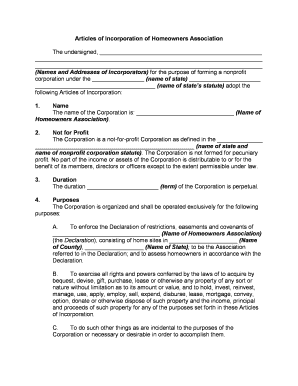
The Articles of Incorporation of Homeowners Association are the foundational legal document filed with a state filing office—typically the Secretary of State—to create a nonprofit corporation that governs a residential community. The articles formally establish the association's legal name, corporate status, registered agent, and broad powers, and they may define membership, assessment authority, and board governance. Filing the articles creates the association as a legal entity separate from individual owners, enabling it to enter contracts, hold property, and enforce covenants under state corporation law and applicable recorded declarations.

Why Proper Articles Matter for an HOA

Well-drafted articles create legal standing, protect the board and members, and clarify the association's powers and limits under state law; they also anchor governing documents such as bylaws and CC&Rs.

Why Proper Articles Matter for an HOA

Who Typically Prepares and Uses These Articles

The Articles of Incorporation of Homeowners Association are prepared and filed by parties forming the HOA or by counsel acting on their behalf.

  • Developers and builders completing community formation, often submitting articles as part of initial conveyance and governance setup.
  • Volunteer board members or property managers who maintain corporate compliance and manage filings or annual reports.
  • Attorneys and title companies that review articles to confirm authority for assessments, liens, and covenant enforcement.

Filing the Articles: Step-by-step Process

Follow these practical steps to prepare, approve, file, and preserve the Articles of Incorporation of Homeowners Association.

  • 01
    Draft: Prepare articles using state-prescribed language and include required fields.
  • 02
    Approve: Obtain incorporator or developer approval and any required board or owner resolutions.
  • 03
    File: Submit to the Secretary of State with the filing fee and required attachments.
  • 04
    Record: Keep certified filed copy and link to CC&Rs, bylaws, and recorded plat.

Core Elements Found in Professional Articles

A complete Articles of Incorporation of Homeowners Association includes specific statutory elements so the association is recognized and can exercise intended powers.

Corporate Name

The association's exact legal name, including corporate suffix when required, establishes identity for filings, contracts, and title records.
Registered Agent

Designates the in-state agent for service of process and official notices; must include physical street address.

Purpose

States nonprofit or membership purpose and authority to manage common areas, assessments, and covenant enforcement.

Duration

Specifies perpetual existence or a limited term; perpetual is common for long-lived community associations.

Incorporators

Lists the person(s) who form the corporation and will sign the articles; required for filing in most states.

Initial Governance

May identify initial board members or authorize bylaws to set voting, quorum, and officer roles after incorporation.

Typical eFiling and Signing Workflow

A digital workflow accelerates preparation, signatures, and submission to the state filing office while preserving a complete audit trail.

  • Upload Document: Add the PDF or DOCX of the drafted articles to the signing platform.
  • Place Fields: Insert signature, date, and initial fields for incorporators and any board members.
  • Authenticate Signers: Use email links, SMS codes, or stronger authentication when required.
  • File Copy: Receive certified signed copy and submit it to the Secretary of State.

Recommended Digital Workflow Settings

Configure these settings to ensure signatures are attributable, documents are retained, and filings meet state requirements.

Field Configuration
Signature Order Set sequential signing where incorporator signs before registered agent acknowledgment.
Authentication Level Use email plus SMS code or ID verification for incorporator identity where risk is higher.
Notary / RON Enable remote online notarization fields when state accepts RON for corporate filings.
Retention Policy Auto-retain certified PDF and audit trail for the required statutory period.

Technical Considerations for Digital Signing and Submission

Ensure the eSignature provider supports secure PDF, audit trails, and the authentication needed by your state or corporate counsel.

  • File Formats: PDF and DOCX supported for submission and archiving.
  • Integrations: Connectors for Google Workspace, NetSuite, and document repositories.
  • Authentication: Email, SMS, KBA, or stronger identity verification available.

Security and Compliance Features to Look For

Encryption: TLS 1.2/1.3 and AES-256 at rest
Audit Trail: Complete signed-event log
ESIGN / UETA: Legal framework compliance
HIPAA Ready: BAA available when required
Access Controls: Role-based permissions
Retention Options: Export and long-term storage

Consequences of Incomplete or Incorrect Articles

Filing Rejection: State returns or rejects filings for missing required language
Loss of Liability Shield: Improper formation can jeopardize corporate protections
Enforcement Issues: Authority to levy assessments may be impaired
Recording Problems: Title companies may flag defects in chain of title
Increased Costs: Attorney fees and refiling fees may apply
Member Disputes: Ambiguous governance can lead to litigation

Common Preparation Mistakes to Avoid

  • Using a name that conflicts with an existing corporate entity can cause rejection and delay; verify name availability before drafting.
  • Failing to designate a valid in-state registered agent or providing an incomplete street address often results in returned filings.
  • Vague purpose clauses or inconsistent powers between articles and recorded CC&Rs create enforceability disputes and title objections.
  • Submitting unsigned or improperly executed incorporator signatures, or relying on initials instead of full signatures, risks invalid acceptance.

Real-world Examples of Articles in Use

How associations use filed articles in formation, title work, and governance.

Martin Properties — Founder

Developer files articles to create the HOA

  • Establishes assessment authority and board governance
  • The filed articles enabled online management of covenant enforcement and simplified title transfers when homes were sold.

Optica Ventures — COO

Startup community creator files articles before closings

  • Names registered agent and initial directors
  • The certified filing clarified association authority and streamlined interactions with lenders and the county recorder.

How eSignature Vendors Compare for HOA Articles and Related Workflows

Compare common vendor criteria for signing and managing Articles of Incorporation of Homeowners Association; signNow appears first per vendor ordering rules.

signNow DocuSign Adobe Sign PandaDoc HelloSign
Starting Price $8/user/mo $15/user/mo $14/user/mo $19/user/mo $15/user/mo
Free Trial 7-day free trial Varies by vendor Varies by vendor Varies by vendor Varies by vendor
Bulk Send Yes Yes Yes Yes No
Audit Trail Yes Yes Yes Yes Yes
HIPAA Compliant Yes Yes Yes No No

Practical Tips to Prepare Accurate Articles Efficiently

Adopt these practical controls and review steps to minimize rework, speed filing, and protect the association's legal position.

Verify Name Availability
Check the Secretary of State registry before drafting to avoid rejection; reserve the name if available and your state permits it.
Use State Templates
Where available, start with the state-provided form language to satisfy mandatory statutory elements and reduce counsel time.
Coordinate with CC&Rs
Ensure articles, bylaws, and recorded covenants are consistent to prevent conflicting governance or enforcement authority.
Keep Certified Copies
After filing, obtain and store a certified copy and the filing receipt for title, lender, and management records.

Typical Timing and Processing Expectations

Know internal approval dates, state processing times, and effective date options to plan community openings and closings.

Board Approval Date:

Set the incorporator or board resolution date before filing

State Processing Time:

Processing commonly ranges from a few business days to several weeks

Expedited Filings:

Most states offer expedited filing for additional fee

Effective Date Choice:

You may specify an effective date or use the filing date where allowed

Record Retention:

File certified copies with title and management records promptly

Frequently Asked Questions About HOA Articles

Answers to common questions about formation, signatures, filing, and practical compliance for Articles of Incorporation of Homeowners Association.


Need help? Contact support

be ready to get more
Join over 28 million airSlate SignNow users