Establishing secure connection…Loading editor…Preparing document…

Texas Certificate of Formation Professional Association

This template is fully customizable. Edit the text, fill out the fields, and send it for signature. Give it a try!
Texas Certificate of Formation Professional Association

What the Texas Certificate of Formation Professional Association Is

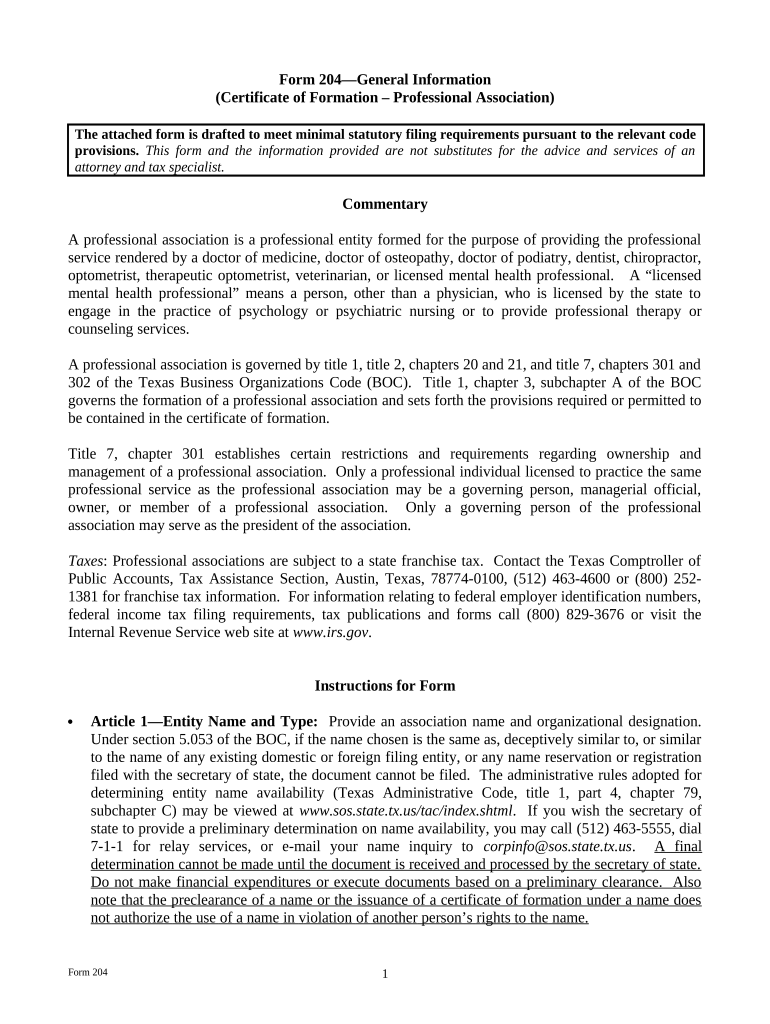
Texas Certificate of Formation Professional Association is the official filing submitted to the Texas Secretary of State to create a professional association under Texas law. It establishes the association's legal name, purpose, duration, registered agent and office, incorporators, and governance provisions required for licensed professionals to practice collectively. Filing creates a distinct legal entity, enabling limited liability protections and formal governance under the Texas Business Organizations Code. The completed certificate must include any profession-specific licensing statements required by state regulatory boards and comply with statutory signature and filing rules.

Why this Certificate Matters for Licensed Groups

Filing a Texas Certificate of Formation Professional Association formalizes a licensed group's legal existence, enables limited liability for members, and sets governance and compliance expectations. It clarifies professional scope and records the registered agent and organizers required by state law.

Why this Certificate Matters for Licensed Groups

Who Typically Prepares and Files This Certificate

Professionals, organizers, and legal counsel use this certificate when forming a licensed association or documenting organizational structure.

  • Licensed professionals forming a collective practice (doctors, lawyers, architects) needing state authorization and governance.
  • Registered agents and incorporators responsible for initial filing, service of process, and statutory contact information.
  • Law firms and professional service providers managing governance and member rights for compliance and reporting.

Primary Roles Involved in Filing

Incorporator

An incorporator signs and submits the certificate, provides organizer contact details, and confirms the association meets professional licensing requirements. They ensure the document accurately reflects membership restrictions, profession-specific statements, and the registered agent before filing with the Secretary of State.

Registered Agent

Registered Agent accepts official service and maintains a physical Texas address for notices. They must be available during business hours, consent to the role, and ensure forwarding of statutory communications to the association's leadership promptly.

Required Core Data Elements

Entity Name: Exact legal name as filed with state
Professional Purpose: Licensed profession and scope description
Registered Agent: Name and Texas address
Principal Office: Physical street address required
Organizers: Names and signatures of organizers
Professional License: License numbers and issuing board

Consequences of Incorrect or Incomplete Filings

Filing Rejection: Incorrect info causes rejection
Formation Delay: Processing delays postpone legal status
Liability Exposure: Members may lose limited liability protections
Regulatory Sanctions: State boards may impose fines or sanctions
Missing Notices: No agent or wrong address risks lost service
Tax Consequences: Incorrect filings can affect tax reporting

Common Preparation Pitfalls to Avoid

  • Using a trade name or DBA instead of the exact legal entity name can lead to filing refusal and time-consuming corrections with the Secretary of State.
  • Failing to obtain written consent from the registered agent prior to filing causes administrative rejection or requirement to amend the record afterward.
  • Omitting profession-specific licensing statements or license numbers may trigger review by the relevant licensing board and delay acceptance.
  • Entering inconsistent addresses or mismatched signer names between license records and the certificate increases the risk of rejection and regulatory inquiries.

Step-by-step: Completing and Filing the Certificate

Follow these steps to complete and file the Texas Certificate of Formation Professional Association accurately and in proper order.

  • 01
    Prepare Information: Gather name, purpose, agent, organizers, and license details.
  • 02
    Complete Form: Enter required fields, use MM/DD/YYYY dates where applicable.
  • 03
    Obtain Consents: Get registered agent and professional license confirmations.
  • 04
    File and Pay: Submit to Secretary of State and include filing fee.

How Filing Becomes an Official Record

Filing routes the completed certificate to the Texas Secretary of State, triggers issuance of a Certificate of Filing, and establishes the association's legal status.

  • Prepare Packet: Assemble form, attachments, and fees.
  • Submit: File online or by mail with Secretary of State.
  • Processing: Secretary of State reviews and assigns filing number.
  • Confirmation: Receive stamped certificate and official filing receipt.

Common e‑Filing and eSignature Workflow Settings

Typical e-filing workflow settings for completing the certificate, from document format to signer authentication and notification preferences.

Field Configuration
Document Format PDF or DOCX
Signer Authentication Email with optional SMS code
Routing Order Organizer then registered agent
Notifications Email receipts to organizers

Platform and File Requirements for eSubmission

Use a secure platform that accepts PDF or DOCX, preserves timestamps, and provides an audit trail for signatures.

  • File Formats: PDF or DOCX preferred
  • Authentication: Email or SMS code options
  • Integrations: CRM and cloud storage support

Timing and Recurring Filing Considerations

Key timing items include the filing effective date, onboarding tasks after acceptance, and recurring reports or taxes required by state authorities.

Filing Effective Date:

Entity becomes effective on filing date unless delayed by filer

Annual Reports:

Many states require annual or biennial reports; deadlines vary by state

Franchise/State Taxes:

Franchise or entity-level tax filings are typically annual

License Renewals:

Professional licenses often require periodic renewal and record updates

Amendments:

File amendments promptly to keep public records accurate

Practical Tips for Accurate and Efficient Filing

Follow these best practices to minimize rejection risk and speed processing.

Confirm Licensing Requirements
Before filing, review the applicable professional licensing board rules to ensure the certificate includes required profession‑specific statements and license numbers; omissions often trigger additional review and delay processing.
Verify Registered Agent Consent
Obtain and retain written consent from the registered agent before filing; having consent on file prevents administrative rejection and provides a clear record for service of process obligations.
Use Accurate Legal Names
Match entity and individual names exactly to government-issued IDs and licensing records to avoid mismatches that can result in processing delays or rejections by the Secretary of State.
Preserve Signed Records
Keep the original signed certificate, any license confirmations, and the platform audit trail; these records support compliance, audits, and any future amendments or disputes.

Practical Filing Scenarios

These anonymized examples show typical formation contexts and outcomes for professional associations.

Medical Group Formation

A group of licensed physicians forms a professional association to share administrative services and limit liability

  • All organizers verified license numbers and agent consent
  • The association filed with complete license attachments; prompt acceptance allowed billing setup and credentialing without regulatory delay.

Attorney Association

A small law firm creates an association to centralize malpractice insurance and billing

  • Bar compliance review flagged ownership language
  • After amending ethics disclosures and resubmitting, the Secretary of State issued the certificate and the firm updated its client engagement materials.

Frequently Asked Questions

Answers to common questions about completing, signing, and filing the Texas Certificate of Formation Professional Association.


Need help? Contact support

eSignature Platform Pricing and Key Capabilities

Comparing baseline pricing and key features for common eSignature vendors; signNow is listed first per table conventions and pricing reflects published per-user monthly tiers.

signNow DocuSign Adobe Sign PandaDoc HelloSign
Starting Price $8/user/mo $15/user/mo $14/user/mo $19/user/mo $15/user/mo
Free Trial 7-day trial Varies Varies Varies Varies
Bulk Send Yes Yes Yes Yes Varies
Audit Trail Yes Yes Yes Yes Yes
HIPAA Compliant Yes Yes Yes No No
Envelope Cap No cap 100 envelopes/user/year Varies Varies Varies
be ready to get more
Join over 28 million airSlate SignNow users