Establishing secure connection…Loading editor…Preparing document…

Assignment Partnership

This template is fully customizable. Edit the text, fill out the fields, and send it for signature. Give it a try!
Assignment Partnership

What an Assignment Partnership document does

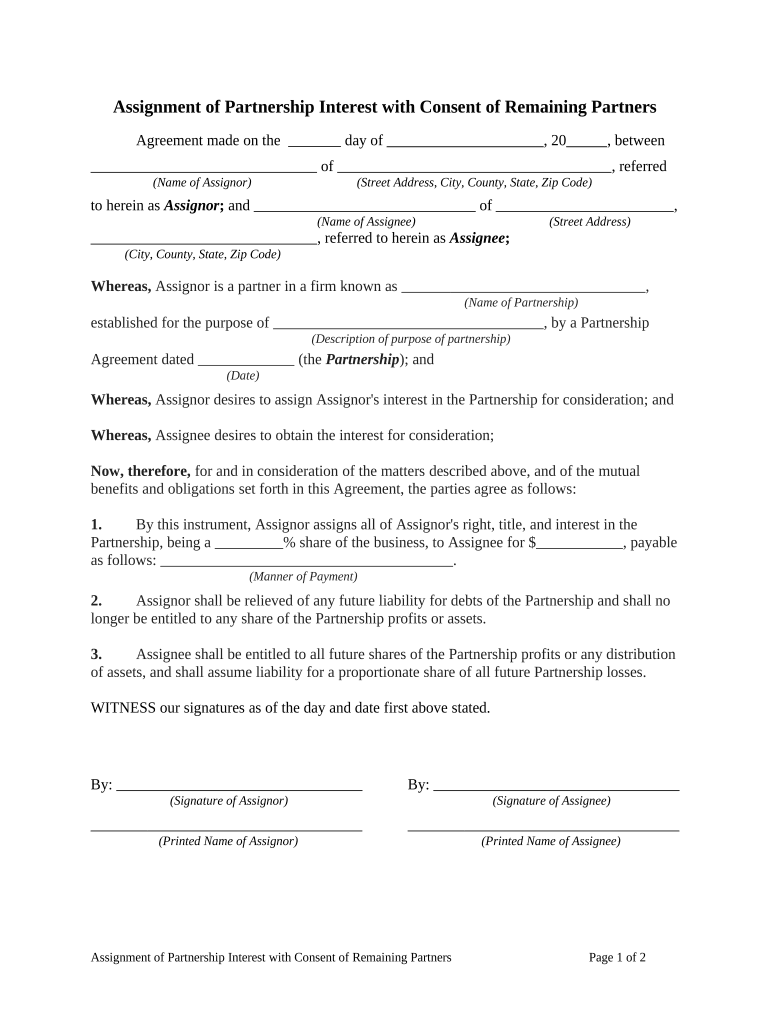
An Assignment Partnership is a legal agreement that transfers an existing partner's rights, interests, or obligations in a partnership to another party. It records the identity of the assignor and assignee, the portion or interest being transferred, the effective date, and any required consents from remaining partners. This document can modify economic shares, voting rights, or management roles and often references the underlying partnership agreement. Accurate execution and clear consideration of tax and state law consequences are essential for enforceability and for updating partnership records and tax registrations.

Why use a formal Assignment Partnership agreement

A written assignment preserves the parties’ intent, documents consideration, and clarifies the scope of transferred rights. It reduces disputes and creates a clear record for partners, banks, and tax authorities.

Why use a formal Assignment Partnership agreement

Who prepares and signs an Assignment Partnership

Use clear internal procedures for approvals and updates to accounting systems, and retain execution evidence for at least the minimum statutory retention period.

  • Transferring partner: drafts or provides details, confirms authority, and supplies signatures or notarization as required.
  • Receiving partner: verifies representations, accepts assigned rights, and provides any required consideration or payment.
  • Partnership representatives: review for consent, update capital accounts, and record changes in partnership records.

Primary signatories and stakeholders

Transferring Partner

A partner who disposes of all or part of their partnership interest. Typically provides written notice, executes the assignment, and confirms representations about authority and absence of encumbrances. Legal and tax advisors often assist to address capital account and tax basis impacts.

Assignee Partner

The recipient of the transferred interest who accepts the assignment, agrees to the partnership terms, and provides any agreed consideration. The assignee must verify governing documents and may need to execute joinder or consent documents per the partnership agreement.

Core elements every Assignment Partnership should include

A professional assignment balances clarity of transfer with compliance. Include the following elements to help ensure enforceability and operational continuity.

Parties

Full legal names and entity types for assignor and assignee, including state of formation and business addresses to avoid ambiguity and facilitate recognition by banks and tax authorities.
Recitals

Background statements that identify the underlying partnership agreement, the reason for transfer, and any reference numbers or dates to connect the assignment to the governing documents.

Scope of Transfer

Precise description of the interest transferred (percentage, unit count, capital or profit share) and whether management or voting rights transfer with economic interest.

Consideration

Clear statement of payment or other consideration exchanged, including currency, payment schedule, and tax allocation if applicable.

Consents and Conditions

Any required partner consents, waivers, or conditions precedent (e.g., approval thresholds in the partnership agreement) and reference to joinder documents.

Signatures

Execution blocks for assignor, assignee, partnership representative, and, if required, notary or witness statements, with dates and printed names for each signer.

Step-by-step: executing an Assignment Partnership

Follow these core steps to prepare, approve, and record an assignment correctly.

  • 01
    Prepare Draft: Complete all fields and attach governing partnership agreement excerpts.
  • 02
    Obtain Consents: Secure required partner approvals per partnership agreement.
  • 03
    Execute Signatures: Assignor and assignee sign; add notary or witnesses if required.
  • 04
    Update Records: File with partnership records and notify tax/payroll systems.

Configuring an online workflow for the assignment

Set up an electronic workflow that enforces approvals and captures audit evidence for each signing step.

Field Configuration
Template Use a reusable template with locked clauses and editable fields for parties and amounts.
Signer Order Require partner consent before assignee signs; enforce sequential signing.
Authentication Enable email + SMS code or higher for identity verification.
Audit Trail Capture IP, timestamp, and document history for reproducibility.

Technical considerations for digital execution

Retain signed copies in secure storage and configure access controls and audit logs to meet regulatory and partnership governance requirements.

  • Integrations: Connectors for NetSuite, Salesforce, Microsoft 365, Google Workspace, and Box streamline record updates and document storage.
  • File formats: PDF, DOCX, and PDF/A support preserves layout and embedded audit data.
  • Authentication Options: Email links, SMS codes, KBA, and higher assurance methods available per workflow needs.

Where to send executed assignment documents

After execution, distribute copies to partners and update any public or tax-facing records required by governing law.

  • Partnership Records: Place fully executed document in the partnership minute book or electronic records repository.
  • Tax Contacts: Notify payroll, accounting, and the partnership's tax preparer for allocation adjustments.
  • Bank and Lenders: Provide executed copies to banks or creditors when ownership impacts covenants.
  • State Filings: File any required state forms if the assignment affects registered ownership or triggers transfer tax.

Key timing considerations after execution

Some actions follow execution and must meet specific deadlines depending on tax, partnership, or state rules.

Effective Date:

Defines when economic and voting changes begin.

Partner Consent Deadline:

Meet any consent timelines in the partnership agreement to avoid invalidation.

Tax Reporting:

Update K-1 allocations for the tax year affected by the transfer.

Recording Window:

Record any related real property instruments per local recording rules.

Recordkeeping Start:

Preserve execution evidence from the date of signing.

Major milestones in the assignment lifecycle

A sequential view of what typically happens from negotiation to post-execution updates.

01

Negotiation

Parties agree on terms and consideration before drafting.

02

Approval

Partnership consents and any third-party approvals are secured.

03

Execution

Signatures are captured, notarized, or witnessed as required.

04

Post-Execution Updates

Accounting, tax allocations, and records are adjusted and distributed.

Security and compliance features to require

Encryption: TLS 1.2/1.3 in transit; AES-256 at rest.
Audit Trail: IP, timestamp, and action log retained.
HIPAA Support: BAA available for protected health information.
21 CFR Part 11: Features to support FDA-regulated records.
SOC 2: SOC 2 Type II compliance available.
SSO: SAML/SSO for enterprise identity control.

Potential legal and financial risks

Unenforceable Transfer: Failure to obtain required consents may void the assignment.
Tax Consequences: Incorrect reporting can lead to IRS adjustments or penalties.
Creditor Claims: Outstanding obligations or liens may attach to transferred interest.
Recording Errors: Failure to record related instruments may affect priority rights.
Notarization Defects: Improper notarization can impair acceptance by third parties.
Data Breach: Unauthorized access risks confidentiality and compliance.

Common preparation and execution mistakes

  • Vague description of interest: failing to specify percentage or units creates ambiguity and litigation risk.
  • Missing consents: skipping required partner approvals can render the transfer ineffective under the partnership agreement.
  • Incorrect effective date: inconsistent dates between documents complicate tax and distribution calculations.
  • Not updating records: not notifying tax preparers, banks, or registers leads to mismatches and compliance issues.

Practical tips for accurate completion

Adopt consistent review and recordkeeping practices to reduce execution risk and speed downstream updates.

Confirm authority early
Verify that the assignor has the power to transfer the stated interest under partnership documents to avoid invalid transfers.
Use precise language
Describe the interest and consideration numerically and in words, and attach references to the governing partnership agreement sections.
Document consents
Attach partner consent or joinder documents and retain proof of approval consistent with corporate governance requirements.
Preserve execution evidence
Retain signed originals or secure electronic copies with audit trails, timestamps, and signer authentication details.

How other organizations handled partner assignments

Real examples illustrate practical considerations when executing assignment documents and updating records.

Martin Properties

A small real estate firm moved partner interests remotely using secure electronic documents and notary acknowledgment.

  • They required updated capital accounts and bank notices.
  • The firm retained clear audit evidence, updated its partnership ledger, and coordinated tax reporting to reflect the new ownership structure, avoiding delays in rent distributions and lender consents.

BIS

A services company used documented consents and joinder agreements to add an assignee after negotiation.

  • The process required sequential approvals.
  • The company attached partner resolutions and amended internal records; legal counsel confirmed tax allocation and updated operating accounts to reflect the transferred economic interest.

eSignature vendor comparison for executing assignments

Comparing basic pricing and core capabilities can help teams choose an eSignature provider that meets authentication, audit trail, and compliance needs.

signNow DocuSign Adobe Sign PandaDoc HelloSign
Starting Price $8/user/mo $15/user/mo $14/user/mo $19/user/mo $15/user/mo
Free Trial 7-day free trial No No Yes, limited Yes, limited
Bulk Send Yes Yes Yes Yes No
Audit Trail Yes Yes Yes Yes Yes
HIPAA Compliant Yes Yes Yes No No

Frequently asked questions about Assignment Partnership documents

Answers to common execution, filing, and enforceability questions for assignment agreements.


Need help? Contact support

be ready to get more
Join over 28 million airSlate SignNow users