Establishing secure connection…Loading editor…Preparing document…

Bailment Contract for Loan of Fine Art

This template is fully customizable. Edit the text, fill out the fields, and send it for signature. Give it a try!
Bailment Contract for Loan of Fine Art

What a Bailment Contract for Loan of Fine Art Is

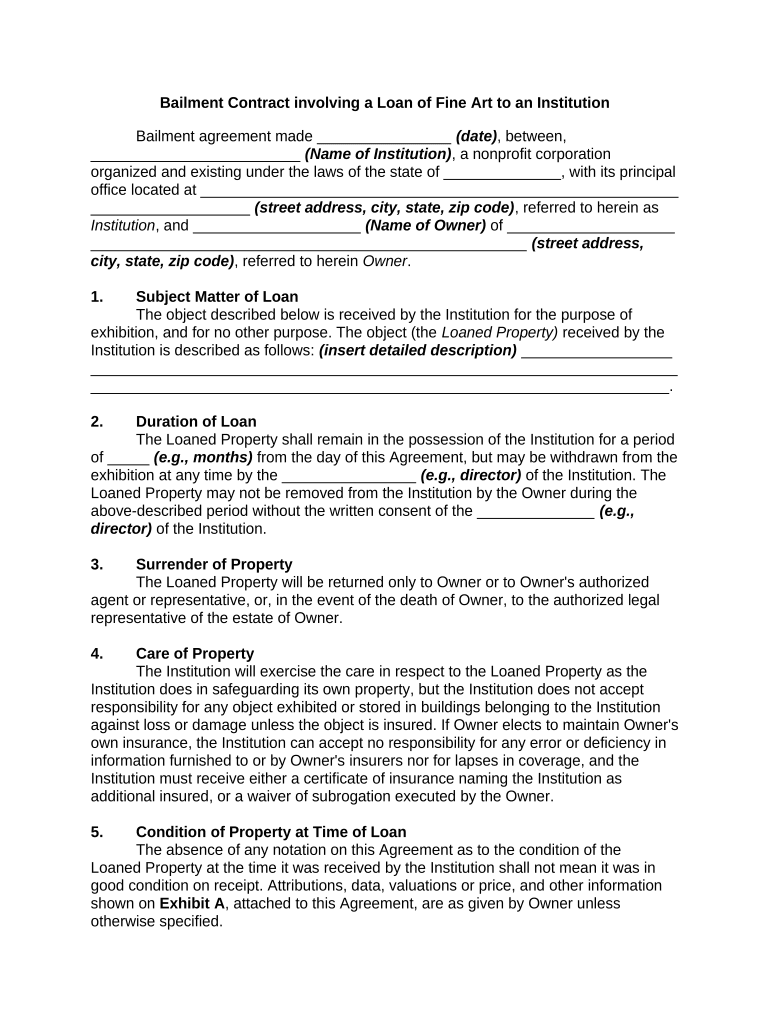
A Bailment Contract for Loan of Fine Art is a written agreement under which the owner (bailor) temporarily transfers possession of a work of art to another party (bailee) for a defined purpose and period without conveying title. The contract specifies responsibilities for care, insured value, transportation, display conditions, environmental controls, and return procedures. It establishes risk allocation for loss, damage, or deterioration while the piece is in the bailee’s custody and typically addresses insurance limits, appraisal requirements, handling protocols, and termination. This document is commonly used by museums, galleries, lenders, and private collectors.

Why a Clear Bailment Contract Matters

Defines clear custody, care, and liability expectations for loaned artworks, reducing disputes and insurance gaps. It documents condition reports, handling protocols, and responsibilities for transportation and display, offering legal clarity that supports claims handling and risk management during temporary transfers of valuable cultural property.

Why a Clear Bailment Contract Matters

Who Commonly Uses This Contract

Typical users include museums, galleries, private collectors, exhibition venues, and specialized art transport or storage firms.

  • Museums and cultural institutions arranging inbound or outbound loans for exhibitions and traveling displays.
  • Galleries lending works for temporary exhibitions, commercial displays, or private viewings with insured transit.
  • Private collectors, foundations, and corporate lenders providing artworks on loan to venues or individuals.

Typical Signatory Roles

Lender — Owner

Typically the artwork owner or authorized representative who retains title. The lender completes valuation and condition reports, provides insurance information, and sets display and environmental requirements. The lender must sign to confirm ownership, authorized loan terms, and indemnity limitations.

Bailee — Borrower

The borrowing institution or individual responsible for physical custody and care during the loan term. The bailee agrees to specified handling, security, climate controls, reporting, and return procedures; accepts liability per the contract and must provide proof of insurance or indemnity.

Essential Fields to Include

Artwork Description: Title, artist, medium, dimensions.
Provenance: Ownership history and authenticity details.
Condition Report: Detailed pre-loan condition and photos.
Insurance Coverage: Policy limits and insurer contact.
Loan Period: Start and end dates, MM/DD/YYYY.
Transport & Handling: Courier, packing, and climate controls.

Key Risks and Potential Consequences

Physical Damage: Restoration costs, diminished value.
Loss or Theft: Full insured value at risk.
Insurance Gaps: Underinsurance increases lender exposure.
Customs Penalties: Fines and seizure possible.
Breach of Terms: Contract damages and legal fees.
Tax Consequences: Appraisal and reporting complications.

Common Preparation Mistakes to Avoid

  • Failing to attach a pre-loan condition report with dated photographs results in disputes over whether damage occurred while on loan.
  • Omitting precise environmental or lighting specifications can cause accelerated deterioration and undermine insurance claims for art sensitive to humidity or light.
  • Relying on vague insurance language or insufficient limits may leave the lender exposed to partial recovery and protracted claims.
  • Not recording chain-of-custody during transit or storage increases risk of theft, misplacement, and difficulties in proving custody for insurers or customs.

Sequential Checklist to Complete the Contract

Use this sequential checklist to complete the Bailment Contract for Loan of Fine Art accurately and reduce execution errors.

  • 01
    Gather Details: Collect owner, artwork, and insurer information.
  • 02
    Document Condition: Prepare dated condition reports and photos.
  • 03
    Set Terms: Specify duration, purpose, insurance, and liability.
  • 04
    Sign & Return: Obtain signatures, notarization if required, and distribute copies.

How the Execution Workflow Typically Operates

Typical routing from lender to borrower and back, showing transport, display, and return steps with documentation at each stage.

  • Upload Agreement: Sender uploads draft contract and reports.
  • Assign Signers: Designate lender, bailee, and insurer reviewer.
  • Obtain Signatures: Secure electronic or wet signatures per authentication level.
  • Archive Records: Store signed contract and audit trail securely.

Core Components of a Professional Bailment Contract

A professional Bailment Contract for Loan of Fine Art combines legal safeguards, logistics, and insurance details to protect lenders, bailees, and the cultural value of the work during temporary transfers.

Identification

Precise artwork identification including title, artist, date, medium, dimensions, serial or accession numbers, and high-resolution images; this prevents misidentification and ties condition reports to the exact object on loan.
Purpose & Term

Clear statement of loan purpose, exhibition or research use, start and end dates, extensions policy, and procedures for early return or prolonged custody; defines the temporal bounds of liability and obligations.

Condition & Handling

Detailed pre- and post-loan condition reports, handling instructions, packing and unpacking protocols, framer or mount specifications, and environmental thresholds to reduce risk during display and storage.

Insurance & Indemnity

Named insured, policy limits, permitted deductibles, waiver details, and indemnification clauses specifying who bears cost for partial loss, restoration, and total loss, including subrogation rights.

Transport & Customs

Agreed carriers, routing, packing standards, export/import clearances, customs declarations, and responsibilities for duties or bonded transport to avoid delays and legal exposure on cross-border loans.

Termination & Return

Return logistics, condition reporting on return, timeline for restitution, remedies for breach, disposition of damaged items, and dispute resolution procedures including governing law and venue.

Example Digital Workflow Configuration

Configure digital workflow fields and approvals for the Bailment Contract to enforce required data and automate routing.

Field Configuration
Signer Order Lender > Bailee > Insurer
Required Attachments Condition report, images, insurance certificate
Authentication Email link or SMS code; escalate to KBA if high value
Notifications Automated reminders 7, 3, and 1 day before return

Technical and Security Considerations for Digital Execution

Digital platforms support e-signing, storage, and audit trails for bailment contracts while meeting authentication and compliance requirements.

  • Formats: PDF and Word DOCX preferred.
  • Integrations: Works with NetSuite, Salesforce, Box.
  • Security: AES-256 at rest; TLS in transit.

How a Bailment Contract Differs from Similar Agreements

Key differences between a Bailment Contract for Loan of Fine Art and similar agreements clarify possession, title transfer, and seller obligations.

Criteria Bailment Contract Consignment Agreement
Title no transfer transfer on sale
Primary Purpose temporary custody sale on consignment
Payment no sale proceeds seller paid after sale
Insurance bailor insured consignee insured

Typical eSignature Pricing and Core Features Comparison

Compare common pricing and core feature availability for eSignature vendors commonly used to execute Bailment Contracts for loaned artworks.

signNow DocuSign Adobe Sign PandaDoc HelloSign
Starting Price $8/user/mo $15/user/mo $14/user/mo $19/user/mo $15/user/mo
Free Trial 7-day free trial Trial available Trial available Trial available Trial available
Bulk Send Yes Yes Yes Yes No
Audit Trail Yes Yes Yes Yes Yes
HIPAA Compliant Yes Yes Yes No No
Envelope Cap No envelope cap 100 envelopes/user/year Varies by plan Varies by plan Varies by plan

Practical Tips for Accurate and Efficient Completion

Follow these best practices to minimize disputes and processing time when preparing the Bailment Contract for Loan of Fine Art.

Document detailed pre-loan condition with photos
Include dated, high-resolution photographs of all visible surfaces, annotated notes for existing damage, and a signed condition report by a qualified conservator to provide objective baseline evidence for insurers and to speed claims resolution.
Clarify insurance and deductibles in the contract
Specify named insured, agreed valuation, deductible amounts, and whether the lender waives subrogation; require insurance certificate before transport, and confirm timely notice procedures for claims to avoid coverage disputes.
Define environmental and display standards
List acceptable temperature, humidity, light levels, and display mounting methods; require monitoring logs for long exhibitions and immediate notification if conditions exceed thresholds to prevent degradation and support mitigation.
Use standardized templates and digital workflows
Adopt a consistent template with mandatory fields, automated reminders, and secure e-signatures to reduce errors, ensure completeness, and preserve an auditable trail for insurers and legal reviews.

Two Practical Loan Scenarios

Real-world scenarios illustrate how bailment contracts manage risk, insurance, and logistics for high-value works loaned for exhibitions.

Museum Loan

A museum borrows a 19th-century painting for a three-month exhibition with strict climate controls and courier transport.

  • Condition report and conservator sign-off required.
  • The contract required agreed valuation, a certificate of insurance naming the museum as additional insured, AV recording during transit, and a documented return schedule; these provisions reduced dispute risk and expedited insurer involvement when minor varnish cracking was reported.

Gallery Loan

A commercial gallery loans a sculpture to a private collector for a temporary installation in a corporate lobby.

  • Agreed-value insurance required before pickup.
  • The agreement specified installation anchor points, maintenance access, and a bonded courier; clear timing and insurance clauses avoided a protracted claim after a minor transit dent was promptly repaired and settled.

Key Milestones in a Bailment Loan Lifecycle

Key milestones show the typical lifecycle stages for a bailment loan from request through return and claims handling.

01

Loan Request

Submit proposal, valuation, and insurance intent.

02

Condition Report

Complete and sign pre-loan condition documentation.

03

Transport & Display

Coordinate courier, install, and monitor environmental conditions.

04

Return & Close

Deinstall, complete return condition report, and settle claims.

Typical Deadlines and Lead Times to Observe

Standard deadlines and lead times for insurance, shipping, and condition reporting reduce exposure and ensure timely returns for loaned artworks.

Insurance Certificate Due:

At least 7 business days before transport

Condition Report Completed:

Must be signed on or before outbound shipment date

Shipping Window:

Courier to schedule within agreed two-week window

Return Notice:

Bailee must confirm shipment 14 days before return

Claims Notification:

Report loss or damage within 30 days of discovery

Frequently Asked Questions About Bailment Contracts

Answers to common questions about executing, validating, and enforcing a Bailment Contract for Loan of Fine Art, with practical remedies and references.


Need help? Contact support

be ready to get more
Join over 28 million airSlate SignNow users