Header
Include sender name, mailing and email address, phone, account number, invoice number, and date to ensure accurate routing.
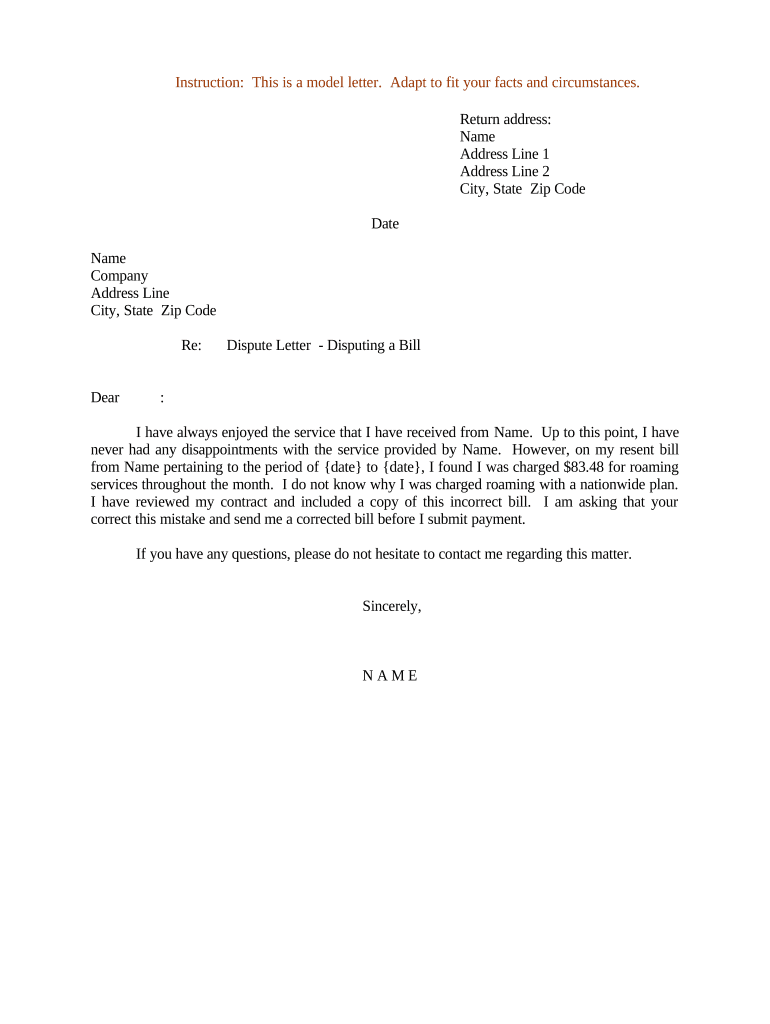
A clear template reduces ambiguity, speeds internal processing, and creates a written record that establishes the consumer’s timely notice. Well-formed disputes help providers identify billing errors, trigger required investigation procedures, and reduce the risk of late fees or credit reporting while the dispute is investigated.

Organizations and individuals use a Bill Dispute Template to document disagreements and request correction or review of charges.
Use the template to create a dated, auditable record; preserve copies and attachments for follow-up or escalation to regulators, credit bureaus, or legal counsel if necessary.
Include sender name, mailing and email address, phone, account number, invoice number, and date to ensure accurate routing.
List each disputed charge with invoice line, date, amount, and a short reason for dispute (e.g., duplicate charge, incorrect amount, service not rendered).
State the remedy you seek—adjusted bill, refund, credit, or investigation—so the provider knows the expected outcome.
Attach copies of receipts, prior communications, contracts, or photos; reference each attachment in the dispute list for easy review.
Add any consumer protection citations or payment-stay requests if applicable under state or federal law; keep language factual and not threatening.
Sign (electronic signature acceptable under ESIGN/UETA) and date the letter; include printed name and relationship to account if signing for a business or on behalf of another.
| Field | Configuration |
|---|---|
| Account Number | Required; auto-validate format |
| Dispute Type | Dropdown: billing error, duplicate, service not rendered |
| Attachments | Allow multiple file uploads; limit 10 MB each |
| Routing | Auto-assign to billing team with SLA |
When you complete and transmit a Bill Dispute Template electronically, choose a platform that preserves an audit trail and supports common file formats.
Ensure your selected provider can produce a tamper-evident signed file and a certificate of completion so the dispute record meets retention and audit requirements.
| signNow | DocuSign | Adobe Sign | PandaDoc | HelloSign | |
|---|---|---|---|---|---|
| Starting Price | $8/user/mo | $15/user/mo | $14/user/mo | $19/user/mo | $15/user/mo |
| Free Trial | 7-day free trial | Varies by plan | Varies by plan | Varies by plan | Varies by plan |
| Bulk Send | Plan-dependent | Plan-dependent | Plan-dependent | Plan-dependent | Plan-dependent |
| Audit Trail | Yes | Yes | Yes | Yes | Yes |
| Envelope Cap | No cap | 100 envelopes/user/year | Plan-dependent | Plan-dependent | Plan-dependent |
Send dispute promptly after identifying the charge; many creditors expect notice within 30–60 days
Many providers acknowledge receipt within 10–30 days and resolve within 30–90 days
Disputes can pause adverse reporting during investigation; timelines vary by furnisher and FTC rules
Some statutes impose specific notice windows; verify the rule that applies to your industry
Keep copies until resolution plus recommended retention periods (see retention timeline)
You send the completed template and attachments to the provider; this creates an official notice.
Provider logs the dispute and sends confirmation with a case number and expected response timeframe.
Provider reviews records, contacts internal teams, and may request additional information from you.
Provider issues adjustment, refund, or explanation; record final outcome and any corrected statements.
A patient found a duplicate hospital charge on an EOB and sent the template with the EOB attached and dates highlighted.
A homeowner submitted meter readings and photos with the template after an unexplained spike in usage.