Establishing secure connection…Loading editor…Preparing document…

Bond Agreement

This template is fully customizable. Edit the text, fill out the fields, and send it for signature. Give it a try!
Bond Agreement

What a Bond Agreement Covers and Who’s Involved

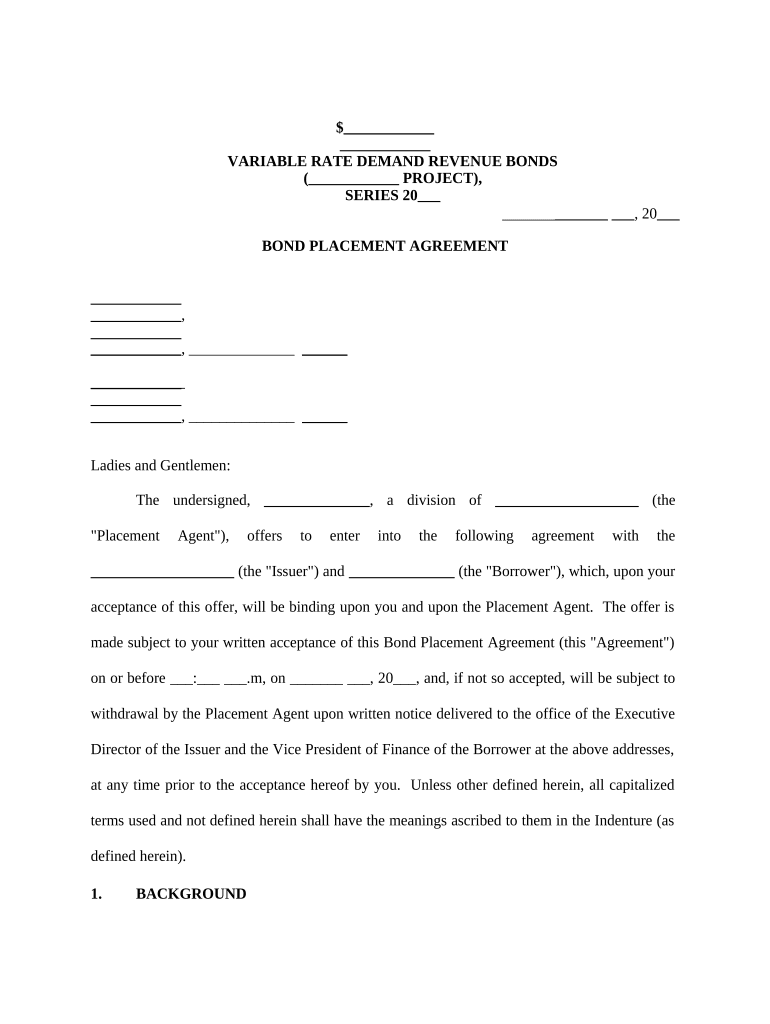
A Bond Agreement is a legally binding contract in which one party (the principal) promises to perform specific obligations and a second party (the surety) guarantees performance to a third party (the obligee). Common in construction, procurement, and judicial settings, bond agreements include payment bonds, performance bonds, and fidelity bonds. They define duties, financial obligations, indemnity provisions, claims procedures, and remedies for default. In the United States, enforceability relies on contract law and applicable statutes; parties should confirm state-specific formalities such as notarization, witness requirements, or filing obligations before execution.

Why a Proper Bond Agreement Matters

A Bond Agreement allocates risk, secures performance or payment obligations, and gives the obligee third-party assurance. Clear bond terms reduce disputes, enable faster recovery of damages, and support enforceability against both principal and surety.

Why a Proper Bond Agreement Matters

Who Typically Prepares or Signs This Agreement

Typical users include contractors, project owners, and lenders who require financial assurance and performance guarantees before construction or procurement begins.

  • General contractors securing payment and performance obligations for subcontractor work on projects.
  • Public agencies requiring bid, performance, and payment bonds on public contracts.
  • Commercial lenders or owners seeking assurance of completion before releasing funds.

Core Sections to Include in a Professional Bond Agreement

Core sections of a Bond Agreement define parties, covered obligations, financial limits, claims procedures, indemnity, and conditions under which the surety will act.

Parties

Identify obligee, principal, and surety with full legal names and addresses; specify authorized representatives and contact details for notices and claims to ensure correct attribution and service.
Obligations

Describe the specific performance or payment duties the principal must satisfy, including milestones, deliverables, acceptance criteria, and any performance standards tied to contract specifications or permits.

Penalty/Limit

Set the bond penal sum, aggregate liability limits, and whether partial payments reduce the penal sum; clarify how interest, costs, and attorney fees are treated in recovery actions.

Claims Process

State notice requirements, deadlines for presenting claims, documentation needed to support a claim, and the process for claim adjudication and payment by the surety.

Indemnity

Specify indemnification obligations, whether the principal must reimburse the surety for paid claims, and procedures for the surety to seek subrogation against the principal.

Termination

Define conditions for bond release, expiration triggers, required consent for substitution or discharge, and post-termination obligations such as claim assertion periods.

Step-by-Step: Complete and Execute the Bond Agreement

Follow these sequential steps to complete, authenticate, and exchange the Bond Agreement securely with signatories.

  • 01
    Prepare: Gather contract, scope documents, and project schedule before creating the bond.
  • 02
    Draft: Populate parties, bond type, penal sum, and governing law.
  • 03
    Authenticate: Obtain signatures, notarization, or RON per state rules.
  • 04
    Distribute: Provide executed copies to obligee and surety.

Common Workflow Settings to Automate Bond Processing

Configuration settings commonly used to create repeatable Bond Agreement workflows and automate routing for teams.

Field Configuration
Signing order Sequential or parallel ordering, enforce required sequence.
Authentication method Email link, SMS code, or KBA for higher assurance.
Template reuse Save templates to prefill fields and expedite reuse.
Notifications Automated reminders and completion alerts to parties.

Routing from Creation to Claims: Typical Process Flow

Typical routing and approval flow for a Bond Agreement moves from creation through signature, filing, and claims handling and resolution.

  • Upload: Attach contract and bond form.
  • Assign: Designate signers and execution order.
  • Sign: Signers authenticate and apply signatures.
  • Archive: Store final bond and audit trail.

Platform and Security Considerations for Electronic Execution

Confirm platform capabilities and integrations before e-signature and notarization to ensure compliance and archival requirements.

  • File formats: Supports PDF, Word DOCX, and Excel.
  • Integrations: Salesforce, NetSuite, Google Workspace available.
  • Security: AES-256 at rest; TLS 1.2/1.3 in transit.

eSignature Vendor Comparison for Executing Bond Agreements

Common vendor pricing and capabilities for eSignature platforms used to sign Bond Agreements; signNow is listed first per comparison guidelines.

signNow DocuSign Adobe Sign PandaDoc HelloSign
Starting Price $8/user/mo $15/user/mo $14/user/mo $19/user/mo $15/user/mo
Free Trial 7-day free trial No No Yes, limited Yes, limited
Bulk Send Yes Yes Yes Yes No
Audit Trail Yes Yes Yes Yes Yes
HIPAA Compliant Yes Yes Yes No No

Consequences and Common Legal Risks

Late filing: May trigger statutory penalties and late-notice disputes.
Incorrect parties: Mismatched names can void claims or delay recovery.
Insufficient penal sum: Underestimating amount limits recoverable damages.
Missing notarization: Can render bond unenforceable in some jurisdictions.
Improper authority: Signatures without capacity may be challenged.
Failure to notify: Late claim notice can bar recovery.

Frequent Preparation Errors to Avoid

  • Using ambiguous language that leaves party obligations or remedies undefined, which increases litigation risk and can make surety liability uncertain.
  • Failing to verify signatory authority or attach corporate resolutions when an entity signs, leading to avoidable challenges to enforceability.
  • Neglecting state-specific notarization, witness, or RON rules, particularly where local law prescribes additional formalities, causing execution defects.
  • Misreading penal sum provisions (aggregate versus per-claim) and failing to coordinate bond limits with the primary contract and insurance policies.

Practical Steps to Reduce Risk and Speed Resolution

Adopt consistent templates, require clear party identification, and include precise claims procedures and notice provisions to reduce disputes and speed recovery.

Use standardized bond templates and exhibits
Create a template with fixed clauses for parties, penal sums, claim steps, notice addresses, and governing law. Maintain version control, legal review checkpoints, and a clear exhibit list so each execution references the same enforceable obligations.
Confirm signer authority and attach corporate evidence
Require signers to include printed name, title, and attach a corporate resolution or power of attorney when an entity signs. Maintain verification records to prevent later challenges to capacity and ensure proper attribution under ESIGN and UETA principles.
Coordinate the bond with the primary contract terms
Mirror performance standards, milestones, and termination dates from the underlying contract to avoid conflicts. Ensure penal sums and durations align with payment schedules and retain clauses for post-completion claims.
Preserve audit trail, notarization, and originals
Capture signed PDFs with embedded audit trails, store notarization acknowledgements or RON recordings when used, and archive digital and required paper originals to support claims or defend against challenges.

Frequently Asked Questions About Bond Agreements

Answers to common questions about validity, notarization, corrections, and signatory authority for Bond Agreements executed electronically or on paper.


Need help? Contact support

be ready to get more
Join over 28 million airSlate SignNow users