Establishing secure connection…Loading editor…Preparing document…

California Judgment Lien

This template is fully customizable. Edit the text, fill out the fields, and send it for signature. Give it a try!
California Judgment Lien

What a California Judgment Lien Is and how it works

A California Judgment Lien is a recorded claim that attaches to a debtor's real property after a court enters a money judgment and an Abstract of Judgment (or equivalent) is recorded with the county recorder. Once recorded, the lien notifies third parties and can prevent sale or refinancing without satisfying the debt. The lien does not transfer title but secures payment against the property and can be enforced through levy or sale procedures if the judgment remains unpaid.

Why recording a judgment lien matters

Recording preserves and enforces a money judgment by creating a public encumbrance on real property, improving collection options and priority against later creditors.

Why recording a judgment lien matters

Who commonly prepares and relies on a judgment lien

These stakeholders typically coordinate across court clerks, county recorders, and enforcement officers to preserve and realize the lien.

  • Judgment creditors and collection firms seeking secured recovery against property.
  • Civil litigation attorneys responsible for preparing Abstracts and recording documents.
  • Title officers and real estate professionals verifying encumbrances on property.

Who can sign and submit the lien

Judgment Creditor

An authorized representative of the creditor (in-house counsel or collections attorney) signs filing documents and coordinates recording and service. The signer must have authority to act on behalf of the creditor entity and ensure entry matches court records.

Filing Agent

A licensed attorney, process server, or agent prepares and records the Abstract of Judgment with the county recorder and certifies service; they must follow county recording rules and maintain proof of filing and service.

Essential data fields for the California Judgment Lien

Debtor Name: Full legal name
Judgment Amount: Principal plus post-judgment interest
Case Number: Court case identifier
Court Name: Issuing court
Property Description: Legal description or assessor parcel number
Recording County: County recorder office

Common risks if the lien is incorrect or incomplete

Name Error: May render lien unenforceable
Wrong County: Lien may not attach to intended property
Incomplete Description: Title issues and search failures
Unrecorded Document: No priority against third parties
Expired Judgment: Lien may be invalid if not renewed
Service Failure: Enforcement or sale delayed

Common mistakes to avoid when preparing a judgment lien

  • Recording in the county where the debtor does not own the property, causing the lien to fail to attach to intended assets.
  • Using an abbreviated or alias name for the debtor instead of the exact legal name shown on court records and government ID.
  • Submitting an Abstract that omits the legal description or assessor parcel number used by the county recorder.
  • Failing to check whether the underlying judgment has been renewed or otherwise modified prior to recording.

Step-by-step: recording a California Judgment Lien

Follow these sequential steps to prepare, record, and preserve a judgment lien in California.

  • 01
    Confirm Judgment: Verify entry date, amount, and case number.
  • 02
    Prepare Abstract: Create Abstract of Judgment with full legal details.
  • 03
    Record with County: Submit Abstract to county recorder where property lies.
  • 04
    Serve Notice: Deliver notice to debtor as required for enforcement.

Where to file and how the filing is routed

Recording a judgment lien involves coordination with court and county recording offices and may require certified copies of the judgment.

  • Court Clerk: Obtain certified judgment copy from issuing court.
  • County Recorder: Record Abstract of Judgment in recorder's office.
  • Sheriff/Levies: Coordinate with enforcement officers for levy actions.
  • Title Companies: Notify title companies to reflect lien in searches.

Key elements to include in a professional California Judgment Lien filing

A complete filing package ensures the lien attaches correctly and is discoverable by title searches and enforcement personnel.

Certified Judgment Copy

Include a court-certified judgment or docket entry to verify the underlying judgment and permit recorder acceptance.
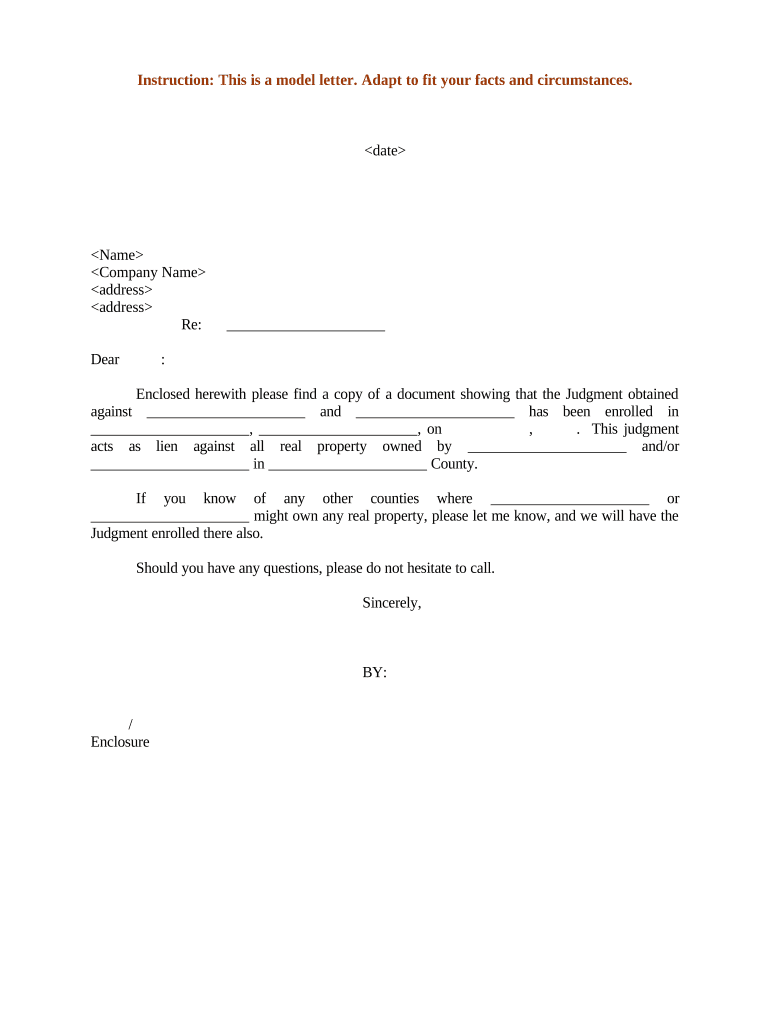
Abstract of Judgment

A properly completed Abstract summarizes parties, case number, judgment amount, and judgment date for recording.

Exact Debtor Name

Use the debtor's precise legal name to avoid search mismatches and potential invalidation.

Accurate Property Description

Provide the full legal description or assessor parcel number so the recorder links the lien to the correct parcel.

Recording Proof

Retain the recorder's stamped copy and tracking number as evidence of filing and priority date.

Renewal/Release Plan

Track judgment expiration and prepare renewal or release instruments as legal status changes.

How to configure an online workflow for judgment lien filings

An online workflow streamlines document preparation, e-signature collection, and distribution for recording and service.

Field Configuration
Template Create reusable Abstract and cover letter templates
Signers Assign creditor and filing agent roles
Authentication Select email or SMS code for signer verification
Attachments Include certified judgment and title documents

Digital signing and e-submission considerations

Ensure the chosen platform supports certified audit trails and export options that meet county recorder and enforcement recordkeeping needs.

  • Integrations: Salesforce, NetSuite, Microsoft 365
  • Document Formats: PDF, DOCX, Excel supported
  • Security: AES-256 at rest; TLS 1.2/1.3

Time-sensitive steps and expected processing windows

Timeliness affects lien priority and enforceability; calendar and local processing expectations help avoid missed opportunities.

Record Promptly:

Record Abstract as soon as practicable after judgment entry

Proof of Service:

Serve debtor per local rules immediately after recording

Renewal Tracking:

Monitor judgment expiration and renew within statutory window

County Processing:

Recording acceptance and indexing times vary by county

Enforcement Timing:

Coordinate levy or execution steps after confirming recording

Key milestones from judgment to enforcement

Sequential milestones illustrate the lifecycle from court judgment to lien enforcement and release.

01

Judgment Entry

Court issues money judgment and enters it on the docket.

02

Abstract Preparation

Prepare Abstract of Judgment with accurate party and case details.

03

Recording

File Abstract with county recorder to establish lien priority.

04

Enforcement

Pursue levy, garnishment, or sale following recording and service requirements.

Real-world examples of judgment lien use

Practical scenarios show how different parties use recorded judgment liens to secure recovery or protect transactions.

Collections Law Firm

A law firm obtains a money judgment against a debtor and prepares an Abstract of Judgment for county recording to secure the creditor's claim

  • The firm records the abstract in the county where the debtor owns property
  • This public record helps the creditor obtain priority and supports later enforcement if the debtor does not satisfy the judgment.

Property Manager

A landlord secures a court judgment for unpaid rent and records a judgment lien to ensure the debt appears in title searches

  • The property manager provides the recorder-stamped copy to the title company
  • The recorded lien prevents the property from transferring clear title until the debt is resolved or a release is recorded.

Frequently asked questions about California Judgment Liens

Answers to common questions about recording, renewals, release, and electronic workflows for judgment liens in California.


Need help? Contact support

eSignature vendor comparison for completing and submitting lien documents

High-level pricing and feature comparison to evaluate eSignature options for preparing and distributing judgment lien documents. signNow is listed first for reference.

signNow DocuSign Adobe Sign PandaDoc HelloSign
Starting Price $8/user/mo $15/user/mo $14/user/mo $19/user/mo $15/user/mo
Free Trial 7-day free trial Varies by plan Varies by plan Varies by plan Varies by plan
Bulk Send Yes Yes Yes Yes No
Audit Trail Yes Yes Yes Yes Yes
HIPAA Compliant Yes Yes Yes No No
be ready to get more
Join over 28 million airSlate SignNow users