Establishing secure connection…Loading editor…Preparing document…

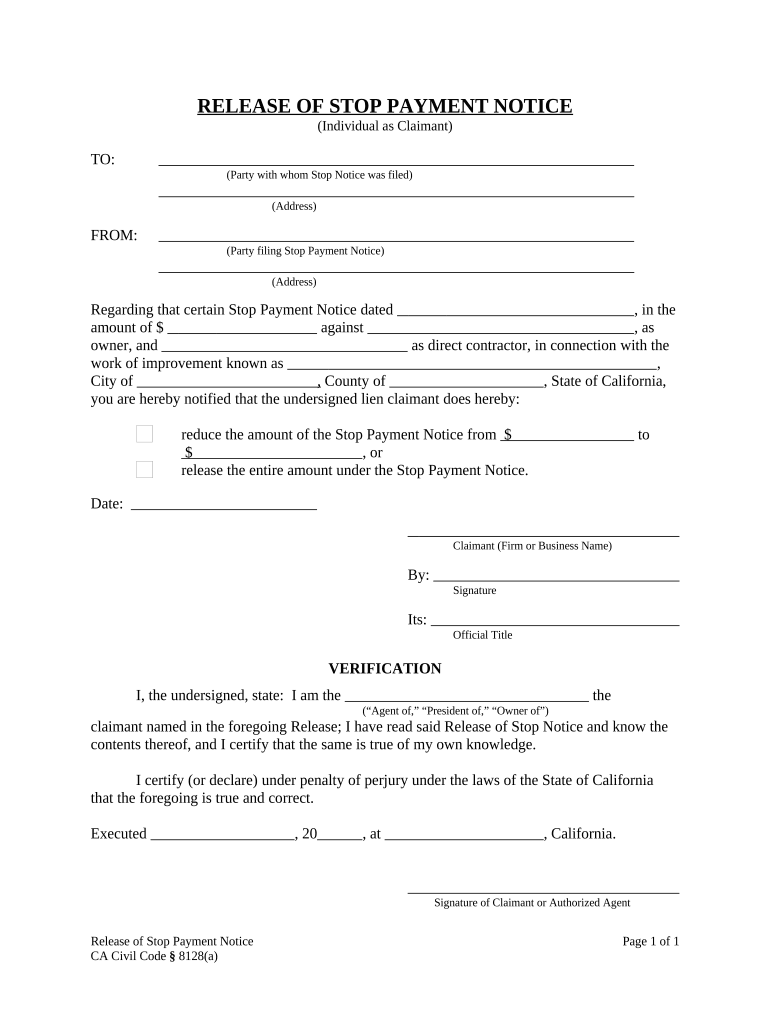
California Release Stop Notice

This template is fully customizable. Edit the text, fill out the fields, and send it for signature. Give it a try!
California Release Stop Notice

What the California Release Stop Notice Is and When It Applies

The California Release Stop Notice is a written claim used in construction and related payment contexts to halt or limit disbursement of funds when a party alleges unpaid work, labor, or materials. It functions as a protective instrument for parties seeking to preserve recovery options while formal claims or lien remedies are pursued. The notice identifies the claimant, the project, the amount at issue, and the payment source or payor. Use and formality vary by contract type and project owner; consult the project documents and applicable California statutes before filing.

Why a Release Stop Notice Matters for Protecting Payment Rights

A properly prepared Release Stop Notice preserves leverage to collect unpaid amounts, notifies payors and owners of a disputed claim, and can interrupt fund distribution to a party alleged to owe payment. It helps align documentation early and supports subsequent lien, bond claim, or litigation remedies in California projects.

Why a Release Stop Notice Matters for Protecting Payment Rights

Who Typically Prepares and Receives These Notices

Common parties involved include subcontractors, suppliers, general contractors, owners, and public agencies depending on the project type and payment chain.

  • Subcontractors and suppliers who supplied labor or materials and have not been paid within contract terms or customary payment cycles.
  • General contractors or construction managers who receive the notice and must review payment obligations or hold funds under contract or public-payment rules.
  • Owners, lenders, and public entities who receive notice so they can withhold or verify funds against competing claims.

Serve and document delivery to each recipient methodically to preserve procedural and evidentiary rights in later collection actions.

Who Signs and Submits the Notice

Claimant — Company

An authorized company officer or project manager typically signs on behalf of the claimant. The signer should be able to attest to the truth of the amounts claimed, provide supporting invoices, and demonstrate authority under corporate resolution or contract documentation.

Payor — Recipient

The payor or owner's representative acknowledges receipt and may need to record the notice internally. Prompt review by project accounting and legal teams helps determine whether funds should be withheld pending investigation or release conditions.

Core Elements a Professional Notice Should Include

A clear, complete Release Stop Notice reduces dispute friction. Include precise identification, contract references, amounts, demand language, recipient information, and signature authority to ensure the notice is actionable and defensible.

Claimant ID

Full legal name and contact information of the entity asserting the stop notice, exactly as on tax or business records.
Project Details

Project name, location, job number, and contract or purchase order references sufficient to identify the work and payment source.

Amount Claimed

Specific dollar amount claimed and brief description of work, dates, or invoices supporting the claim.

Payor Information

Name and address of the party holding or disbursing funds (owner, lender, general contractor, or public entity).

Demand Statement

Clear instruction to withhold specified funds and notice of potential lien, bond, or legal action if payment is not made.

Signature Block

Printed name, title, signature, and date by an authorized representative; include contact details for follow-up.

Step-by-Step: Preparing and Serving a Release Stop Notice

Follow a consistent process to document the claim, identify recipients, and preserve proof of service and authority before delivering the notice.

  • 01
    Gather Documents: Collect invoices, change orders, delivery tickets, and contract references supporting the claimed amount.
  • 02
    Complete Form: Fill all required fields accurately and attach supporting exhibits or invoice lists.
  • 03
    Determine Recipients: Identify owner, lender, general contractor, and any statutory payors who must receive notice.
  • 04
    Serve and Record: Deliver by required methods and retain proof of delivery, including mail receipts or electronic transmission logs.

Configuring an Online Workflow to Create and Track Notices

An online workflow speeds preparation, ensures consistency, and preserves an audit trail across steps from drafting to service.

Field | Configuration Field Name | Required/Conditional
eSignature Field Required — signer, date, and printed name
Authentication Level Email plus SMS code for recipient verification
Routing Order Sequential: claimant → general contractor → owner → lender
Notifications Automatic copy to claimant and legal counsel on completion

Where to Send or File the Notice and Typical Next Steps

Delivery method depends on contract terms and whether the project is private or public; document every transmission and response.

  • Owner / Payor: Send to the entity holding funds so they can consider withholding payment.
  • General Contractor: Provide notice to the general contractor to trigger internal fund holds or dispute handling.
  • Lender or Trustee: If funds pass through a lender, notify their legal or servicing department as required.
  • Record Retention: Keep copies of service receipts, email delivery records, and proofs of posting.

Delivery Channels and Technical Requirements

Notices can be delivered by mail, courier, email, or e-submission depending on contract and recipient preferences.

  • Mail / Courier: Certified mail or tracked courier provides physical proof of delivery.
  • Email Delivery: Use addressed business emails and retain delivery receipts.
  • eSubmission: Electronic filing portals accept PDF uploads with timestamped audit logs.

For electronic workflows, ensure the platform supports PDF, DOCX, audit trails, and industry integrations to preserve evidence of service and signatures.

Typical Timing Expectations for Preparing and Serving Notices

Plan for adequate time to assemble supporting documentation and deliver notices in a manner that provides clear proof of service.

Document Preparation:

Allow 1–3 business days to compile invoices and attachments for accuracy.

Delivery by Mail:

Certified or registered mail generally requires 3–7 business days for typical domestic delivery.

Electronic Delivery:

Email or portal submission is effectively immediate but confirm receipt and save logs.

Response Window:

Recipients often investigate within 10–30 days; contract terms may specify faster timelines.

Follow-up Actions:

If unresolved, expect further collection steps over 30–90 days including lien or bond claims.

Common Preparation Errors to Avoid

  • Incomplete claimant or payor identification leading to misrouting and delayed enforcement of withholding or bonding requirements.
  • Missing or inconsistent invoice references that make it difficult for recipients to validate amounts and reconcile accounts.
  • Improper service method or lack of proof of delivery that diminishes the notice’s evidentiary value in later claims.
  • Failure to confirm signer authority which can create disputes over the notice’s validity or binding effect.

Material Risks If the Notice Is Incorrect or Misused

Wrongful Withholding: Civil liability risk
Payment Delay: Cashflow and project disruption
Procedural Forfeiture: Loss of lien or bond remedies
Counterclaims: Potential tort or contract claims
Evidence Gaps: Reduced enforceability in court
Reputation Risk: Damaged business relationships

eSignature Pricing and Feature Snapshot for Notice Workflows

Select a platform that supports PDF, audit trails, and authentication. The table compares starting price and common feature availability; confirm plan details with vendors.

signNow DocuSign Adobe Sign PandaDoc HelloSign
Starting Price $8/user/mo $15/user/mo $14/user/mo $19/user/mo $15/user/mo
Free Trial 7-day free trial Varies by plan Varies by plan Varies by plan Varies by plan
Bulk Send Yes (plan-specific) Yes Yes Yes No
Audit Trail Yes Yes Yes Yes Yes
Envelope Cap No cap 100 envelopes/user/year Varies by plan Varies by plan Varies by plan

Security and Compliance Items to Include or Verify

Encryption: TLS 1.2/1.3 in transit; AES-256 at rest
Audit Trail: Timestamped logs with IP and action history
Authentication: Multi-factor or SMS/email verification available
BAA Availability: HIPAA BAA option for covered health information
Standards: SOC 2 Type II and ISO 27001 certified
Formats: PDF, DOCX, and exportable audit reports supported

Real-World Examples of Notice Use and Outcomes

Case examples illustrate how accurate documentation and timely service affected resolution and payment outcomes.

Optica Ventures — COO

The interface is simple and easy-to-use for our team; more importantly, it is just as easy for our customers.

  • Rapid documentation
  • The claimant was able to present organized invoices and secure a prompt reconciliation with the general contractor, reducing collection time.

Martin Properties — Founder

I can process and execute all of these documents online with 100% compliance and built-in security.

  • Mobile and offline signing
  • Using a standardized template preserved proof of service and expedited payment from an owner escrow account with minimal follow-up.

Frequently Asked Questions and Answers

Answers to common questions cover validity, signature methods, service proof, and next steps when payment disputes continue.


Need help? Contact support

be ready to get more
Join over 28 million airSlate SignNow users