Identification
List the minor's full legal name, aliases, date and place of birth, and current residence. Accurate identification prevents mismatches with vital records and supports proper notice and verification during court review.
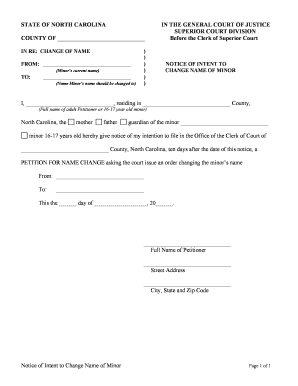
A properly prepared notice clarifies who has standing, documents consent or objections, and enables the court to schedule a hearing without procedural delay. It reduces the risk of service defects and supports judges in resolving best-interest concerns for the minor.

Parents, guardians, and attorneys most commonly prepare a Notice of Intent when starting a minor name change case in North Carolina superior court.
The child's biological or legal guardian who must sign the petition or provide documented consent. Courts commonly require identification, proof of relationship, and a clear statement of reasons; absence of a consenting parent may require additional notice or a judicial determination.
Licensed counsel representing the petitioner may prepare and file the Notice of Intent, ensure correct service, draft supporting affidavits, and present evidence at hearing. An attorney helps comply with jurisdictional and local clerks' procedural requirements.
| Field | Configuration |
|---|---|
| Document Uploads | Require certified birth certificate and custody order attachments |
| Signature Blocks | Add parent/guardian signature and date fields with explicit intent statements |
| Authentication | Use email or SMS codes; add stronger verification if required |
| Routing Order | Set petitioner's attorney, other parent, then clerk for final filing |
Confirm platform capabilities for signatures, attachments, and authentication before collecting or submitting the notice electronically.
List the minor's full legal name, aliases, date and place of birth, and current residence. Accurate identification prevents mismatches with vital records and supports proper notice and verification during court review.
State the exact proposed given and surname, formatted as it should appear on birth certificates and other official records. Avoid abbreviations and include punctuation the petitioner expects.
Include clearly worded consent signed by the parent(s) or guardian(s). Where consent is unavailable, attach affidavits explaining the circumstances to assist judicial review of the child's best interests.
Document how notice was or will be served to the non-filing parent and interested parties, including dates, method of service, and returns or attempted deliveries.
Attach certified birth certificate, custody orders, and any court-issued guardianship documents that establish authority and context for the judge's decision.
Include the superior court division, county, case caption, and preferred hearing availability to improve clerk processing and help the court schedule review efficiently.
File petition and notice as soon as practical.
Follow court-specified notice periods before the hearing.
If required, publish notice for the prescribed number of days.
Court schedules hearing after notice and service complete.
Allow time after order to update vital records and IDs.
Gather documents and complete the Notice of Intent.
Serve other parent and interested parties per local rules.
Attend the court hearing for judge's review and questions.
Receive signed order and update records after issuance.
A parent files a petition with signed consent from both parents and certified birth records
A guardian petitions when the other parent cannot be located
| signNow | DocuSign | Adobe Sign | PandaDoc | HelloSign | |
|---|---|---|---|---|---|
| Starting Price | $8/user/mo | $15/user/mo | $14/user/mo | $19/user/mo | $15/user/mo |
| Free Trial | 7-day free trial | Varies by plan | Varies by plan | Varies by plan | Varies by plan |
| Bulk Send | Yes | Yes | Yes | Yes | No |
| Audit Trail | Yes | Yes | Yes | Yes | Yes |
| HIPAA Compliant | Yes | Yes | Yes | No | No |
| Envelope Cap | No envelope cap | 100 envelopes/user/year | Varies | Varies | Varies |