Establishing secure connection…Loading editor…Preparing document…

Kentucky Bankruptcy Forms

This template is fully customizable. Edit the text, fill out the fields, and send it for signature. Give it a try!
Kentucky Bankruptcy Forms

What Kentucky Bankruptcy Forms Are and where they apply

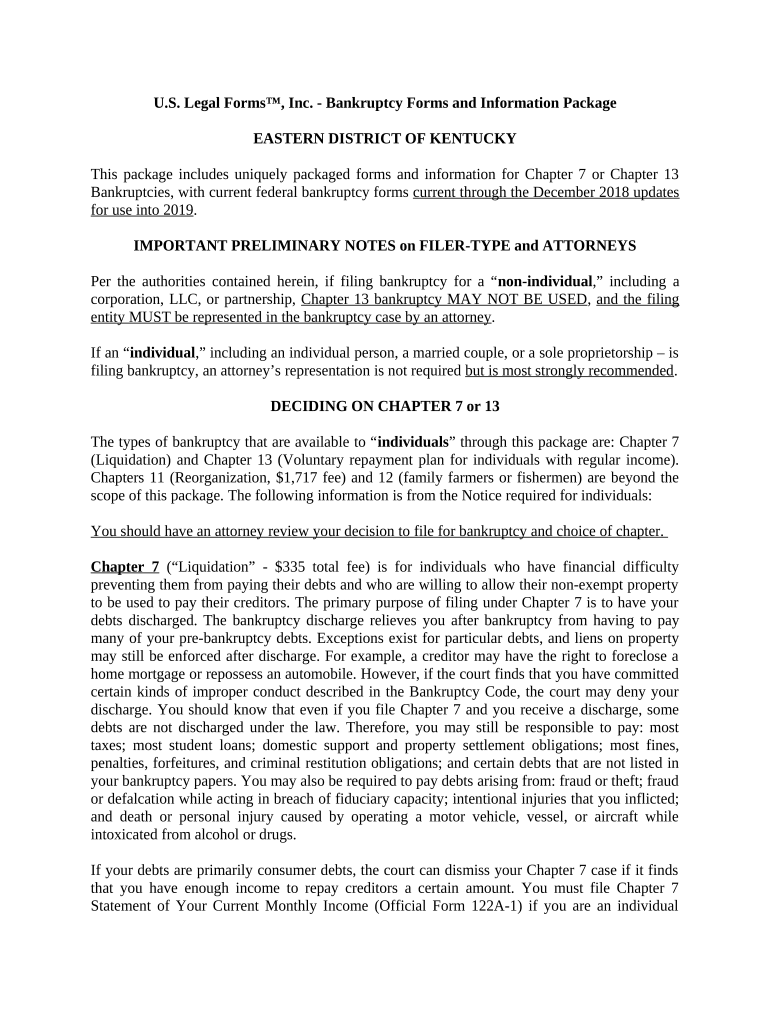
Kentucky Bankruptcy Forms are the official documents used to begin and manage consumer and business bankruptcy cases filed in federal bankruptcy courts that serve Kentucky. They include the United States Bankruptcy Court Official Forms (petition, schedules, statement of financial affairs, and other required attachments) together with any district-specific supplements or local forms required by the Kentucky bankruptcy districts. Filings are submitted to the federal bankruptcy court (typically via the court's CM/ECF electronic filing system), and completed forms establish the case record, creditor notice requirements, and trustee review of assets and exemptions.

Why these forms matter for debt relief and court procedures

Accurate completion of Kentucky Bankruptcy Forms starts the federal case, sets the timetable for creditor claims and meetings, and documents assets, liabilities, and income. Properly prepared forms reduce the risk of delays, objections, or dismissal and ensure the trustee and court have the information required to evaluate discharge eligibility or confirm a repayment plan.

Why these forms matter for debt relief and court procedures

Who prepares and relies on Kentucky Bankruptcy Forms

These forms are used by multiple parties in a bankruptcy case and by professionals who support them.

  • Individual debtors filing pro se or with counsel, to report finances and request relief under Chapter 7, 11, or 13.
  • Bankruptcy attorneys and paralegals preparing petitions, schedules, and plan documents for court submission and trustee review.
  • Trustees, creditors, and court clerks who examine the submitted information, schedule hearings, and process claims.

Each participant relies on accurate, complete forms to protect rights, preserve claims, and satisfy court rule requirements during the case lifecycle.

Typical signer and preparer profiles

Consumer Debtor

An individual with unsecured or secured debts completing Official Forms to request relief. The debtor must disclose income, assets, recent financial history and sign under penalty of perjury; pro se filers submit directly to the clerk while represented debtors file through counsel using CM/ECF.

Bankruptcy Attorney

A licensed attorney who prepares and files the petition, schedules, and any plan documents. Counsel ensures compliance with local rules, attends the 341 meeting, responds to trustee inquiries, and represents the debtor at confirmation or adversary proceedings when needed.

Step-by-step: completing and filing Kentucky Bankruptcy Forms

Follow these sequential steps to prepare, review, and submit bankruptcy forms correctly to the federal court.

  • 01
    Gather Documents: Collect pay stubs, bank statements, tax returns, and mortgage records.
  • 02
    Complete Official Forms: Fill petition, schedules, statement of affairs, and required attachments.
  • 03
    Review and Sign: Confirm accuracy, sign under penalty of perjury, and date forms.
  • 04
    File with Court: Submit via CM/ECF or clerk's office and pay the filing fee or request fee waiver.

Configuring an online workflow for bankruptcy filings

Set up a consistent online workflow to assemble documents, manage signer steps, and produce the court-ready PDF package.

Field Configuration
Document Format Create a single, bookmarked PDF for court filing.
Signer Authentication Use email verification and optional multi-factor for attorney/ddebtors.
Attachment Handling Combine exhibits, schedules, and creditor matrices into one submission.
Filing Receipt Capture court confirmation number and save a timestamped copy.

How the filing and notification process typically flows

The basic filing lifecycle includes preparation, submission, creditor notice, and trustee review; each stage triggers specific actions and deadlines.

  • Prepare Package: Assemble petition, schedules, statements, and creditor list.
  • File Electronically: Submit via CM/ECF or clerk; receive docket number.
  • Serve Creditors: Court issues notice; creditors receive notice of the filing.
  • Trustee Review: Trustee examines assets, schedules, and eligibility.

Core components found on Kentucky Bankruptcy Forms

These elements appear across most Official Forms and control case scope, creditor rights, and the court's adjudication of the filing.

Voluntary Petition

The initiating document that identifies the debtor, states the bankruptcy chapter election, and begins the case on the court docket; it must be signed under penalty of perjury.
Schedules of Assets

Detailed lists of real and personal property with fair market values, liens, and any exemptions claimed; accuracy here affects liquidation or plan outcomes.

Schedules of Liabilities

Complete creditor listing with addresses and claim types; omitted creditors may preserve certain claims or cause later disputes.

Statement of Financial Affairs

Chronology of recent financial transactions, income, transfers, and lawsuits; used by trustees to assess potential avoidable transfers or undisclosed assets.

Chapter-specific Attachments

Means test documentation for Chapter 7, repayment plan for Chapter 13, or corporate schedules for Chapter 11; each contains items critical to eligibility and confirmation.

Verification and Signature Blocks

Signature lines where the debtor (and preparer, if any) attest under penalty of perjury; unsigned forms are typically rejected or returned for correction.

Security and compliance considerations for electronic handling

ESIGN / UETA: Legal acceptance of e-signatures
Encryption: TLS 1.2/1.3 in transit
Data at Rest: AES-256 encryption
Audit Trail: Timestamped signer events
HIPAA (if PHI): BAA required for health data
SOC 2: Controls for data protection

Common preparation errors to avoid

  • Using incomplete or inconsistent creditor addresses, which can prevent proper notice and later allow creditors to assert claims were not timely served.
  • Failing to list all assets or transfers within specified look-back periods, leading to trustee objections or motions to recover assets.
  • Submitting unsigned petitions or missing verification signatures, causing administrative rejection or delays in scheduling the 341 meeting.
  • Incorrect or missing Social Security numbers and dates of birth on forms, which complicates identity verification and can delay case processing.

Consequences of inaccurate or incomplete submissions

Case Dismissal: Possible if material omissions occur
Perjury Exposure: Risk for knowingly false statements
Loss of Discharge: Creditors may object and seek denial
Trustee Recovery: Assets may be reclaimed
Administrative Delays: Clerk returns or requests for amendment
Cost Increase: Additional attorney and court fees

Timing and common deadlines to expect in a bankruptcy case

While schedules are filed with the petition, several post-filing deadlines follow; these timeframes are typical but may vary by district and chapter.

Petition Filing:

Occurs when the petition and initial schedules are accepted by the clerk.

341 Meeting:

Typically scheduled about 20–40 days after filing for creditor examination.

Deadline to File Claims:

Set by court notice; unsecured creditors must observe the claims bar date.

Plan Confirmation:

For Chapter 13, confirmation hearing timing varies by court docket and plan complexity.

Discharge Entry:

Issued after trustee review and absence of successful objections.

Key milestone sequence in a typical bankruptcy case

The following numbered stages outline the common lifecycle from filing through resolution.

01

1. Document Assembly

Gather income, asset, and creditor documentation prior to filing.

02

2. File Petition

Submit petition and schedules to the clerk (CM/ECF for e-filings).

03

3. 341 Meeting

Attend trustee meeting where the debtor is examined under oath.

04

4. Resolution

Trustee administration, confirmation or discharge, and case closure.

Digital signing and submission: platform and integration notes

Use a secure eSignature workflow that supports the required PDF formats, audit trails, and record retention needed for court-ready submissions.

  • Supported Formats: PDF, PDF/A, DOCX conversion
  • Integrations: Salesforce, NetSuite, Google Workspace, Microsoft 365
  • Authentication: Email verification, SMS codes, advanced options

Ensure the platform preserves an immutable audit trail, stores signed originals securely, and produces a court-ready PDF package for CM/ECF upload.

eSignature vendor pricing and capability snapshot relevant to bankruptcy document workflows

Comparison of starting prices and key features for common eSignature vendors; signNow is listed first per standard vendor ordering and feature mapping.

signNow DocuSign Adobe Sign PandaDoc HelloSign
Starting Price $8/user/mo $15/user/mo $14/user/mo $19/user/mo $15/user/mo
Free Trial 7-day free trial Limited trial Limited trial Limited trial Limited trial
Bulk Send Yes Yes Yes Yes No
Audit Trail Yes Yes Yes Yes Yes
HIPAA Compliant Yes Yes Yes No No

Illustrative filing scenarios using Kentucky Bankruptcy Forms

Two representative examples show how accurate forms affect outcomes in common situations.

Individual Chapter 7 Filing

A self-represented debtor compiles pay stubs and tax returns and files a complete petition online.

  • Trustee schedules a 341 meeting quickly to verify assets.
  • Because schedules were accurate and debts listed fully, the trustee closed the estate with minimal administration and the court issued a discharge without contested issues.

Chapter 13 Plan Amendment

A debtor files a plan amendment to reflect a changed income stream.

  • Counsel updates schedules and serves creditors promptly.
  • The timely amendment enabled confirmation to proceed without further objections and avoided arrearage motions.

Frequently asked questions about Kentucky Bankruptcy Forms

Answers to common questions about signing, filing, corrections, and authentication when preparing bankruptcy forms.


Need help? Contact support

be ready to get more
Join over 28 million airSlate SignNow users