Establishing secure connection… Loading editor… Preparing document…
Navigation

Fill and Sign the Charitable Trust Form

Fill and Sign the Charitable Trust Form

How it works

Open the document and fill out all its fields.
Apply your legally-binding eSignature.
Save and invite other recipients to sign it.

Rate template

4.5
52 votes
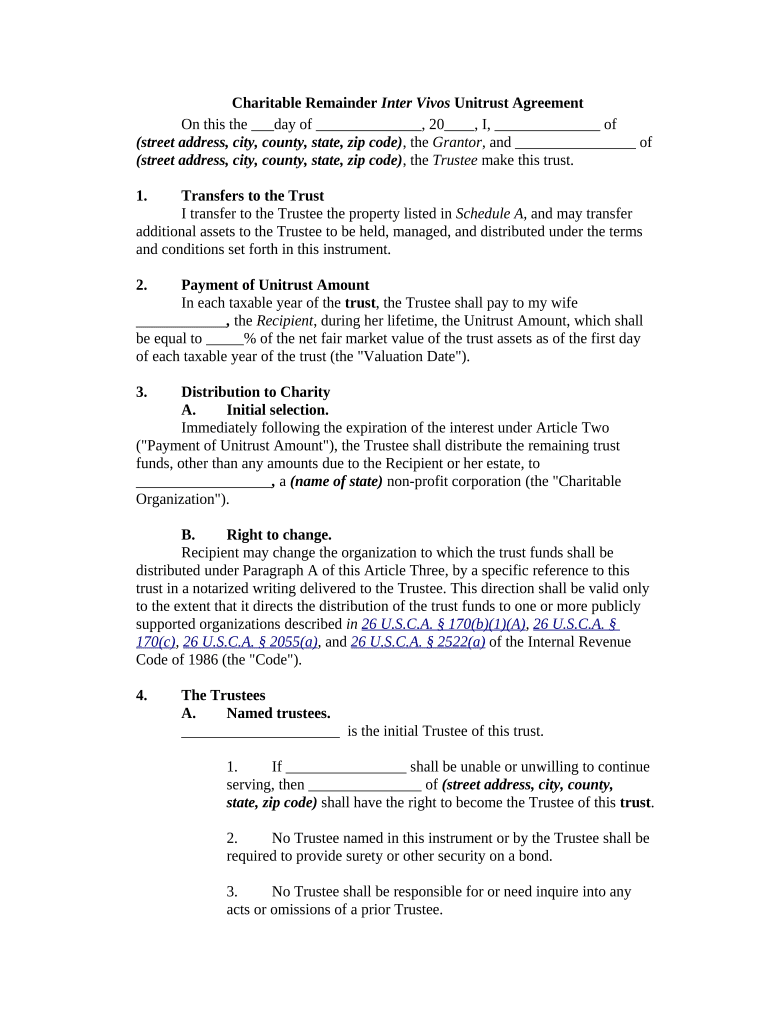
Charitable Remainder Inter Vivos Unitrust Agreement On this the ___day of ______________, 20____, I, ______________ of (street address, city, county, state, zip code) , the Grantor, and ________________ of (street address, city, county, state, zip code) , the Trustee make this trust. 1. Transfers to the Trust I transfer to the Trustee the property listed in Schedule A, and may transfer additional assets to the Trustee to be held, managed, and distributed under the terms and conditions set forth in this instrument. 2. Payment of Unitrust Amount In each taxable year of the trust , the Trustee shall pay to my wife ____________ , the Recipient , during her lifetime, the Unitrust Amount, which shall be equal to _____% of the net fair market value of the trust assets as of the first day of each taxable year of the trust (the "Valuation Date"). 3. Distribution to Charity A. Initial selection. Immediately following the expiration of the interest under Article Two ("Payment of Unitrust Amount"), the Trustee shall distribute the remaining trust funds, other than any amounts due to the Recipient or her estate, to __________________ , a (name of state) non-profit corporation (the "Charitable Organization"). B. Right to change. Recipient may change the organization to which the trust funds shall be distributed under Paragraph A of this Article Three, by a specific reference to this trust in a notarized writing delivered to the Trustee. This direction shall be valid only to the extent that it directs the distribution of the trust funds to one or more publicly supported organizations described in 26 U.S.C.A. § 170(b)(1)(A) , 26 U.S.C.A. § 170(c) , 26 U.S.C.A. § 2055(a) , and 26 U.S.C.A. § 2522(a) of the Internal Revenue Code of 1986 (the "Code"). 4. The Trustees A. Named trustees. _____________________ is the initial Trustee of this trust . 1. If ________________ shall be unable or unwilling to continue serving, then _______________ of (street address, city, county, state, zip code) shall have the right to become the Trustee of this trust . 2. No Trustee named in this instrument or by the Trustee shall be required to provide surety or other security on a bond. 3. No Trustee shall be responsible for or need inquire into any acts or omissions of a prior Trustee. B. Additional trustee. The Trustee may appoint any person as Co-Trustee or additional Trustee to serve at the pleasure of the appointing Trustee. C. Delegation. Any Trustee may delegate any powers and authorities to another Trustee for any period that the delegating Trustee deems appropriate. A person dealing in good faith with any Trustee may rely without inquiry upon that Trustee's representation that a particular power or authority has been delegated and not rescinded. D. Resignation. Any Trustee may resign by giving written notice specifying the effective date of the resignation to the designated successor Trustee. 1. If no successor Trustee is designated, a resigning Trustee shall give this written notice to the Recipient, if then living, and to the Charity. 2. A successor Trustee to fill any vacancy shall be named by the Recipient, if then living, or otherwise by the Charity. E. Compensation . Each person who serves as a Trustee shall be entitled to receive reasonable compensation for services rendered. In the case of a corporate Trustee, reasonable compensation is based upon its published fee schedule in effect at the time its services are rendered, or as otherwise agreed, and its compensation may vary from time to time based on that schedule. F. Management powers. I grant the Trustee the powers described below, to be exercised in a fiduciary capacity. 1. The Trustee may hold and retain as part of the trust any assets received from any source, and invest and reinvest them (or leave them temporarily uninvested) in any type of property and every kind of investment in the same manner as a prudent investor would invest its own assets. 2. The Trustee may sell or exchange any real or personal property contained in the trust , for cash or credit, at public or private sale, and with such warranties or indemnifications as the Trustee may deem advisable. 3. The Trustee may borrow money (even from the Trustee and from any beneficiary of the trust ) for the benefit of the trust and may secure these debts with assets of the trust . 4. The Trustee may grant security interests and execute all instruments creating such interests on such terms as the Trustee may deem advisable. 5. The Trustee may compromise and adjust claims against or on behalf of the trust on such terms as the Trustee may deem advisable. 6. The Trustee may take title to any securities in the name of any custodian or nominee without disclosing this relationship. 7. The Trustee may determine whether receipts are to be allocated to income or principal and whether disbursements are to be charged against income or principal to the extent not clearly established by state law. All determinations made by the Trustee in good faith shall not require equitable adjustments. 8. The Trustee may make all tax elections and allocations the Trustee may consider appropriate; however, this authority is exercisable only in a fiduciary capacity and may not be used to enlarge or shift any beneficial interest except as an incidental consequence of the discharge of fiduciary duties. All tax elections and allocations made by the Trustee in good faith shall not require equitable adjustments. 9. The Trustee may employ such lawyers, accountants, and other advisers as the Trustee may deem useful and appropriate for the administration of the trust . The Trustee may employ a professional investment adviser and delegate to this adviser any discretionary investment authorities to manage the investments of the trust (including any investment in mutual funds, investment trusts , or managed accounts), and may rely on the adviser's investment recommendations without liability to any beneficiary. 10. The Trustee may divide and distribute the assets of the trust in kind or in cash, or partly in each, without regard to the income tax basis of any asset and without the consent of any beneficiary. The decision of the Trustee in dividing any portion of the trust between or among two or more beneficiaries shall be binding on all persons. 5. Mandatory Unitrust Provisions A. Overriding tax purpose. This trust is established as and shall operate as a charitable remainder unitrust, within the meaning of 26 U.S.C.A. § 664(d)(2) and Rev. Proc. 89-20 , and all provisions of this instrument shall be construed in a manner consistent with this purpose. The Trustee shall not exercise any discretion under this instrument in a manner inconsistent with this purpose. B. Payment of the Unitrust Amount. The Unitrust Amount shall be paid in quarterly installments on the last day of each quarter. The Unitrust Amount shall be paid from trust income and, to the extent income is insufficient, from principal. Any trust income for a taxable year in excess of the Unitrust Amount shall be added to principal. C. Misvaluation. If for any year the net fair market value of the trust assets is incorrectly determined, then within a reasonable period after the value is finally determined for federal tax purposes, the Trustee shall pay to the Recipient (in the case of an undervaluation) or receive from the Recipient (in the case of an overvaluation) an amount equal to the difference between the Unitrust Amount properly payable and the Unitrust Amount actually paid. D. Short taxable years. In determining the Unitrust Amount, the Trustee shall prorate the same on a daily basis for a short taxable year and for the taxable year ending with the Recipient's death. E. Additional contributions. If any additional contributions are made to the trust after the initial contribution, the Unitrust Amount for the year in which the additional contribution is made shall be equal to ________% of the sum of: 1. The net fair market value of the trust assets as of the Valuation Date (excluding the assets so added and any income from, or appreciation on, such assets); and 2. That proportion of the fair market value of the assets so added that was excluded under item (1) that the number of days in the period that begins with the date of contribution and ends with the earlier of the last day of the taxable year or the date of the Recipient's death bears to the number of days in the period that begins on the first day of such taxable year and ends with the earlier of the last day in such taxable year or the date of the Recipient's death. In the case where there is no Valuation Date after the time of contribution, the assets so added shall be valued as of the time of contribution. F. Hard-to-value assets. Any donor who is also a Trustee cannot participate in the determination of the value of any hard-to-value assets, such as real estate or closely held stock. The value of such assets shall be determined by any then-serving Trustee who is not a donor of such assets, or if there are no such Trustees, by a non-donor appointed as Trustee by the then serving Trustee. G. Private foundation rules. The trust income for each taxable year shall be distributed at such time and in such manner as not to subject the trust to tax under 26 U.S.C.A. § 4942 . Except for the payment of the Unitrust Amount to the Recipient, the Trustee shall not engage in any act of self-dealing, as defined in 26 U.S.C.A. § 4941(d) , and shall not make any taxable expenditures, as defined in 26 U.S.C.A. § 4945(d) . The Trustee shall not make any investments that jeopardize the charitable purpose of the trust , within the meaning of 26 U.S.C.A. § 4944 , or retain any excess business holdings, within the meaning of 26 U.S.C.A. § 4943 . H. Investment of trust assets. Nothing in this instrument shall restrict the Trustee from investing the trust assets in a manner that could result in the annual realization of a reasonable amount of income or gain from the sale or disposition of trust assets. I. Taxable year. The trust's taxable year shall be the calendar year. J. Irrevocability. This trust is irrevocable. However, the Trustee shall have the power, acting alone, to amend the trust in any manner required for the sole purpose of ensuring that the trust qualifies and continues to qualify as a charitable remainder unitrust within the meaning of 26 U.S.C.A. § 664(d)(2) of the Code. K. Qualification of charities . If any Charity designated to receive any distribution from this trust is not a publicly supported organization described in 26 U.S.C.A. § 170(b)(1)(A) , 26 U.S.C.A. § 170(c) , 26 U.S.C.A. § 2055(a) , and 26 U.S.C.A. § 2522(a) of the Code, at the time when any principal or income of the trust is to be distributed to it, then the Trustee shall distribute such principal and income to one or more organizations, selected at the Trustee's sole discretion, which are publicly supported organizations described in Sections 170(b)(1)(A), 170(c), 2055(a), and 2522(a ) of the Code. 6. Trust Administration A. Disabled recipient. The Trustee may distribute payments that would be made to the Recipient at a time when the Recipient is a minor or disabled to the Recipient's parent, guardian, or personal representative, or to the person with whom the Recipient resides, without looking to the proper application of those payments. B. Accountings. The Trustee shall not be required to file annual accounts with any court or court official in any jurisdiction. C. Change of situs. The Trustee may change the situs of this trust (and to the extent necessary or appropriate, move the trust assets) to a state or country other than the one in which the trust is then administered, if the Trustee believes it to be in the best interests of the trust or the beneficiaries. The Trustee may elect that the law of such other jurisdiction shall govern the trust to the extent necessary or appropriate under the circumstances. D. Additional transfers. Anyone may transfer property to the Trustee at any time. The Trustee may refuse to accept a transfer if the Trustee deems acceptance is not in the trust's best interests. The Trustee may accept a gift subject to one or more conditions imposed by the donor or the Trustee if it is in the best interests of the trust and the beneficiaries and if the condition does not change the rights of a beneficiary with respect to any prior gift. 7. Definitions and miscellaneous A. Disabled. An individual is "disabled" or "under a disability" if the Trustee (or, if the person whose disability is in question is a Trustee, the next successor Trustee), receives written certification from two physicians, both of whom have personally examined the individual and at least one of whom is board-certified in the specialty most closely associated with the alleged disability. The certification must state that the individual is incapable of managing his or her own finances, regardless of cause and regardless of whether there is an adjudication of incompetence, mental illness, or need for a committee, conservator, guardian, or other personal representative. No person is liable to anyone for actions taken in reliance on these certifications, or for dealing with a Trustee other than the one removed for disability based on these certifications. B. Trustee. The "Trustee" shall include each Trustee, Co-Trustee, and any successor Trustee. C. Tax-related terms. All tax-related terms shall have the same meaning that they have in the Internal Revenue Code of 1986, as amended. D. Choice of law. The operation of the trust shall be governed by the laws of the state of _______________. However, the Trustee may not exercise any power or discretion granted under the laws of said state that would be inconsistent with the qualification of the trust under 26 U.S.C.A. § 664(d)(2) of the Code and the corresponding regulations. E. Copies. Anyone may rely on a copy of this trust instrument certified by a notary public or similar official to be a true copy of the signed original (and of any amendments), as if that copy were the signed original. Anyone may rely upon any statement of fact certified by the person who appears from the original document or a certified copy to be a Trustee. F. Number. Whenever the context requires, the singular number includes the plural, and the plural the singular. WITNESS our signatures as of the day and date first above stated. By:______________________________ ______________________ (Name and Office in Bank) JOHN DOE Acknowledgments (form of acknowledgment may vary by state) Attach Schedule A

Valuable suggestions for completing your ‘Charitable Trust’ online

Are you fatigued by the inconvenience of managing paperwork? Look no further than airSlate SignNow, the premier electronic signature solution for individuals and businesses. Bid farewell to the laborious task of printing and scanning documents. With airSlate SignNow, you can effortlessly complete and sign paperwork online. Utilize the powerful features integrated into this user-friendly and cost-effective platform and transform your document management strategy. Whether you need to sign forms or gather signatures, airSlate SignNow takes care of everything seamlessly, needing just a few clicks.

Follow this detailed guide:

  1. Access your account or register for a complimentary trial with our service.
  2. Click +Create to upload a file from your device, cloud, or our form library.
  3. Open your ‘Charitable Trust’ in the editor.
  4. Click Me (Fill Out Now) to arrange the form on your end.
  5. Add and designate fillable fields for other parties (if necessary).
  6. Proceed with the Send Invite settings to solicit eSignatures from others.
  7. Download, print your copy, or convert it into a reusable template.

Don’t fret if you need to work with others on your Charitable Trust or send it for notarization—our platform has you covered with all the essentials to achieve these tasks. Create an account with airSlate SignNow today and elevate your document management to a higher level!

Here is a list of the most common customer questions. If you can’t find an answer to your question, please don’t hesitate to reach out to us.

Need help? Contact Support

The best way to complete and sign your charitable trust form

Save time on document management with airSlate SignNow and get your charitable trust form eSigned quickly from anywhere with our fully compliant eSignature tool.

How to Sign a PDF Online How to Sign a PDF Online

How to complete and sign paperwork online

Previously, coping with paperwork required lots of time and effort. But with airSlate SignNow, document management is quick and simple. Our robust and user-friendly eSignature solution lets you easily fill out and electronically sign your charitable trust form online from any internet-connected device.

Follow the step-by-step guide to eSign your charitable trust form template online:

  • 1.Register for a free trial with airSlate SignNow or log in to your account with password credentials or SSO authentication.
  • 2.Click Upload or Create and import a file for eSigning from your device, the cloud, or our form library.
  • 3.Click on the document name to open it in the editor and utilize the left-side menu to fill out all the empty areas properly.
  • 4.Drop the My Signature field where you need to approve your sample. Provide your name, draw, or import an image of your handwritten signature.
  • 5.Click Save and Close to finish editing your completed document.

As soon as your charitable trust form template is ready, download it to your device, export it to the cloud, or invite other individuals to eSign it. With airSlate SignNow, the eSigning process only takes several clicks. Use our robust eSignature tool wherever you are to handle your paperwork productively!

How to Sign a PDF Using Google Chrome How to Sign a PDF Using Google Chrome

How to fill out and sign forms in Google Chrome

Completing and signing documents is easy with the airSlate SignNow extension for Google Chrome. Adding it to your browser is a fast and efficient way to manage your forms online. Sign your charitable trust form sample with a legally-binding electronic signature in just a few clicks without switching between programs and tabs.

Follow the step-by-step guidelines to eSign your charitable trust form in Google Chrome:

  • 1.Go to the Chrome Web Store, locate the airSlate SignNow extension for Chrome, and add it to your browser.
  • 2.Right-click on the link to a document you need to eSign and choose Open in airSlate SignNow.
  • 3.Log in to your account using your credentials or Google/Facebook sign-in option. If you don’t have one, sign up for a free trial.
  • 4.Use the Edit & Sign menu on the left to complete your sample, then drag and drop the My Signature field.
  • 5.Add a photo of your handwritten signature, draw it, or simply type in your full name to eSign.
  • 6.Make sure all information is correct and click Save and Close to finish modifying your paperwork.

Now, you can save your charitable trust form template to your device or cloud storage, email the copy to other people, or invite them to eSign your form with an email request or a protected Signing Link. The airSlate SignNow extension for Google Chrome enhances your document workflows with minimum effort and time. Start using airSlate SignNow today!

How to Sign a PDF in Gmail How to Sign a PDF in Gmail How to Sign a PDF in Gmail

How to complete and sign paperwork in Gmail

Every time you receive an email containing the charitable trust form for approval, there’s no need to print and scan a document or save and re-upload it to another tool. There’s a better solution if you use Gmail. Try the airSlate SignNow add-on to rapidly eSign any paperwork right from your inbox.

Follow the step-by-step guide to eSign your charitable trust form in Gmail:

  • 1.Visit the Google Workplace Marketplace and locate a airSlate SignNow add-on for Gmail.
  • 2.Set up the program with a related button and grant the tool access to your Google account.
  • 3.Open an email with an attachment that needs signing and use the S key on the right sidebar to launch the add-on.
  • 4.Log in to your airSlate SignNow account. Select Send to Sign to forward the file to other parties for approval or click Upload to open it in the editor.
  • 5.Drop the My Signature option where you need to eSign: type, draw, or import your signature.

This eSigning process saves time and only requires a few clicks. Utilize the airSlate SignNow add-on for Gmail to update your charitable trust form with fillable fields, sign paperwork legally, and invite other people to eSign them al without leaving your inbox. Enhance your signature workflows now!

How to Sign a PDF on a Mobile Device How to Sign a PDF on a Mobile Device How to Sign a PDF on a Mobile Device

How to complete and sign documents in a mobile browser

Need to rapidly complete and sign your charitable trust form on a mobile phone while working on the go? airSlate SignNow can help without needing to install additional software programs. Open our airSlate SignNow tool from any browser on your mobile device and add legally-binding eSignatures on the go, 24/7.

Follow the step-by-step guide to eSign your charitable trust form in a browser:

  • 1.Open any browser on your device and follow the link www.signnow.com
  • 2.Sign up for an account with a free trial or log in with your password credentials or SSO authentication.
  • 3.Click Upload or Create and add a file that needs to be completed from a cloud, your device, or our form collection with ready-to go templates.
  • 4.Open the form and complete the blank fields with tools from Edit & Sign menu on the left.
  • 5.Put the My Signature area to the form, then enter your name, draw, or upload your signature.

In a few simple clicks, your charitable trust form is completed from wherever you are. Once you're done with editing, you can save the file on your device, create a reusable template for it, email it to other people, or invite them eSign it. Make your documents on the go quick and effective with airSlate SignNow!

How to Sign a PDF on iPhone How to Sign a PDF on iPhone

How to fill out and sign paperwork on iOS

In today’s corporate environment, tasks must be done quickly even when you’re away from your computer. Using the airSlate SignNow app, you can organize your paperwork and approve your charitable trust form with a legally-binding eSignature right on your iPhone or iPad. Set it up on your device to conclude agreements and manage forms from anywhere 24/7.

Follow the step-by-step guide to eSign your charitable trust form on iOS devices:

  • 1.Go to the App Store, search for the airSlate SignNow app by airSlate, and install it on your device.
  • 2.Launch the application, tap Create to upload a form, and choose Myself.
  • 3.Select Signature at the bottom toolbar and simply draw your signature with a finger or stylus to eSign the sample.
  • 4.Tap Done -> Save after signing the sample.
  • 5.Tap Save or use the Make Template option to re-use this document later on.

This method is so straightforward your charitable trust form is completed and signed in a few taps. The airSlate SignNow app works in the cloud so all the forms on your mobile device remain in your account and are available any time you need them. Use airSlate SignNow for iOS to boost your document management and eSignature workflows!

How to Sign a PDF on Android How to Sign a PDF on Android

How to complete and sign paperwork on Android

With airSlate SignNow, it’s simple to sign your charitable trust form on the go. Set up its mobile app for Android OS on your device and start improving eSignature workflows right on your smartphone or tablet.

Follow the step-by-step guide to eSign your charitable trust form on Android:

  • 1.Go to Google Play, find the airSlate SignNow app from airSlate, and install it on your device.
  • 2.Log in to your account or create it with a free trial, then add a file with a ➕ option on the bottom of you screen.
  • 3.Tap on the uploaded document and select Open in Editor from the dropdown menu.
  • 4.Tap on Tools tab -> Signature, then draw or type your name to eSign the form. Complete blank fields with other tools on the bottom if necessary.
  • 5.Use the ✔ button, then tap on the Save option to finish editing.

With an easy-to-use interface and total compliance with main eSignature requirements, the airSlate SignNow app is the best tool for signing your charitable trust form. It even operates without internet and updates all record changes once your internet connection is restored and the tool is synced. Fill out and eSign documents, send them for eSigning, and create multi-usable templates anytime and from anywhere with airSlate SignNow.

Sign up and try Charitable trust form
  • Close deals faster
  • Improve productivity
  • Delight customers
  • Increase revenue
  • Save time & money
  • Reduce payment cycles