Establishing secure connection…Loading editor…Preparing document…

Wisconsin Claim Against Estate

This template is fully customizable. Edit the text, fill out the fields, and send it for signature. Give it a try!
Wisconsin Claim Against Estate

What a Wisconsin Claim Against Estate Is and when it applies

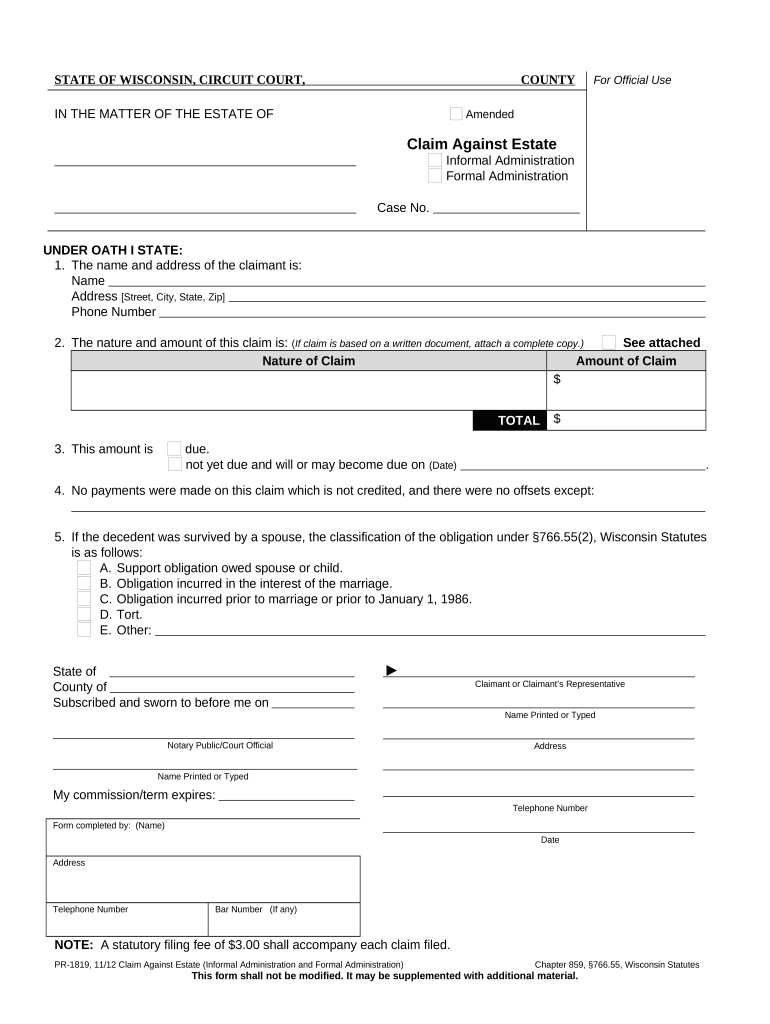
A Wisconsin Claim Against Estate is a creditor’s formal assertion for payment from a decedent’s probate estate administered in Wisconsin. It is filed with the county probate court handling the estate and typically identifies the creditor, the basis for the claim, the amount owed, and supporting documentation. Claims may arise from loans, unpaid invoices, medical services, or secured obligations; the probate process determines priority, allowance, or rejection. Filing properly preserves the creditor’s right to seek payment from estate assets rather than pursuing the decedent’s family personally.

Why filing a clear, complete claim matters

Properly presented claims protect a creditor’s legal right to be considered in probate, establish recordable proof of debt, and preserve priority against other claimants while the estate is administered.

Why filing a clear, complete claim matters

Step-by-step: prepare and present a claim in Wisconsin probate

Follow a consistent sequence to prepare, support, and file a claim so the probate court and estate personal representative can review it without delay.

  • 01
    Gather records: Collect contracts, invoices, and proof of delivery or service.
  • 02
    Compute amount: Include principal, interest, fees, and adjustments accurately.
  • 03
    Prepare affidavit: Verify facts in a sworn statement if the court requires verification.
  • 04
    File with court: Submit claim to the county probate court and serve the personal representative.

Who typically files a claim against an estate in Wisconsin

Several creditor types commonly present claims during probate administration; identify which group fits your situation before filing.

  • Unsecured creditors: vendors, suppliers, and contractors with unpaid invoices seeking repayment from estate assets.
  • Medical providers: hospitals and clinics presenting balances for treatment provided to the decedent prior to death.
  • Secured creditors: lenders asserting liens or claims against specific estate property to enforce collateral.

Knowing your creditor category helps determine documentation, priority, and whether to pursue lien enforcement or general allowance in probate.

Representative users who complete this form

Estate Administrator

The personal representative or executor who responds to claims, evaluates supporting evidence, and either admits, compromises, or contests claims in probate. They must follow court rules and timelines while protecting estate assets and communicating decisions to creditors.

Creditor Representative

Accounts receivable managers, attorneys, or billing agents who prepare and present claims on behalf of a creditor. They gather documentation, verify balances, serve the representative, and may negotiate allowance or file objections if a claim is rejected.

Essential information to include on the claim form

Creditor contact: Mailing address; phone; email
Decedent details: Full name; date of death
Court info: County probate court name
Claim amount: Total owed in dollars
Basis summary: Contract, judgment, or service
Attachments: Invoices, contracts, judgments

Common preparation errors that delay probate processing

  • Submitting incomplete documentation or unsigned pages forces the court or administrator to request supplements and pauses review.
  • Mismatching names or incorrect court captions may cause the claim to be filed in the wrong estate or to be rejected outright.
  • Failing to serve the personal representative per local rules can forfeit the creditor’s ability to have the claim considered.
  • Using informal language or vague amounts without itemization increases the chance the claim will be disallowed or reduced.

Consequences of improper or late filing

Claim barred: Late or unserved claims may be time-barred
Priority loss: Unsecured claims lose priority to allowed claims
Interest loss: Recovery may exclude interest if not documented
Fee exposure: Court costs or attorney fees may be assessed
Perjury risk: False statements may trigger penalties
Administrative delay: Poor documentation slows estate distribution

Realistic examples of typical claim scenarios

Two concise scenarios illustrate how a claim is presented and how documentation affects allowance or dispute resolution.

Hospital balance claim

A hospital submits an itemized billing statement and physician notes to support a $12,450 balance from inpatient care.

  • The claim includes a certified copy of the medical record summary and original invoices.
  • The estate’s administrator reviews the documentation, negotiates a compromise for a reduced lump-sum payment, and the court approves the allowance as part of estate distributions.

Unpaid contractor invoice

A contractor files a claim for unpaid roof repairs carried out two months before death, attaching contract and delivery receipts.

  • The claim cites contract dates and written acceptance by the decedent.
  • The personal representative contests some charges; mediation resolves the account with a partial allowance and payment schedule from estate funds.

Typical workflow for electronic preparation and submission

An efficient digital workflow reduces errors and ensures the claim reaches the probate court and estate representative in a verifiable format.

  • Draft claim: Complete the fillable form and attach exhibits.
  • Verify identity: Confirm signer authority and contact details.
  • Sign and notarize: Apply signatures; obtain notary or verification if required.
  • File and serve: File with the court and serve the representative.

How to configure a digital claim workflow

Set up the online workflow to capture required fields, attachments, authentication, and audit records before filing.

Field Configuration
Document upload Accept PDF, DOCX; require labeled exhibits
Signature capture Enable typed, drawn, or secure digital signatures
Authentication Use email verification or SMS code
Retention Store signed PDF with audit trail

Technical options for electronic completion and submission

Choose a platform that supports fillable PDFs, secure signing, and trusted audit trails when preparing claims for probate.

  • File formats: PDF, DOCX supported
  • Integrations: Works with Salesforce, NetSuite, Google Workspace
  • Security: TLS in transit; AES-256 at rest

Ensure the chosen system preserves an unalterable signed copy and a detailed certificate of completion for court or administrator review.

Comparing eSignature providers for completing claims

Basic feature and price comparisons can help organizations pick a platform for preparing and delivering verified signed claim documents.

signNow DocuSign Adobe Sign PandaDoc HelloSign
Starting Price $8/user/mo $15/user/mo $14/user/mo $19/user/mo $15/user/mo
Free Trial 7-day trial Varies by plan Varies by plan Varies by plan Varies by plan
Bulk Send Yes Yes Yes Yes No
Audit Trail Yes Yes Yes Yes Yes
HIPAA Compliant Yes Yes Yes No No

Key timing considerations when presenting a claim

Timing affects whether a claim is allowed; confirm probate court local rules and official notice periods for creditors in each estate.

Presentation deadline:

Varies by jurisdiction; check county probate rules and published creditor notice

Service requirement:

Serve the personal representative per local rules to preserve consideration

Court response window:

Administrator may accept, compromise, or contest within set intervals

Litigation deadlines:

If claim is contested, follow state civil procedure for filing objections

Record retention:

Keep proof of service and filing for at least 7 years

Practical tips for accurate and efficient claim filing

Small steps in preparation improve acceptance rates and reduce follow-up requests from administrators or the court.

Be exact with names
Use the decedent’s full legal name and the estate caption matching the court petition to avoid misrouting.
Itemize amounts
Provide clear, dated line items and calculations so the administrator can verify each charge quickly.
Attach labeled exhibits
Include numbered exhibits and reference them in the claim to streamline review and potential settlement.
Preserve audit trail
Use a secure signing method that records identity, timestamp, and signed PDF for court admissibility.

Frequently asked questions about Wisconsin claims against estates

Answers to common practical and procedural questions about preparing, filing, and resolving claims during probate administration.


Need help? Contact support

be ready to get more
Join over 28 million airSlate SignNow users