Establishing secure connection…Loading editor…Preparing document…

Letter Regarding Estate Closure

This template is fully customizable. Edit the text, fill out the fields, and send it for signature. Give it a try!
Letter Regarding Estate Closure

What a Letter Regarding Estate Closure Is and When it’s Used

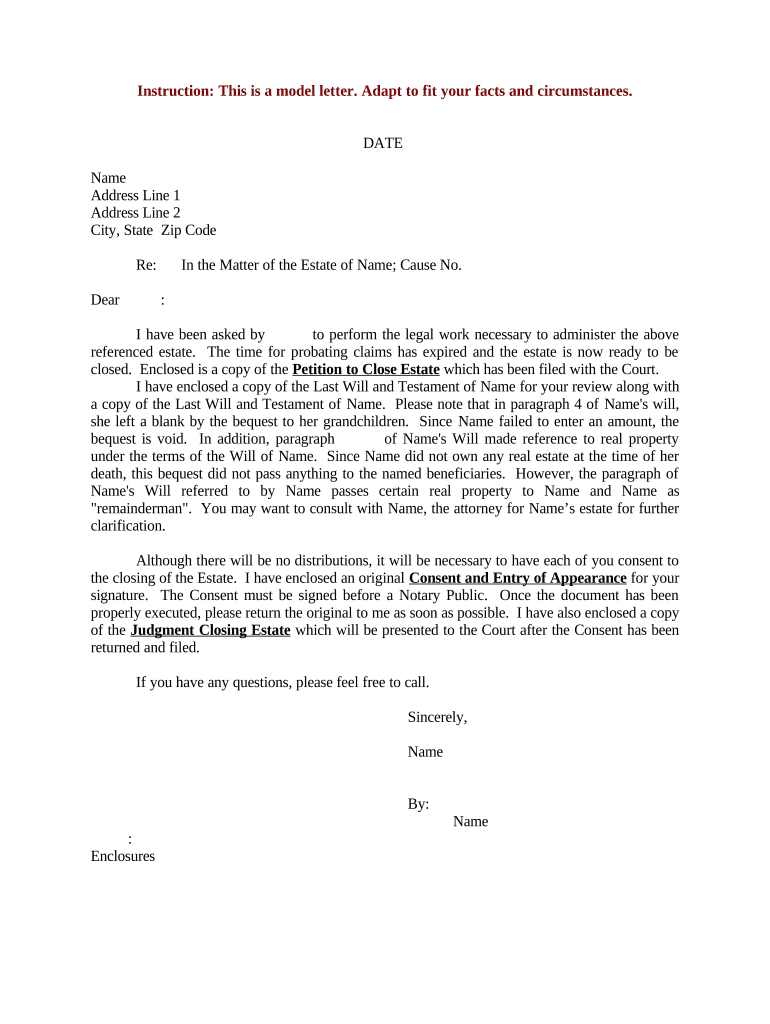
A Letter Regarding Estate Closure is a formal written notice prepared by an executor, personal representative, or estate attorney to confirm that an estate has been administered and closed. It typically summarizes the decedent’s identification, estate file number, summary of assets and distributions, confirmation that debts and taxes were addressed, and a statement that no further administration is pending. The letter is used to inform beneficiaries, creditors, financial institutions, government agencies, and other stakeholders that the estate is complete and the executor has discharged duties under the will or state probate law.

Why a Clear Closure Letter Matters

A concise closure letter documents final actions, reduces future disputes, and provides recipients with a single authoritative record showing who handled the estate and when administration ended.

Why a Clear Closure Letter Matters

Who Typically Prepares and Receives This Letter

Executors, personal representatives, probate attorneys, and trustees most often prepare the letter; banks, insurers, and beneficiaries commonly receive it.

  • Banks and financial institutions — Request confirmation of account closures, transfers, or beneficiary changes to update records and release assets.
  • Beneficiaries and heirs — Receive formal notice that distributions occurred and the estate administration is complete for their records.
  • Creditors and government agencies — Use the letter to reconcile claims, confirm tax filings, and close creditor accounts related to the decedent.

Keep proof of delivery (mailed receipt, e-delivery log, or signed acknowledgement) to document that stakeholders received the final estate accounting.

Primary Roles Involved

Executor

An appointed personal representative who administers the estate, pays debts and taxes, and distributes assets; responsible for preparing or approving a formal closure letter under probate rules.

Estate Attorney

A licensed lawyer who reviews the final accounting, confirms statutory compliance, and advises on creditor notice and release language to minimize future liability.

Security and Compliance Considerations

Encryption: TLS 1.2/1.3 in transit; AES-256 at rest.
Audit Trail: Detailed timestamps, IP, and action logs.
HIPAA: BAA required for health-related records.
ESIGN / UETA: Supports legal e-signature frameworks.
Access Controls: Role-based permissions and SSO options.
Retention: Tamper-evident storage and exportable copies.

Key Risks of an Incorrect or Incomplete Letter

Probate Reopening: Executor liability exposure.
Creditor Claims: Late claims may revive obligations.
Tax Exposure: Errors can trigger audits or penalties.
Bank Refusals: Institutions may freeze accounts.
Beneficiary Disputes: Increased litigation risk.
Record Loss: Difficulty proving final distributions.

Common Preparation Mistakes to Avoid

  • Using informal language or missing key identifiers (decedent full name, date of death, probate case number) that recipients use to match records.
  • Failing to attach supporting documentation, such as the final accounting, letters of administration, discharge orders, or receipts for major distributions.
  • Sending the letter without confirming authority—if the sender is not the appointed executor or lacks official letters, the notice may be ignored.
  • Not preserving proof of delivery or digital audit trail, which hinders defense against later claims that notice was not provided.

Step-by-Step: Preparing the Letter Regarding Estate Closure

Follow a structured sequence to ensure the letter is complete, authoritative, and defensible.

  • 01
    Collect documents: Assemble death certificate, probate case number, final accounting, and distribution receipts.
  • 02
    Draft the letter: Use formal headings, include decedent info, executor details, and a clear closing statement.
  • 03
    Legal review: Have counsel confirm statutory language and creditor notice compliance.
  • 04
    Deliver and archive: Send via tracked mail or e-delivery and retain proof of transmission and signed acknowledgements.

How Delivery and Confirmation Typically Flow

A reliable delivery process reduces follow-up and evidentiary disputes; choose methods that create durable proof of receipt.

  • Prepare: Finalize letter and attach supporting exhibits as PDF.
  • Authorize: Sign the document with required authority and date.
  • Distribute: Send to recipients by tracked mail, secure email, or registered courier.
  • Confirm: Capture delivery receipts, read receipts, or signed acknowledgements; store audit evidence.

Essential Elements to Include in a Professional Closure Letter

A complete closure letter follows a predictable structure so recipients can verify estate status quickly and accurately.

Header

State the document title, estate name, probate or case number, and date of the letter so it is immediately identifiable.
Decedent Details

Include full legal name, date of death, last known address, and any identifiers the probate court used to avoid confusion.

Executor Information

Name the executor or personal representative, provide contact information, and reference letters testamentary or appointment order.

Summary of Actions

Summarize assets administered, major distributions made, debts paid, and taxes filed to give a concise final accounting overview.

Creditor and Claim Statement

Confirm that creditor claims were addressed per statute or note outstanding claim resolution steps to limit future disputes.

Closing Declaration

A clear statement that administration is complete, the date of closure, and signature block with printed name and title of signer.

Practical Tips for Accuracy and Clarity

Adopt consistent formatting and checks to reduce risk and speed recipient processing.

Use precise legal names and dates
Enter the decedent’s full legal name exactly as it appears in probate records; include the date of death and the probate case number to avoid misidentification.
Attach supporting exhibits
Include the final accounting, receipts for major disbursements, proof of tax filings, and a copy of letters testamentary or the court discharge order where applicable.
Document delivery and consent
Choose delivery methods that create an audit trail: certified mail return receipt, registered courier, or secure e-delivery with read confirmations.
Keep a versioned archive
Store the signed letter and all attachments in a secure, tamper-evident archive and maintain records of who accessed the files and when.

Typical Timelines to Keep in Mind

Certain post-death actions have statutory or practical timelines; track these so closure is timely and defensible.

Creditor notice period:

Varies by state; many allow creditors 3–6 months to file claims.

Tax filing deadlines:

Estate tax and final individual returns must follow IRS deadlines and extensions.

Distribution window:

Hold distributions until creditor claims and tax obligations are resolved.

Record retention start:

Begin retention from the date of estate closure and delivery of the final accounting.

Challenge limitation:

Statutes of limitation for contesting distributions vary by state and claim type.

How to Revise or Amend a Closure Letter

Use a controlled amendment process when new information requires updating the closure statement.

01

Identify new facts:

Document why the letter needs amendment and which distribution or action is affected.
02

Draft amendment:

Create a brief amendment referencing the original letter date and probate case number.
03

Legal review:

Have counsel verify that changes comply with court orders and creditor statutes.
04

Reissue to recipients:

Send the amended letter with a clear subject line and attach the original for context.
05

Archive version history:

Keep both the original and amended letters with delivery proofs and a change log.
06

Consider court notice:

If the estate was closed by court order, file the amendment with the probate court when required.

Suggested Digital Workflow Settings for eSubmission

Configure your digital process to produce a single signed PDF and a retrievable audit trail for each recipient.

Field Configuration
Document format PDF/A recommended for long-term archival
Signature method E-signature with audit trail; optional two-factor auth
Recipient delivery Secure email with read receipt or certified mail for legal notices
Retention Exportable signed copy plus tamper-evident storage

Selecting Tools for Secure eDelivery and Signing

Choose a platform that supports strong audit trails, multiple authentication options, and exportable signed PDFs.

  • Integrations: Works with document storage and case management systems.
  • Formats: Accepts PDF, DOCX and returns signed PDF/A copies.
  • Authentication: Supports email, SMS, KBA, and SSO options.

Ensure the selected solution can produce a complete audit trail and store signed letters securely for the legally required retention period; note that some vendors limit envelope counts while others do not.

Practical Use Cases: How Organizations Send Closure Letters

Sample scenarios show how different organizations format and distribute the final notice to stakeholders.

Executor — Small Estate

A single-executor estate uses a brief closure letter attached to the final accounting

  • Letter references probate case number and distribution schedule
  • The executor sends the signed PDF to beneficiaries and the bank and retains delivery receipts for seven years.

Trustee — High-Value Estate

A trustee-led administration includes detailed asset schedules and tax clearance certificates

  • Trustee includes notarized signature and counsel certification
  • Copies are delivered to institutional creditors, title companies, and tax authorities with full audit trail preserved.

Comparison: eSignature Provider Costs and Core Capabilities

Basic pricing and feature availability for typical eSignature plans; signNow is listed first per vendor-comparison convention.

signNow DocuSign Adobe Sign PandaDoc HelloSign
Starting Price $8/user/mo $15/user/mo $14/user/mo $19/user/mo $15/user/mo
Free Trial Yes, 7-day trial No No Yes, limited Yes, limited
Bulk Send Yes Yes Yes Yes No
Audit Trail Yes Yes Yes Yes Yes
HIPAA Compliant Yes Yes Yes No No

Frequently Asked Questions and Troubleshooting

Answers to common questions about preparing, signing, and delivering a Letter Regarding Estate Closure.


Need help? Contact support

be ready to get more
Join over 28 million airSlate SignNow users