Establishing secure connection…Loading editor…Preparing document…

Colorado Revocation

This template is fully customizable. Edit the text, fill out the fields, and send it for signature. Give it a try!
Colorado Revocation

What the Colorado Revocation Is and When it Applies

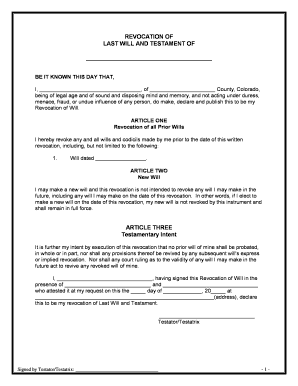
A Colorado Revocation is a written document used to terminate or cancel a previously executed authorization, power of attorney, authorization to release records, or similar instrument under Colorado law. It identifies the original document, names the individual or entity revoking authority, states the effective date of revocation, and explains how notice will be delivered to affected parties. A properly executed revocation reduces the risk of unauthorized acts under the revoked authority and creates a clear record for third parties such as banks, medical providers, or county recorders.

Why a Clear Colorado Revocation Matters

A concise Colorado Revocation ends legal authority clearly and creates a written record that third parties can rely on, reducing disputes and financial or fiduciary exposure under the revoked instrument.

Why a Clear Colorado Revocation Matters

Who Typically Prepares or Receives a Revocation

Individuals and organizations use a Colorado Revocation whenever they need to terminate a prior authorization or agency relationship and notify affected parties.

Delivering the revocation promptly to all listed recipients and recording it where required preserves legal protections and prevents continued reliance on the revoked document.

Step-by-step: Completing a Colorado Revocation

Follow these sequential steps to create, sign, and serve a Colorado Revocation so it is effective and enforceable.

  • 01
    Identify document: List the title, date, and parties of the original instrument.
  • 02
    State revocation: Unambiguously declare the document revoked as of an effective date.
  • 03
    Sign and date: Principal signs; include printed name and date beside signature.
  • 04
    Notify parties: Deliver copies to agent, institutions, and recorders as necessary.

Core elements a professional Colorado Revocation should include

A professional revocation reduces ambiguity and ensures recipients can act promptly to end the prior authority.

Revoker Identity

Full legal name and contact information for the person revoking the authority, including mailing address and phone so recipients can verify the source.
Referenced Document

Clear description of the original instrument being revoked: title, parties, and execution date to prevent misinterpretation or partial revocation.

Effective Date

An explicit effective date in MM/DD/YYYY format to establish when third parties must cease reliance on the prior authorization.

Signature and Date

Handwritten or compliant electronic signature of the revoker plus the date of signing; signature attribution is essential for enforceability.

Notarization

A notary acknowledgment or jurat when state law or recording offices require notarized revocations, including notary seal and commission details.

Delivery Instructions

Directions for serving notice to agents, institutions, and for recording when the revoked document affects real property or public records.

Essential information required on the form

Revoker name: Full legal name
Original document: Title and date
Effective date: MM/DD/YYYY
Signature: Signed and dated
Notary block: When required
Delivery list: Recipients' addresses

Where to send or file a Colorado Revocation

Choose destinations for delivery based on the revoked instrument and who relied on it; some revocations also require public recording.

  • Named agent: Deliver a signed copy directly to the former agent or attorney-in-fact.
  • Third-party institutions: Send certified or registered copies to banks, insurers, or healthcare providers.
  • County recorder: Record with the county recorder if the original instrument was recorded or affected real property.
  • Maintain proof: Retain delivery receipts, certified mail tracking, or e-sign audit trails demonstrating notice.

Online setup: recommended field and workflow settings

Configure the digital workflow to capture identity, signatures, notarization, and proof of delivery for a robust record.

Field Configuration
Signature Enabled; enforce signer name entry
Date field MM/DD/YYYY format required
Notary block Restrict signing until notarized in session
Delivery method Certified mail or logged e-sign delivery

Digital signing and e-submission considerations

Use an e-signature platform that captures signer attribution, timestamp, IP address, and an immutable audit trail for legal defensibility.

  • File formats: PDF/X, DOCX supported
  • Authentication: Email, SMS, or advanced KBA
  • Integrations: CRM and cloud storage

Preserve the final signed PDF with its audit report and retain proof of delivery; if notarization is required, use certified RON or in-person notary workflows accepted by the recorder.

Penalties and legal risks of an incomplete revocation

Continued liability: Third parties may rely on revoked authority
Recording rejection: County recorder may refuse improperly executed documents
Contractual disputes: Agents may assert authority until notice received
Financial exposure: Unauthorized transactions risk loss
Notary defects: Incorrect acknowledgment can void recordation
Proof gaps: Lack of delivery proof weakens defenses

Common mistakes to avoid when preparing a revocation

  • Failing to identify the exact instrument being revoked, which creates ambiguity about which authority was terminated and may lead to continued reliance by third parties.
  • Not serving the revocation on the agent or institutions in a verifiable manner; informal notice without proof often fails to stop unauthorized acts.
  • Omitting notarization or recording when required; counties and financial institutions may reject or ignore unnotarized revocations affecting property.
  • Using inconsistent names or dates across copies; mismatched data can delay acceptance by banks, health providers, or recorders.

Practical tips for accurate and efficient completion

Follow consistent formatting and delivery practices to ensure the revocation is recognized and enforceable by all recipients.

Confirm identity
Verify your legal name and, if signing remotely, use platform authentication methods to establish signer identity and reduce disputes.
Use precise references
Cite the original document by exact title and date; avoid vague descriptions that could be interpreted as partial revocation.
Record when necessary
Record revocations that affect real property where the original instrument was recorded to provide public notice and clear title records.
Keep documented proof
Retain signed originals, notarizations, certified mail receipts, and e-sign audit trails to demonstrate timely notice and proper execution.

eSignature vendor comparison for Colorado Revocation workflows

Common vendor features relevant to revocation workflows include starting price, free trial, bulk send, audit trail, HIPAA support, and envelope or session caps.

signNow DocuSign Adobe Sign PandaDoc HelloSign
Starting Price $8/user/mo $15/user/mo $14/user/mo $19/user/mo $15/user/mo
Free Plan Yes, 7-day trial No No Yes, limited Yes, limited
Bulk Send Yes Yes Yes Yes No
Audit Trail Yes Yes Yes Yes Yes
HIPAA Compliant Yes Yes Yes No No

Real-world situations where a Colorado Revocation is used

Two practical examples show common triggers for preparing and delivering a revocation.

Healthcare Record Revocation

A patient withdraws prior medical record release authorization after a change in care provider

  • The patient signs a dated Colorado Revocation
  • The provider receives a notarized copy, updates records, and retains proof under HIPAA for six years.

Power of Attorney Revocation

An individual replaces an appointed agent after a relocation or trust change

  • The principal executes a Colorado Revocation naming the prior POA and effective date
  • Copies are sent to the former agent, banks, and recorded if the original POA was filed with a recorder.

Frequently asked questions about Colorado Revocation

Answers to common questions on execution, notarization, delivery, and electronic signing of a Colorado Revocation.


Need help? Contact support

be ready to get more
Join over 28 million airSlate SignNow users