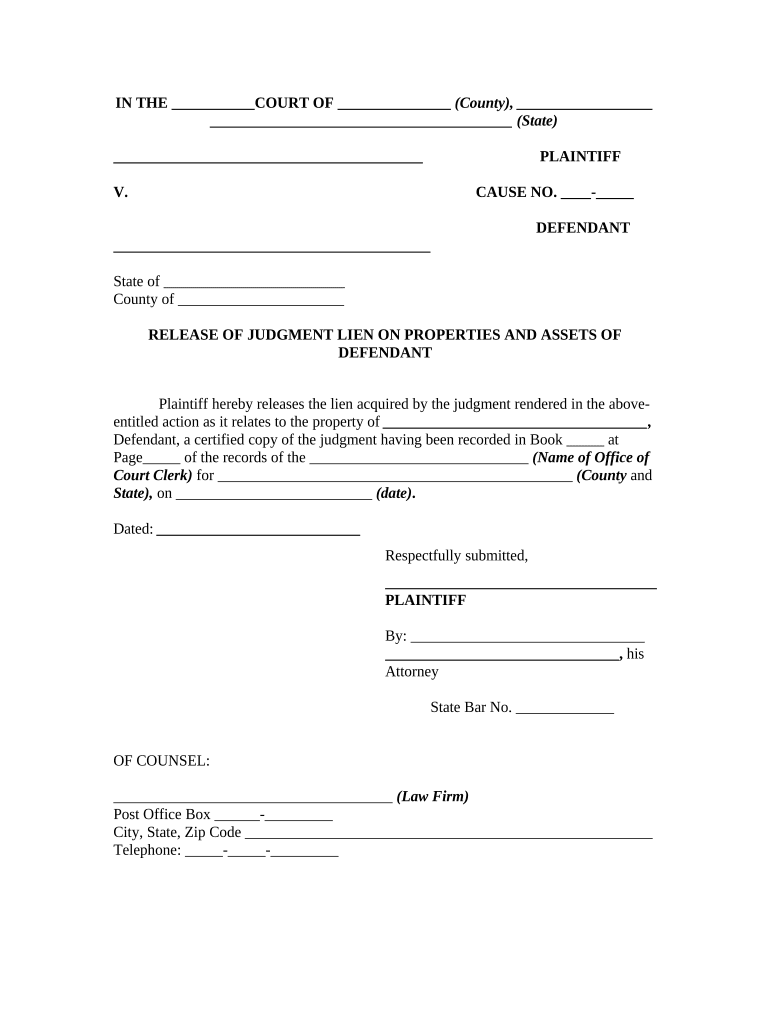
Bexar County Judgment Lien
Overview of a Bexar County Judgment Lien
Why recording a judgment lien matters
Recording protects creditor rights by creating public notice, improving chances of recovery, and attaching the judgment to real property that might otherwise transfer clear of the debt.
Who typically files or relies on a judgment lien
Parties who commonly prepare or review a Bexar County Judgment Lien include creditors, collection attorneys, title companies, and lenders conducting title searches.
- Creditors seeking to secure a money judgment and preserve remedies against real property.
- Title companies and lenders verifying encumbrances before closing a sale or refinance.
- Attorneys and collection agencies managing enforcement, releases, or post-judgment remedies.
Accurate filing reduces the risk of overlooked claims during transactions and supports enforcement options while the judgment remains valid under Texas law.
Step-by-step: preparing and filing in Bexar County
-
01Confirm Judgment: Verify the final judgment and obtain a certified copy from the clerk.
-
02Complete Abstract: Prepare an abstract/transcript with correct names, amount, and judgment date.
-
03Verify Property: Search county property records to identify affected parcels and owners.
-
04File with Clerk: Submit the abstract at the Bexar County Clerk's recording office with required fees.
How the recorded lien affects property title and transactions
-
Public Notice: The recording appears in county records and is discoverable in title searches.
-
Clouds Title: A recorded lien can impede closing, refinancing, or sale until satisfied or released.
-
Enforcement: Creditors may use the lien in execution, foreclosure, or garnishment proceedings consistent with Texas law.
-
Release: A satisfaction or release must be recorded to clear the lien from title records.
Preparing a digital workflow for filing and distribution
| Field | Configuration |
|---|---|
| Document Template | Pre-fill judgment fields from court export to reduce errors. |
| Signer Order | Creditor signs first, then debtor if required by agreement or release. |
| Authentication | Use multi-factor or ID verification for remote notarization workflows. |
| Delivery | Route final recorded copy to parties and title companies. |
Digital signing and e-submission considerations
Electronic workflows can speed signature collection and reduce transcription errors, but must meet legal and county requirements.
- File Formats: Use PDF/A or standard PDF for record compatibility with county systems.
- Authentication: Employ signer authentication consistent with ESIGN and UETA criteria.
- Notarization Support: Confirm the platform supports remote online notarization if a notary acknowledgment is needed.
Verify Bexar County Clerk policies on electronic submissions and maintain audit trails, timestamps, and copies for the case file and title examiners.
Timing and filing expectations
Recording Timing:
Record promptly after final judgment to ensure priority in subsequent transactions.
Interest Accrual:
Interest on the judgment typically begins from the judgment date per state statute; entry determines calculations.
Statute of Limitations:
Check Texas statutes for judgment enforcement periods; interest and renewal rules may apply.
Renewal Requirements:
Some jurisdictions permit renewal or revival before expiration to preserve enforceability.
Title Searches:
Allow time for title companies to locate and report recorded liens before closings.
Key processing milestones after filing
File Abstract
Submit to county clerk for recording and indexing in real property records.
Indexing Complete
County clerk indexes the record; becomes searchable by name or parcel.
Title Flagging
Title searches and closing checks will show the recorded lien.
Enforcement Actions
Creditor may pursue execution or foreclosure consistent with procedural requirements.
Risks and legal consequences of incorrect or incomplete filings
Practical tips to ensure correct recording and indexation
Illustrative scenarios involving a Bexar County judgment lien
Collection Scenario
A creditor records an abstract after a money judgment
- The lien appears in title searches
- The recorded lien enables levy on sale of non-exempt property and strengthens settlement leverage with the debtor.
Closing Impact
A homebuyer’s title search reveals a recorded judgment lien
- The seller must obtain a recorded release or payoff
- The lien delays closing until the judgment is satisfied or escrowed for payoff at closing.
eSignature vendor pricing and compliance comparison
| signNow | DocuSign | Adobe Sign | PandaDoc | HelloSign | |
|---|---|---|---|---|---|
| Starting Price | $8/user/mo | $15/user/mo | $14/user/mo | $19/user/mo | $15/user/mo |
| Free Trial | 7-day free trial | No | No | Yes, limited | Yes, limited |
| Bulk Send | Yes | Yes | Yes | Yes | No |
| Audit Trail | Yes | Yes | Yes | Yes | Yes |
| HIPAA Compliant | Yes | Yes | Yes | No | No |
| Envelope Cap | No cap | 100 envelopes/user/year | Varies | Varies | Varies |
Frequently asked questions about Bexar County judgment liens
-
How do I ensure the lien is indexed?
Provide exact legal names, certified judgment copies, and parcel identifiers where possible. Request a recording receipt from the Bexar County Clerk and verify the clerk’s online index within a few business days.
-
Can I record remotely or electronically?
Check Bexar County Clerk policies for electronic submissions and remote online notarization acceptance. Where RON is used, ensure the notary and platform meet identity-proofing and retention requirements.
-
What if the clerk rejects my filing?
Address the rejection reason promptly—common causes include mismatched names, missing certification, or incorrect fee. Correct and refile with supporting documentation and preserve rejection notices.
-
Does recording create an automatic foreclosure right?
No. Recording provides notice and secures the judgment against property but separate statutory procedures and court authority are typically required for execution or sale.
-
How do I remove a satisfied lien?
Record a satisfaction of judgment or release executed by the creditor or court. File the release with the county clerk to clear public records and notify title companies.
-
How long should I retain lien records?
Retain originals while the judgment is enforceable and for several years after satisfaction; follow IRS (3 years) and any applicable state or industry retention rules when disposing of records.